
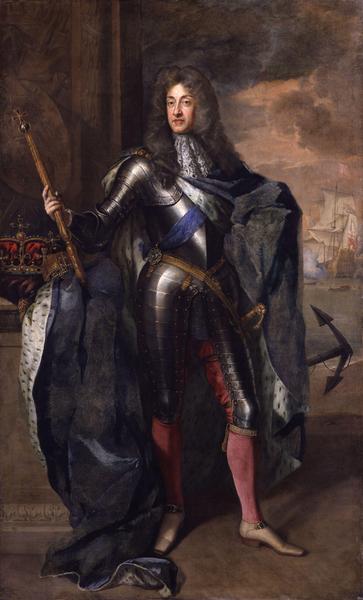
James II Of England
| Name | James II Of England |
| Title | King of England, Scotland, and Ireland (1633–1701) |
| Gender | Male |
| Birthday | 1633-10-14 |
| nationality | Kingdom of Scotland |
| Source | https://www.wikidata.org/wiki/Q126188 |
| pptrace | View Family Tree |
| LastUpdate | 2025-11-12T01:14:13.285Z |
Family Tree
Tap  to expand more relatives
Introduction
James II and VII (14 October 1633 – 16 September 1701) was monarch of England and Ireland as James II and of Scotland as James VII from February 1685 until his deposition in the Glorious Revolution of 1688. He was the second surviving son of King Charles I of England and Henrietta Maria of France. James was created Duke of York at birth and held the title Duke of York from 1644.
Born at St James's Palace in London, James was baptized by William Laud, the Anglican Archbishop of Canterbury. He was educated privately alongside his older brother, Charles II, and the sons of the Duke of Buckingham. At age three, he was appointed Lord High Admiral—a position which was honorary initially but became substantive after the Restoration. During the English Civil War, James and his brother Charles participated in the Battle of Edgehill in 1642 and spent subsequent years in Oxford, the Royalist capital, where he was made a Master of Arts and served as a colonel of a volunteer regiment.
Following the defeat of the Royalist cause and the surrender of Oxford in 1646, James was taken to London and held with his siblings in St James's Palace. In April 1648, he escaped from Parliamentary custody with the aid of Joseph Bampfield and crossed into The Hague. During the Interregnum, James served in the French army under Turenne against the Fronde and later against Spanish forces. In 1652, he was appointed command of a captured Irish regiment, and in 1654, he became Lieutenant-General.
With the restoration of his brother Charles II in 1660, James returned to England. He was made Duke of Albany in Scotland and became Duke of York in England. He married Anne Hyde secretly in 1660; they had multiple children, including two daughters, Mary and Anne, and a son, Charles, who died in infancy. Anne Hyde died in 1671.
James was confirmed as Lord High Admiral and was active in naval affairs, including leading fleets in the Anglo-Dutch Wars. He also served as Governor of the Hudson’s Bay Company and was appointed Governor of New York following its capture from the Dutch. His military involvement extended to overseeing defenses and fortifications, notably during the Great Fire of London in 1666.
His exposure to Catholicism during his residence in France led him to convert secretly around 1668–1669, formally converting in 1676. His conversion was publicly recognized following his refusal to take oaths under the Test Act of 1673. He married Mary of Modena, an Italian princess, in 1673, a union that heightened distrust due to her Catholic faith.
Politically, James faced opposition during the Exclusion Crisis (1679–1681), when efforts sought to prevent his succession due to his Catholic faith. He was appointed Lord High Commissioner to Scotland in 1680 and returned to favor after a series of plots and conspiracies. His attempt to promote religious toleration and to expand Catholic influence in Britain became central to his reign.
James ascended to the throne upon the death of Charles II on 6 February 1685. His accession was initially greeted with general support, but his reign soon encountered resistance due to his policies favoring Catholics and his attempts to bypass parliamentary authority using dispensing powers. He faced rebellions in Scotland and England, notably the rebellion of Monmouth in 1685 and the suppression of Covenanter uprisings.
His pro-Catholic policies and efforts to repeal penal laws caused alarm. In 1687, he issued the Declaration of Indulgence to religious dissenters and Catholics, promoting religious toleration amid opposition from Parliament. He sought to further relax restrictions on Catholics holding office and to influence the Church of England, including attempts to pack Parliament with supportive members.
In 1688, James's policies provoked widespread opposition. The birth of his son, James Francis Edward, raised fears of a Catholic dynasty. Leading Protestants invited William of Orange to invade England. William arrived in November 1688, and James's army deserted. James attempted to flee to France but was captured and then released into exile.
Following his flight, Parliament declared that James had abdicated and that the throne was vacant. William and Mary were proclaimed joint monarchs in 1689, establishing principles of constitutional limits on royal authority. James sought to recover his kingdoms with French support but was decisively defeated at the Battle of the Boyne in July 1690. Subsequently, he lived in exile in France at Saint-Germain-en-Laye until his death.
James died of a brain hemorrhage on 16 September 1701. He was buried in Paris at the Church of the English Benedictines. His remains and various parts of his body were disposed of in accordance with the customs of the time. His legacy is complex, reflecting debates over his intentions, policies, and impact on British constitutional development. His descendants, including his daughter Anne, succeeded after William III, with the succession eventually passing to the House of Hanover under the Act of Settlement 1701.

Children
- Mary II Of England
- James FitzJames, 1st Duke Of Berwick
- Louisa Maria Stuart
- James Francis Edward Stuart, Prince Of Wales
- Arabella FitzJames
- Child3 Stuart
- Elizabeth Stuart
- Anne Of Great Britain
- James Darnley
- Prince James, Duke Of Cambridge
- Child1 Stuart
- Child4 Stuart
- Henrietta FitzJames
- Princess Isabel Of York
- Child5 Stuart
- Catherine Sheffield, Duchess Of Buckingham And Normanby
- Edgar Stuart, Duke Of Cambridge
- Charles Stuart, Duke Of Kendal
- Charles Stuart, Duke Of Cambridge
- Catherine Laura Stuart
- Henrietta Stuart
- Charlotte Maria Stuart
- Charles Stuart, Duke Of Cambridge
- Catherine Stuart
- Charles Darnley
- Henry FitzJames
- Child2 Stuart