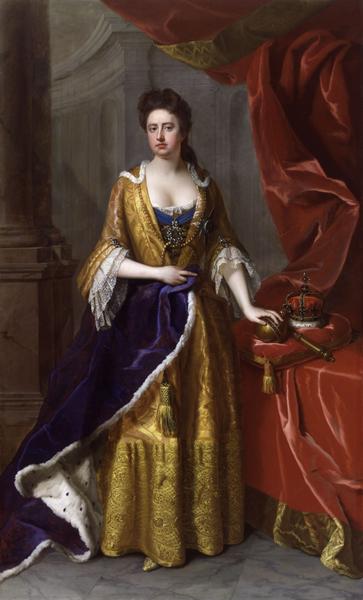
Anne Of Great Britain
| Name | Anne Of Great Britain |
| Title | Queen of Great Britain and Ireland from 1702 to 1714 |
| Gender | Female |
| Birthday | 1665-02-06 |
| nationality | Great Britain |
| Source | https://www.wikidata.org/wiki/Q119702 |
| pptrace | View Family Tree |
| LastUpdate | 2025-11-12T01:14:11.285Z |
Family Tree
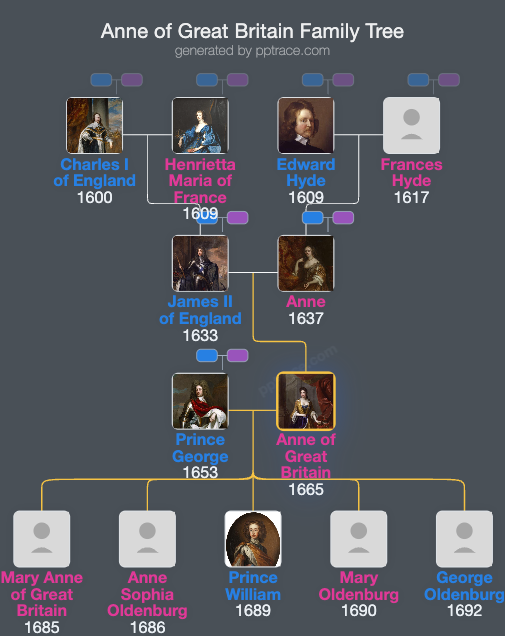
Tap  to expand more relatives
Introduction
Anne (6 February 1665 – 1 August 1714) was the Queen of England, Scotland, and Ireland from 8 March 1702, and subsequently Queen of Great Britain and Ireland following the Acts of Union 1707 which unified the kingdoms of England and Scotland. She reigned until her death in 1714.
Born at St James's Palace in London, Anne was the fourth child and second daughter of the Duke of York (later King James II and VII) and Anne Hyde. Her birth occurred at 11:39 p.m. on 6 February 1665. Her father was the younger brother of King Charles II, and her mother was the daughter of Lord Chancellor Edward Hyde, 1st Earl of Clarendon. During her early childhood, Anne had an eye condition known as "defluxion," which led to her being sent to France for treatment. She lived with her paternal grandmother Henrietta Maria of France at the Château de Colombes near Paris after her mother's death in 1671, and with her aunt Henrietta Anne, Duchess of Orléans, following her grandmother's death in 1669. She returned to England after her aunt's death in 1670, and her mother died the following year.
Anne and her elder sister Mary were raised separately from their father at Richmond in Surrey, with a focus on Anglican religious instruction, despite their father's Catholic faith. Her education was overseen by Bishop Henry Compton. She first met Sarah Jennings around 1671, who would become a lifelong friend and political confidante.
In 1673, her uncle James converted to Catholicism and married Maria of Modena, an event which increased concerns about Catholic influence. Anne married Prince George of Denmark, a Lutheran, in 1683; the marriage was arranged by her family to secure a Protestant alliance. The wedding took place on 28 July 1683 at the Chapel Royal in St James's Palace. Anne and George had several children, but only one, Prince William, Duke of Gloucester, survived infancy; he died in 1700.
Anne's father ascended the throne as James II in 1685, but his attempts to promote Catholicism led to widespread dissatisfaction. The Glorious Revolution of 1688 resulted in James's abdication and the ascension of William III and Mary II, Anne's sister. During this period, Anne experienced estrangement from her sister Mary due to disagreements over titles and finances.
Following William's death in 1702, Anne became queen. Her reign saw the passage of the Acts of Union 1707, which united England and Scotland into the Kingdom of Great Britain. She was inclined towards Tory politics, favoring moderate policies and the Anglican church, but her government was marked by conflict between Tories and Whigs over issues such as the War of the Spanish Succession and succession policies.
Throughout her life, Anne suffered from poor health. She experienced numerous pregnancies—seventeen in total—yet all her children except Prince William died before reaching adulthood. Her final pregnancy ended in a stillbirth in 1700. She suffered from gout, which limited her mobility and contributed to her declining health in her later years.
The death of her only surviving child, Prince William, in 1700, along with her increasing health problems, led to concerns over the succession. The Act of Settlement 1701 established that her nearest Protestant relative, Sophia of Hanover, and her descendants would succeed her, which resulted in her being succeeded by George I after her death.
Anne's reign was characterized by significant political, military, and constitutional developments, including the union of England and Scotland and the establishment of the constitutional monarchy. She was crowned in 1702, and her style and heraldic arms reflected her status as monarch of the newly united kingdom.
She died on 1 August 1714 at Kensington Palace, and was buried in Westminster Abbey. Her death marked the end of the House of Stuart's direct lineage; she was the last Stuart monarch. Her legacy includes the political and territorial unification of Great Britain and contributions to the arts and sciences during her reign.