
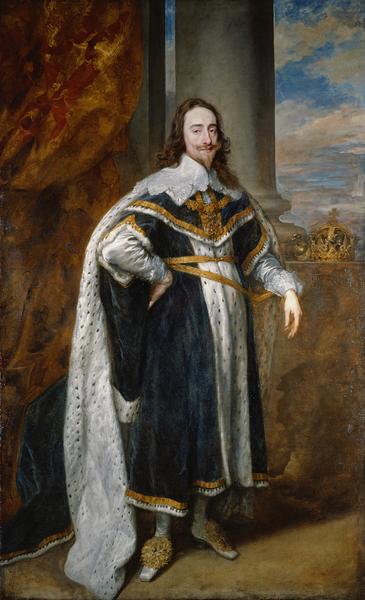
Charles I Of England
| Name | Charles I Of England |
| Title | monarch of the three kingdoms of England, Scotland, and Ireland (1600-1649) |
| Gender | Male |
| Birthday | 1600-11-19 |
| nationality | Kingdom of England |
| Source | https://www.wikidata.org/wiki/Q81506 |
| pptrace | View Family Tree |
| LastUpdate | 2025-11-12T01:14:20.184Z |
Family Tree
Tap  to expand more relatives
Introduction
Charles I (19 November 1600 – 30 January 1649) was King of England, Scotland, and Ireland from 27 March 1625 until his execution in 1649. He was born in Dunfermline Palace, Fife, as the second son of King James VI of Scotland and Anne of Denmark. His baptism took place in Holyrood Palace, Edinburgh, on 23 December 1600, and he was created Duke of Albany, among other titles.
James VI inherited the English throne in 1603, becoming James I of England, prompting Charles's relocation to England with his family. By early 1604, Charles was strong enough to travel and was again reunited with his family in England. During childhood, he was educated in classics, languages, mathematics, and religion, and was made a Knight of the Garter in 1611. He suffered from health issues, including a stammer, but overcame some of his infirmities and developed skills as a horseman and marksman.
In November 1612, at age 12, Charles became heir apparent following the death of his elder brother, Henry Frederick, Prince of Wales. He received the titles of Duke of Cornwall and Rothesay, and in 1616, Prince of Wales and Earl of Chester.
In 1623, Charles traveled incognito to Spain with the Duke of Buckingham in an unsuccessful attempt to marry Infanta Maria Anna of Spain. The negotiation failed due to cultural and religious differences, and Charles returned to England in October of that year. Subsequently, he married Henrietta Maria of France in 1625, shortly after ascending to the throne.
His reign was characterized by conflicts with the English Parliament over issues of royal prerogative, taxation, and religion. Charles upheld the divine right of kings and aimed to govern without parliamentary interference, leading to disputes over taxes levied without parliamentary consent and religious policies perceived as too Catholic by Puritans and Scottish Covenanters. These conflicts contributed to the outbreak of the English Civil War in 1642.
Charles fought against the Parliamentarian forces, supported by groups opposed to his policies and religious reforms. After military defeats, he was captured and taken to Scotland, then returned to Parliament’s custody. His refusal to accept a constitutional monarchy led to his trial for high treason. The court found him guilty, and he was executed on 30 January 1649. His death resulted in the abolition of the monarchy and the establishment of the Commonwealth of England.
Following his execution, England was declared a republic. The monarchy was restored in 1660 under his son, Charles II. Charles I’s death marked a significant constitutional and political upheaval in British history.
Early Life:
Born at Dunfermline Palace, Charles was baptized in Holyrood Palace, Edinburgh. His health was fragile in infancy, leading to a prolonged separation from his family. He was placed under the guardianship of Lord Fyvie and later returned to England in 1604. As a child, he was tutored in various subjects, and his physical health improved over time. The death of his elder brother in 1612 made him heir apparent, and he gained the titles of Duke of Cornwall and Rothesay.
Heir Apparent:
Charles’s political and religious views developed amidst the broader context of European conflicts, particularly the Thirty Years’ War. He initially considered a marriage alliance with Spain but ultimately pursued a Protestant marriage with Henrietta Maria of France. His early diplomatic efforts included unsuccessful negotiations in Spain and war against Spain and France, which strained royal finances and relations with Parliament.
Early Reign:
Charles’s accession in 1625 was marked by strained relations with Parliament, chiefly over religious policies and taxation. His marriage to Henrietta Maria intensified suspicions of Catholic favoritism. His support for Arminianism and attempts to impose religious uniformity in Scotland sparked the Bishops' Wars. These conflicts weakened his position, and efforts to raise revenue without Parliament's consent led to further conflicts.
Personal Rule and Conflict:
From 1629 to 1640, Charles ruled without Parliament, a period known as the "eleven years' tyranny," relying on controversial revenue methods such as ship money and monopolies. Opposition grew over his refusal to call Parliament, his religious policies, and his attempts to enforce royal prerogative.
The English Civil War (1642–1651):
Tensions erupted into civil war when Charles raised an army, leading to significant battles including Edgehill, Marston Moor, and Naseby. He was ultimately defeated, captured, and held prisoner. His attempts at negotiation failed, culminating in his trial and execution for high treason in 1649.
Captivity and Trial:
Charles's imprisonment and escape attempts reflected the deep divisions within England. His trial by the Rump Parliament was controversial due to questions of legal authority over a reigning monarch. Found guilty, he was executed on 30 January 1649, in Westminster Hall.
Legacy:
Charles I’s death ended the monarchy for a time, establishing the Commonwealth. His image as a martyr was emphasized by royalists, while Whig historians criticized his policies. His Art Collection, amassed during his reign, included significant works by Titian, Rubens, and others. His policies and execution had lasting political repercussions, influencing constitutional debates and perceptions of monarchy and authority in Britain.
Titles and Honours:
Charles held titles such as Duke of York, Prince of Wales, and King of Great Britain and Ireland. He was a Knight of the Bath and Knight of the Garter. His arms as king combined heraldic symbols of England, Scotland, and France.
Issue:
Charles had nine children; five reached adulthood. His sons, Charles II and James II, later became monarchs of England and Great Britain.
Note:
This biography covers key factual details of Charles I's life, reign, conflicts, trial, and death, based on available information, and avoids subjective evaluations.
