Anne, Duchess Of York
| Name | Anne, Duchess Of York |
| Title | English Royal |
| Gender | Female |
| Birthday | 1637-03-12 |
| nationality | Kingdom of England |
| Source | https://www.wikidata.org/wiki/Q145609 |
| pptrace | View Family Tree |
| LastUpdate | 2025-11-12T01:14:12.345Z |
Family Tree
Tap  to expand more relatives
Introduction
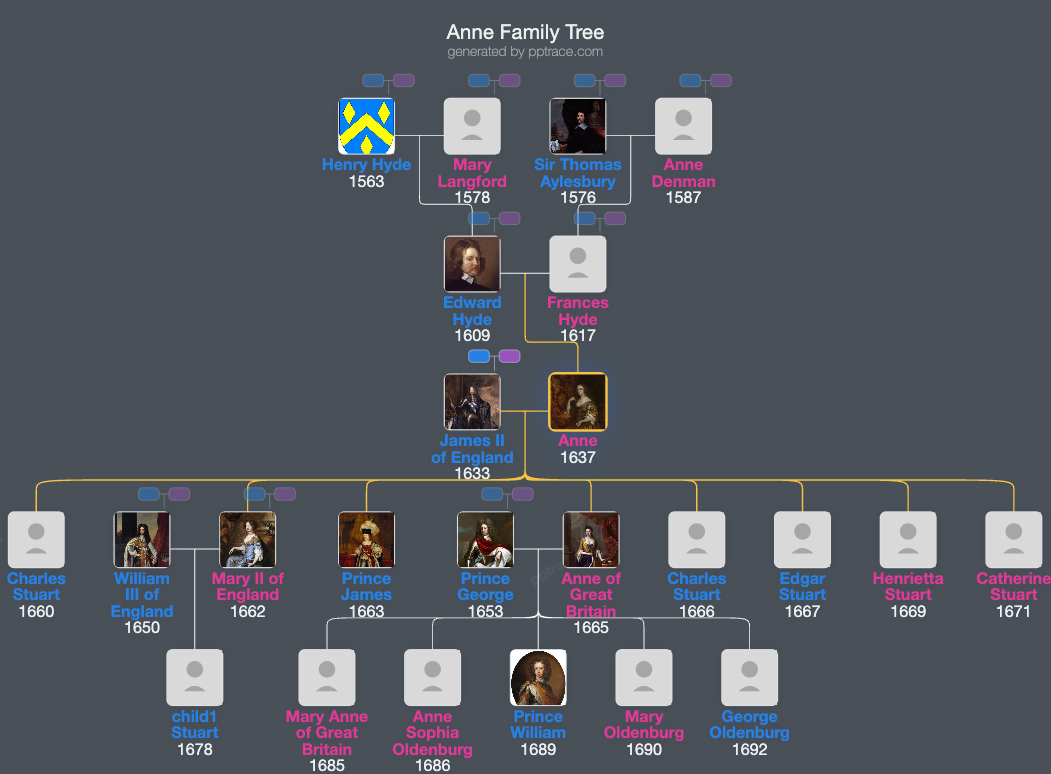
Anne Hyde (12 March 1637 – 31 March 1671) was the wife of James, Duke of York, who later became King James II and VII of England, Scotland, and Ireland. She was born on 12 March 1637 and was the daughter of Edward Hyde, later created Earl of Clarendon, and his first wife, Anne Ayliffe of Grittenham. Hyde married Anne Ayliffe in 1629; shortly afterward, she contracted smallpox, miscarried, and died. Hyde remarried Frances Aylesbury, and with her, fathered Hyde's first daughter, also named Anne, born at Cranbourne Lodge in Windsor in 1637.
Anne Hyde's early years included a period of exile in the Netherlands, which began in 1649 after the execution of King Charles I. Her family settled in Breda, where she served as a maid of honour to Mary of Orange. During this period, Anne gained popularity among expatriates and visitors, attracting various suitors, including Spencer Compton and Henry Jermyn, before eventually forming a relationship with James, Duke of York.
In 1659, James promised to marry Anne, and despite opposition from her father and others, the marriage proceeded after Anne became pregnant. Their marriage was held privately at Worcester House in London on 3 September 1660, following the Restoration of the Monarchy in May of that year. The official ceremony was conducted by Dr. Joseph Crowther. The couple's first child, Charles, was born in October 1660 but died seven months later. They subsequently had eight children, six of whom died in early childhood. Their surviving children included Mary (born 1662), who later became Queen Mary II, and Anne (born 1665), who became Queen Anne.
At court, Anne was not particularly popular, and her husband James maintained numerous mistresses during their marriage. Anne was aware of his infidelities and was described as jealous and reproaching him for his affairs. Despite personal difficulties, Anne played a role in influencing James’s conversion to Catholicism, which became a significant factor in the political tensions leading to the Glorious Revolution. Raised Anglican, Anne converted to Catholicism shortly after her marriage, influenced by visits to France and the Netherlands. James converted around the same time, and both remained members of the Church of England due to political circumstances, although James publicly converted to Catholicism on his deathbed.
Anne Hyde's health declined after the birth of her eighth child, Edgar, in 1671. She developed advanced breast cancer and died on 31 March 1671. On her deathbed, she refused Anglican sacraments and received the Catholic viaticum. Her body was interred in the vault of Mary, Queen of Scots, at Westminster Abbey. Following her death, her children Mary and Anne remained heirs to the dukedom, with her son Edgar dying in June 1671 and her daughter Catherine in December 1671.
After Anne's death, James married Mary of Modena, who bore him James Francis Edward Stuart. James ascended to the throne in 1685 but was deposed in 1688 during the Glorious Revolution. The crown was offered to Mary II and William III. Anne Hyde’s surviving daughter, Anne, became Queen of Great Britain in 1702, and in 1707, the first monarch of the unified Kingdom of Great Britain.
Portrayals of Anne Hyde include the 2003 mini-series "Charles II: The Power and the Passion," where she was played by Tabitha Wady.