James FitzJames, 1st Duke Of Berwick
| Name | James FitzJames, 1st Duke Of Berwick |
| Title | Anglo-French military leader (1670-1734) |
| Gender | Male |
| Birthday | 1670-08-21 |
| nationality | Kingdom of France |
| Source | https://www.wikidata.org/wiki/Q166023 |
| pptrace | View Family Tree |
| LastUpdate | 2025-11-12T01:14:18.586Z |
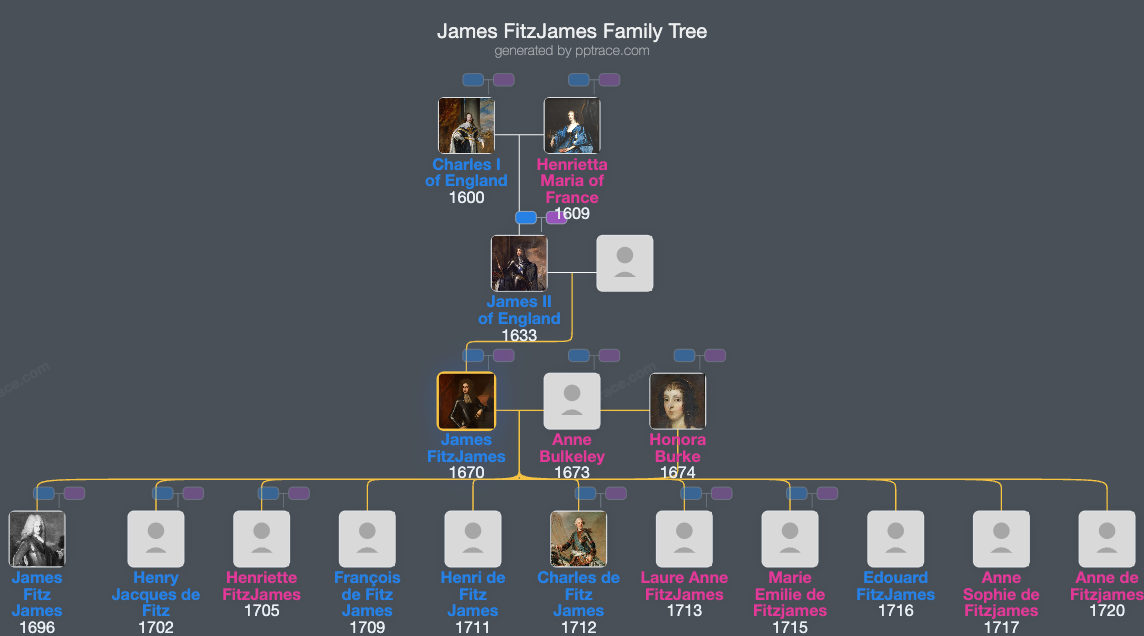
Family Tree
Tap  to expand more relatives
Introduction
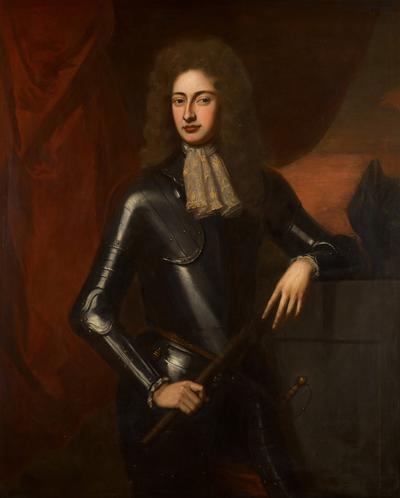
James FitzJames, 1st Duke of Berwick (21 August 1670 – 12 June 1734), was a military officer with both French and English connections. He was the eldest illegitimate son of James II of England and Arabella Churchill, sister of John Churchill, 1st Duke of Marlborough. Born in Moulins, France, FitzJames was raised there as a Roman Catholic.
He received education at the College of Juilly, the Collège du Plessis, and the Jesuit College of La Flèche, funded by the Stuart family. Early in his military career, he served under Charles V, Duke of Lorraine, participating in the Siege of Buda in 1686 and engaging in battles such as Mohács in Hungary.
In 1687, he was created Duke of Berwick, Earl of Tinmouth, and Baron Bosworth by his father. He returned to Hungary and was involved in the Battle of Mohács. Subsequently, he returned to England, where he was appointed Governor of Portsmouth, made a Knight of the Garter, and appointed Colonel of The Blues, a unit he slated to command. However, the Glorious Revolution of 1688 and the invasion by William of Orange led to the overthrow of King James II, after which FitzJames went into exile in France alongside his father.
In Ireland, FitzJames fought in the Jacobite campaigns, including the Siege of Derry, the Battle of Cavan, and the Battle of the Boyne in 1690. During the Battle of the Boyne, he led a charge, was unhorsed, and narrowly escaped death. After James II's departure to France, FitzJames persisted with the Jacobite cause, defending Limerick during the Williamite War and participating in the final negotiations culminating in the Treaty of Limerick in 1691. The terms led to Irish soldiers, known as the "Wild Geese," leaving for continental Europe.
Following his father's exile, FitzJames entered French service under Marshal Luxembourg. He participated in notable battles, including Steenkerque and Neerwinden. Captured at Landen in 1694, he was ransomed and later exchanged for the Duke of Ormonde. His loyalty to France resulted in his attainder by the British Parliament in 1695, forfeiting his English peerages.
In France, FitzJames rose through the military ranks, becoming a Marshal of France in 1706 after distinguished service during the War of the Spanish Succession. He commanded significant forces, including at the Battle of Almanza in 1707, where his leadership led to a decisive Franco-Spanish victory over the Allies. He was granted titles such as Duke of Liria and Jérica by Philip V of Spain and Duke of Fitz-James in France.
During the war, he engaged in various military operations across Spain and the Low Countries. His strategic acumen included the defense of Lille in 1708, where he managed to preserve his forces despite the retreat of allied armies. Throughout subsequent years, he maintained close contact with his political and military contacts, including relatives and former colleagues.
The final major military action of his career was the storming of Barcelona in 1714, which marked the end of the War of the Spanish Succession in the region. He was appointed Knight of the Golden Fleece in that year.
Later, FitzJames served as military governor of Guienne and participated in campaigns during the War of the Quadruple Alliance, including the siege of San Sebastián. His final military engagement was during the War of the Polish Succession, where he led the Army of the Rhine in 1733. He died on 12 June 1734 at the Siege of Philippsburg, when he was killed by a cannonball and subsequently decapitated.
FitzJames married twice and had children by both marriages. His first wife was Honora Burke, widow of Patrick Sarsfield; they married in 1695 and had a son, James Francis Fitz-James Stuart, who inherited the dukedom and married into the family of Christopher Columbus's descendants. After Honora's death in 1698, he married Anne Bulkeley in 1700, with whom he fathered multiple children, including Charles Fitz-James, the 4th Duke of Fitz-James.
His descendants held titles in both France and Spain, notably the Dukes of Fitz-James and the Dukes of Liria.