Prince James, Duke Of Cambridge
| Name | Prince James, Duke Of Cambridge |
| Title | English prince |
| Gender | Male |
| Birthday | 1663-07-12 |
| nationality | — |
| Source | https://www.wikidata.org/wiki/Q2269986 |
| pptrace | View Family Tree |
| LastUpdate | 2025-11-12T01:14:17.585Z |
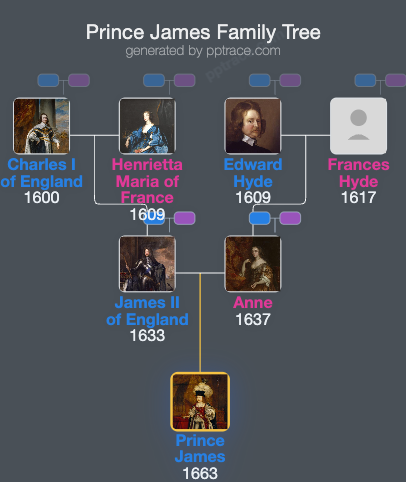
Family Tree
Tap  to expand more relatives
Introduction
James Stuart, Duke of Cambridge, was born on 12 July 1663 at 1:22 a.m. at St. James's Palace. He was the second surviving son of the Duke of York, later King James II of England, and his first wife, Anne Hyde. He was a grandson of Charles I of England and a great-grandson of Henry IV of France. His baptism occurred at St. James's Palace on 22 July 1663, performed by Gilbert Sheldon, Archbishop of Canterbury. His godparents were King Charles II, his maternal grandfather Edward Hyde, 1st Earl of Clarendon, Queen Henrietta Maria, and others including Henry Jermyn, 1st Earl of St Albans, and Edward Montagu, 1st Earl of Sandwich. James was held by Mary Fairfax, Duchess of Buckingham.
He was a great-grandson of King James VI of Scotland and I of England, the first Stuart king of England. During the English Civil War, his uncle King Charles II had escaped to France. James's father, the Duke of York, was a member of the Church of England during James's lifetime; all of his children were raised as Anglicans. Two years after James's death, his father converted to Roman Catholicism.
On 23 August 1664, at approximately one year old, James was granted the titles of Duke of Cambridge, Earl of Cambridge, and Baron of Dauntsey by his uncle, King Charles II. These titles had been created specifically for him; among the four sons of the Duke of York bearing the title Duke of Cambridge, only James and his brother Edgar were formally created with these titles. In 1665, a sister named Anne was born, who would later ascend to the throne. In 1666, a brother, the Duke of Kendal, was born and died shortly thereafter.
On 3 December 1666, James was appointed Knight of the Garter. The ceremony involved the King, accompanied by other Knights, installing James into the Order. At that time, it was believed that King Charles II might not have any legitimate heirs from his wife, and James was considered the heir apparent after his father. In May 1665, a year prior, the King issued letters patent granting James a yearly pension of £3,000, which was to be managed until he reached fourteen years of age.
In late April 1667, James became ill, likely from smallpox or bubonic plague, as documented by Samuel Pepys, who noted that James was "full of spots" and that his physician, Dr. Frazier, was unsure of how to treat his illness. On 22 May 1667, the Duke of Kendal died from convulsions, and James was transferred to Richmond for care. His mother was anxious for his life following Kendal’s death. Reports from Pepys's diaries indicated that public hopes for James's recovery fluctuated, with the nation losing hope by 6 June 1667. However, by 9 June, there were signs that James was improving.
James died on 20 June 1667, which came as a surprise to the public and the court. He was nearly four years old at the time of his death. His body was taken to Westminster Abbey, where he lay in state before being interred on 26 June 1667. His tomb bears a Latin inscription indicating he was "the second-born son and Heir of the Most Powerful Prince James Duke of York."
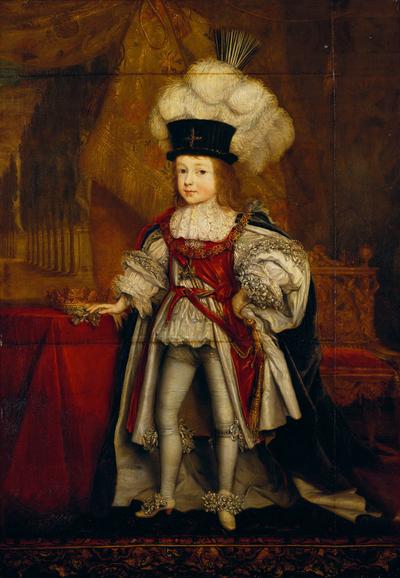
Following his death, Samuel Pepys recorded that the nation was concerned about the succession and that there was disappointment over his demise. His titles, Duke of Cambridge and Baron of Dauntsey, became extinct upon his death. The title Duke of Cambridge was revived several times subsequently, while the barony was only temporarily revived for his brother Edgar in 1667. A portrait of James by Willem Wissing, commissioned by his sister Lady Mary (later Queen Mary II), was displayed at Windsor Castle. His pension continued to be paid to his father to support his surviving siblings.
James Stuart's coat of arms as a grandson of a British Sovereign consisted of the royal arms differenced by a label argent of five points ermine.