Louisa Maria Stuart
| Name | Louisa Maria Stuart |
| Title | British princess (1692-1712) |
| Gender | Female |
| Birthday | 1692-06-28 |
| nationality | Great Britain |
| Source | https://www.wikidata.org/wiki/Q271999 |
| pptrace | View Family Tree |
| LastUpdate | 2025-11-12T01:14:21.026Z |
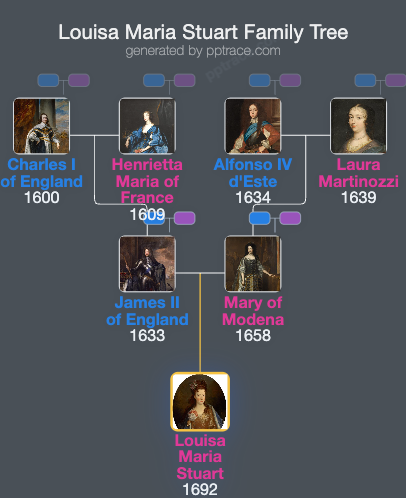
Family Tree
Tap  to expand more relatives
Introduction
Louisa Maria Teresa Stuart (French: Louise Marie Thérèse), born on 28 June 1692, was a member of the House of Stuart. She was the youngest child of James II and VII, deposed King of England, Scotland, and Ireland, and his second wife, Mary of Modena. Her place of birth was Saint-Germain-en-Laye, France, four years after her father fled England in 1688 and never returned.
Her birth was surrounded by controversy, particularly regarding the legitimacy of her older brother, James Francis Edward Stuart. James II had sent invitations to witnesses, including Protestant ladies and members of the royal family, to attend the birth in an effort to counter accusations of substitution. A historian, Thomas Babington Macaulay, commented on the precautions taken for her birth, noting that the absence of witnesses from England contributed to the subsequent revolution. James II believed her birth was a divine consolation during a period of political distress, and she was later referred to as La Consolatrice.
Her full name was Louisa Maria Teresa at baptism, with the middle name Teresa added later at her confirmation. Her godparents were King Louis XIV of France, in whose honor she was named, and Elizabeth Charlotte, Princess Palatine, Duchess of Orléans. She had several siblings, but only her brother James Francis Edward Stuart survived infancy among her full siblings. Her relationship with her brother was close, although she also maintained contact with her half-sisters, Mary and Anne.
Following her father's death in 1701, her family recognized her brother as King James III of England, Scotland, and Ireland. Louis XIV proclaimed him as such, and he received recognition from Spain, the Papal States, and Modena. Louisa Maria and her brother were then moved to Passy, France, under the care of Antonin Nompar de Caumont, 1st Duke of Lauzun, with her governess, Lady Middleton, continuing her education.
By 1705, at the age of thirteen, Louisa Maria was a guest of honor at a court ball at Château de Marly, where she ranked after Louis XIV, her mother Queen Mary of Modena, and her brother James Francis Edward. She was involved in the diplomatic considerations of potential marriages, including proposals with Charles, Duke of Berry, and King Charles XII of Sweden, both of which were not pursued due to political and religious reasons.
In 1708, she was involved in a planned French-supported landing on Scottish soil, which was ultimately unsuccessful. She was known for her interests in dancing and opera, and she was popular at the French court. She supported the education of daughters of Jacobite supporters, regardless of their religious backgrounds.
In April 1712, Louisa Maria contracted smallpox along with her brother. While her brother recovered, she succumbed to the disease and died on 18 April 1712 (Old Style calendar). She was aged 19 at the time of her death and was buried at the Church of the English Benedictines in Paris. Contemporary accounts describe her as a princess of notable presence, and her death was widely mourned in France and among European supporters of her family.
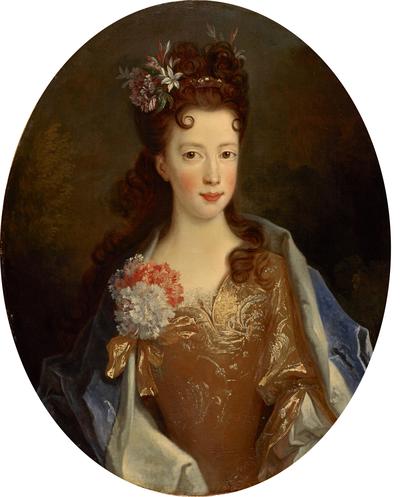
Several portraits of Louisa Maria survive, painted by artists including François de Troy and Alexis Simon Belle. Her likeness has been preserved in various collections, including the National Portrait Gallery in London. Her story has also appeared in literature, such as Eliza Haywood's 1744 novel The Fortunate Foundlings.
Her remains, along with those of her father, King James II, were reportedly resting at the Church of the Val-de-Grâce before being affected by the French Revolution, which led to the desecration of many historic sites. The names Louisa Maria Teresa have been used for other historical figures, including Queen Luisa Maria Teresa of Parma and daughters of French aristocracy.