Mary Of Modena
| Name | Mary Of Modena |
| Title | English royal consort |
| Gender | Female |
| Birthday | 1658-09-25 |
| nationality | Great Britain |
| Source | https://www.wikidata.org/wiki/Q232475 |
| pptrace | View Family Tree |
| LastUpdate | 2025-11-12T01:14:23.565Z |
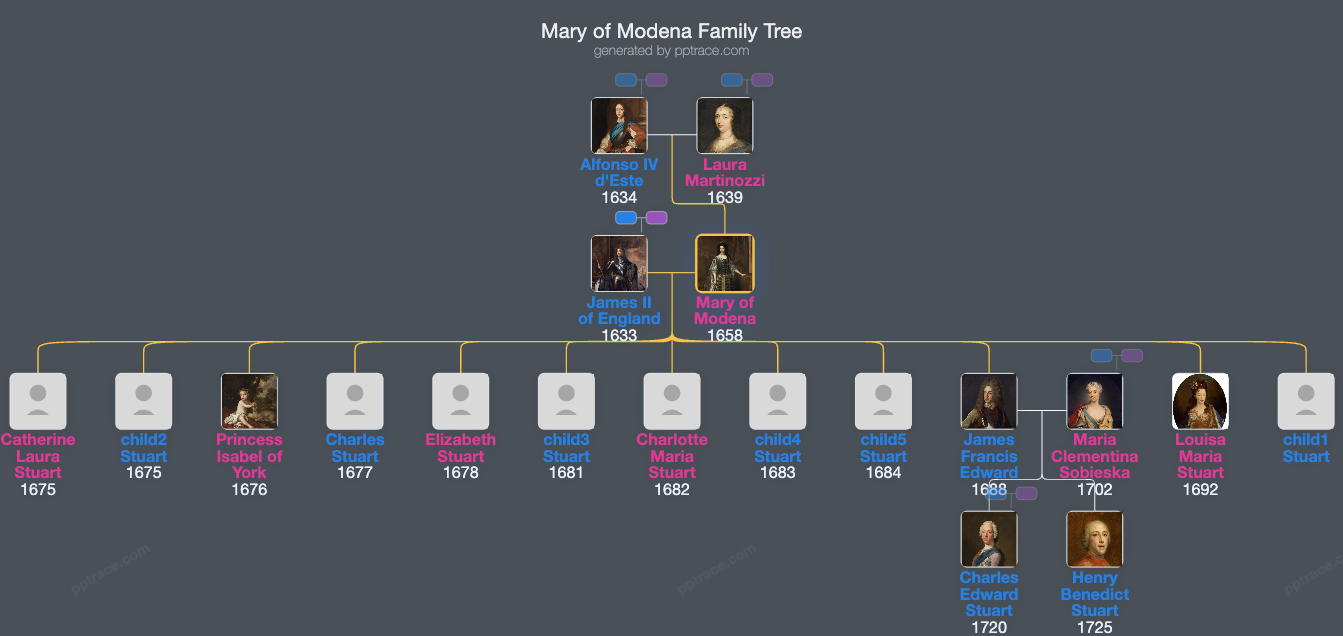
Family Tree
Tap  to expand more relatives
Introduction
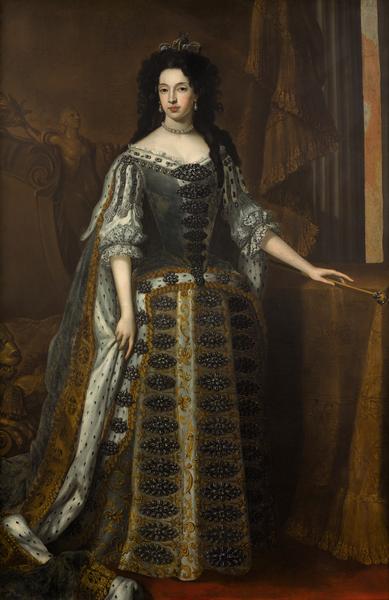
Mary of Modena (Italian: Maria Beatrice Eleonora Anna Margherita Isabella d'Este) was born on October 5, 1658 (September 25, Old Style) in Modena, Duchy of Modena, Italy. She was the second child and eldest surviving daughter of Alfonso IV, Duke of Modena, and Laura Martinozzi. After her father's death in 1662, her younger brother Francesco succeeded as Duke, with their mother acting as regent. Mary received an education that included fluency in Italian and French, knowledge of Latin, and later, proficiency in English.
In 1673, Mary was married by proxy to James, Duke of York, the younger brother and heir presumptive to Charles II of England. The marriage was brokered in part by Lord Peterborough, Groom of the Stool to the Duke of York. Mary was nearly 15 years old at the time, and James was 39. The wedding took place amid political tensions due to Mary's Roman Catholic faith, which was controversial in Protestant England. Her marriage faced opposition from Parliament and the public, who feared a Catholic influence on the throne. Despite initial reluctance, the marriage proceeded, and Mary became known as the Duchess of York.
During her tenure as Duchess of York (1673–1685), Mary experienced multiple childbirths, several of whom died in infancy. She was involved in the political and religious turmoil of the period, including the Popish Plot of 1678–1681, which led to accusations against her secretary and exile to Brussels with her husband and children. While in exile, Mary resided at the Château de Saint-Germain-en-Laye in France, a residence provided by King Louis XIV. She was generally well received there, though James was often considered dull, and she maintained connections with the French court.
In 1685, upon the death of her brother-in-law Charles II, James II ascended the throne. Mary became queen consort of England, Scotland, and Ireland. The coronation was held on April 23, 1685. Her health declined during this period, and she faced political challenges, including the birth of her son, James Francis Edward in 1688. Rumors circulated that her son's birth was a deception, purportedly with the child smuggled into the birth chamber. These rumors, along with the political unrest, contributed to the Glorious Revolution of 1688, which led James II’s abdication and exile in France.
Following the revolution, Mary and her family went into exile in France, where they resided at the Château de Saint-Germain-en-Laye under the protection of Louis XIV. She was regarded as a prominent figure at Versailles, enjoying the ranks and privileges associated with her status, although her husband's court was often considered dull. Mary supported her husband's efforts to regain the throne, notably during James's attempt to rally support in Ireland, which ended with his defeat at the Battle of the Boyne in 1690.
After James's death in 1701, Mary served as regent for her son, James Francis Edward, who was proclaimed king by Jacobites. Her regency lasted until her son reached age 16. She focused on the political situation in Britain and sought alliances, but her influence was limited, and she remained largely supportive of Jacobite claims.
Mary spent her later years in the Convent of the Visitations at Chaillot and Saint-Germain, experiencing personal hardships and financial difficulties, especially after her son's expulsion from France in 1712. She died of breast cancer on May 7, 1718, in Saint-Germain-en-Laye. Her remains were interred in the convent at Chaillot. Mary of Modena is remembered for her involvement in significant historical events during the late 17th and early 18th centuries, including her role as queen consort and her life in exile.