James Francis Edward Stuart, Prince Of Wales
| Name | James Francis Edward Stuart, Prince Of Wales |
| Title | pretender to the English, Scottish and Irish throne |
| Gender | Male |
| Birthday | 1688-06-10 |
| nationality | Great Britain |
| Source | https://www.wikidata.org/wiki/Q211681 |
| pptrace | View Family Tree |
| LastUpdate | 2025-11-12T01:14:21.849Z |
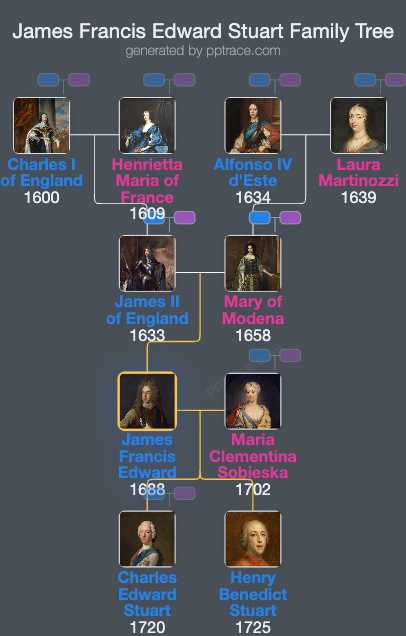
Family Tree
Tap  to expand more relatives
Introduction
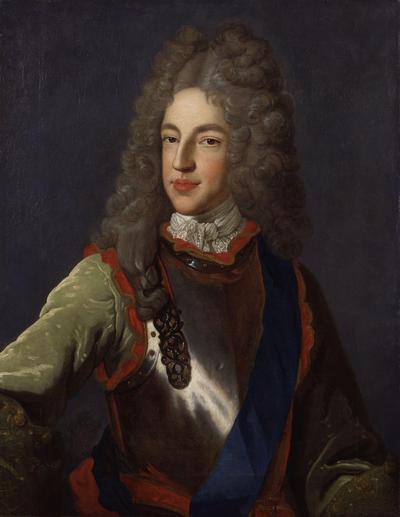
James Francis Edward Stuart, also known as the Old Pretender, was born on June 10, 1688, at St. James's Palace in London. He was the only son of James II of England, a Catholic monarch, and his second wife, Mary of Modena. As the eldest surviving son of the reigning monarch, he was automatically given titles such as Duke of Cornwall and Duke of Rothesay at birth and was created Prince of Wales in July 1688.
His birth occurred five years after a series of pregnancies by his mother, none of which resulted in surviving offspring. His accession as the presumed heir revived religious and political controversies, particularly among Protestants who considered his Catholicism a threat to the established church and succession laws. Rumors circulated claiming he was stillborn or that he was an impostor, and there were speculations about the legitimacy of his birth and paternity, which his father attempted to dispel by publishing witness testimonies.
Following the deposition of his father during the Glorious Revolution in 1688, which led to William III and Mary II ascending the throne, James and his family fled to France. On December 9, 1688, his mother disguised herself as a laundress and escaped with the infant James to France. He was raised at the Château de Saint-Germain-en-Laye, which Louis XIV of France provided to exiled James II. During his childhood, he received a military education overseen by Richard Hamilton and Dominic Sheldon.
In 1701, upon the death of James II, James Francis Edward Stuart was proclaimed the rightful king by Louis XIV of France. Several countries, including Spain, the Papal States, and the Duchy of Modena, recognized him as king, though he was attainted for treason in England, and his titles were forfeited under English law.
Several attempts at restoring him to the throne were made. An invasion in 1708 was thwarted by the British fleet, and he served in the French army for a period. In 1710, Britain’s government engaged in secret negotiations with France regarding James's potential accession if he converted to Protestantism, but he refused to renounce his Catholic faith. With the accession of George I in 1714, following Queen Anne's death, James’s claim was temporarily sidelined. Subsequently, Jacobite risings occurred, notably in 1715 and 1745, led by his son Charles Edward Stuart, known as Bonnie Prince Charlie.
James lived in exile in various locations, including Avignon, Pesaro, and Rome, where he maintained a court-in-exile supported by the Catholic Church. Pope Clement XI and Pope Innocent XIII offered support, and he received an annuity of 12,000 Roman scudi from the papacy. Efforts to restore the Stuarts continued through planned invasions and correspondence, but these largely failed or were called off.
In 1717, James married Maria Clementina Sobieska, granddaughter of King John III Sobieski of Poland. The couple had two sons: Charles Edward Stuart (born December 31, 1720) and Henry Benedict Stuart (born March 11, 1725). Charles, known as "Bonnie Prince Charlie," later led the 1745 Jacobite rising, which ended in defeat.
James Francis Edward Stuart died on January 1, 1766, at the Palazzo Muti in Rome. He was buried in the crypt of St. Peter's Basilica. His long claim to the British throne lasted more than 64 years, longer than any reigning monarch until Queen Elizabeth II's reign surpassed it in 2016. Following his death, the papal claim to the British throne was gradually abandoned, and Rome recognized the Hanoverian dynasty as the legitimate rulers of Britain.
He was created Prince of Wales on July 4, 1688, and held the Jacobite Order of the Garter from 1692 until his death. His arms as Prince of Wales consisted of the royal arms differenced with a label argent of three points.