
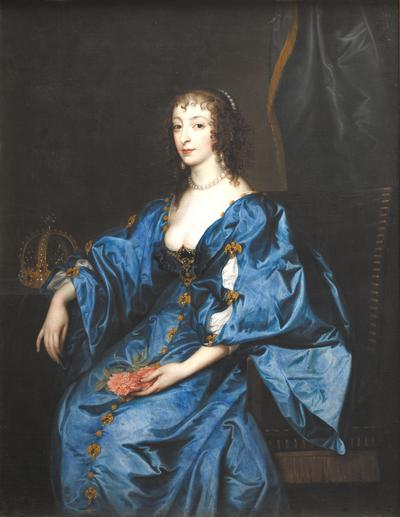
Henrietta Maria Of France
| Name | Henrietta Maria Of France |
| Title | queen consort of England, Scotland, and Ireland as the wife of King Charles I |
| Gender | Female |
| Birthday | 1609-11-25 |
| nationality | Kingdom of France |
| Source | https://www.wikidata.org/wiki/Q848615 |
| pptrace | View Family Tree |
| LastUpdate | 2025-11-12T01:14:22.690Z |
Family Tree
Tap  to expand more relatives
Introduction
Henrietta Maria of France (French: Henriette Marie), born on 25 November 1609, died on 10 September 1669, was Queen of England, Scotland, and Ireland by marriage to King Charles I. She held this title from her marriage on 13 June 1625 until the execution of Charles I on 30 January 1649. She was the mother of Charles II and James II and VII. During her lifetime, she was also known in England as Queen Mary, a title decreed by her husband, though she personally preferred to be addressed as "Henriette" or "Henriette Marie."
**Early Life and Family Background**
Henrietta Maria was the youngest daughter of Henry IV of France (also known as Henry III of Navarre) and Marie de' Medici. She was born at the Palais du Louvre in Paris. Her birth date is recorded as 25 November 1609, though some sources cite 26 November; in England using the Julian calendar, her birthdate is often listed as 16 November. She was raised as a Roman Catholic and was a member of the House of Bourbon, with the designation of Fille de France. Her older brother was the future Louis XIII. Her father was assassinated on 14 May 1610, when Henrietta Maria was less than a year old, and she was subsequently raised under the care of the royal governess Françoise de Montglat.
**Education and Upbringing**
Her education included riding, dancing, singing, and participation in court plays. She received instruction in reading and writing but was not particularly noted for academic achievement. Her religious upbringing was influenced heavily by the Carmelites at the French court. By 1622, she was residing in Paris with a household of approximately 200 staff, as marriage negotiations commenced.
**Marriage Negotiations and Marriage**
Her first encounter with her future husband, King Charles I of England, occurred in 1623 during a court entertainment in Paris. Initial marriage plans with Maria Anna of Spain fell through due to Spanish demands that Charles convert to Catholicism and reside in Spain, which he declined. Subsequently, in 1624, a marriage alliance was negotiated with Henrietta Maria, facilitated by James Hay, 1st Earl of Carlisle. She was about fifteen years old at the time of her marriage. The marriage was conducted via proxy at Notre-Dame de Paris on 1 May 1625, with Duke Claude of Chevreuse acting on Charles's behalf. The couple spent their first night together at St Augustine's Abbey near Canterbury on 13 June 1625.
**Queenship and Religious Affiliation**
As a devout Catholic, Henrietta Maria's religious faith played a significant role during her queenship. She was unable to be crowned in the Church of England, and thus, she was never formally crowned as queen. She was publicly known as Queen Mary, a name she disliked, often signing her correspondence as "Henriette" or "Henriette Marie." Her open practice of Catholicism and efforts to promote Catholic worship caused tensions within England, especially given the Protestant-majority population and fears of Catholic conspiracy. She also engaged in Catholic proselytizing and facilitated Catholic marriages despite laws prohibiting such practices.
**Relationship with King Charles I**
The marriage initially faced difficulties, with the relationship described as cold and argumentative. She disliked Charles's favorite, the Duke of Buckingham, at first, but their relationship improved after Buckingham's assassination in 1628. Henrietta Maria and Charles developed a close partnership, often exchanging affectionate correspondence. She had significant influence over her husband and became his key confidante and adviser, especially after the birth of their son, Charles II, in 1630.
**Art Patronage and Court Life**
Henrietta Maria was an active patron of the arts. She commissioned works from Italian painter Orazio Gentileschi, Guido Reni, and Anthony van Dyck, among others. She was involved in Stuart masques and performed in court entertainments, as well as supporting English theatre and music. She also invested in courtly architecture and garden design, employing notable designers like Inigo Jones.
**Political Involvement and Civil War**
During the 1640s, tensions between the monarchy and Parliament escalated into the English Civil War. Henrietta Maria was politically engaged, often supporting royalist causes. Her Catholic faith and actions in promoting Catholic worship contributed to her unpopularity among Protestant factions. She faced opposition and suspicion from Parliament and was implicated in the political conflicts of the era. When the war broke out, she remained abroad for a period, raising funds and supporting Royalist efforts, including attempting to bring aid from the continent.
**Exile and Later Life**
Following the execution of Charles I in 1649, Henrietta Maria lived in exile, mainly in France. She established a royal court-in-exile at Saint-Germain-en-Laye. During her exile, she experienced factional disputes within the Royalist circle and dealt with the financial and political instability after her husband's death. She continued her advocacy for her son's eventual return and the restoration of the monarchy.
**Restoration and Final Years**
In October 1660, with the Restoration of Charles II, Henrietta Maria returned to England with her daughter. Her reception was modest; she resided at Somerset House and received a pension from the crown. She arranged her daughter Henrietta's marriage to Philippe, Duke of Orléans, and supported her son's marriage plans. In 1662, she returned to France, residing at the Hôtel de la Bazinière, and maintained close ties with the French court and her family. She died at the Château de Colombes near Paris in 1669, reportedly after taking an overdose of opiates due to a lung infection. She was buried in the Basilica of Saint-Denis.
**Legacy**
The name of the U.S. state Maryland was derived from her, in honor of her husband, Charles I. The northwest headland of James Bay was named "Henrietta Maria" by Captain Thomas James during an exploration in 1631. Her patronage of the arts and her role in the political conflicts of her time are also notable aspects of her historical profile.
**Genealogy and Issue**
Her children included Charles II and James II of England, as well as others. Her descendants and transplanted influence extended into European royal families, linking her to many subsequent monarchies.
**References and Further Reading**
Numerous historical works elaborate on her life, including biographies by Elizabeth Hamilton, Carola Oman, and Leanda de Lisle. She is also depicted in cultural media and retains a historical footprint in art and colonial nomenclature.
