
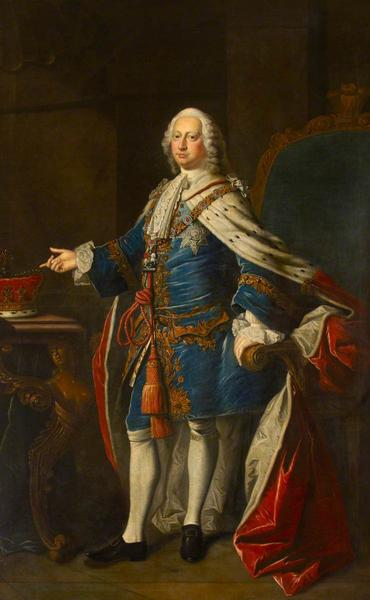
Frederick, Prince Of Wales
| Name | Frederick, Prince Of Wales |
| Title | heir apparent to the British throne from 1727 until his death |
| Gender | Male |
| Birthday | 1707-01-31 |
| nationality | Great Britain |
| Source | https://www.wikidata.org/wiki/Q165349 |
| pptrace | View Family Tree |
| LastUpdate | 2025-11-12T01:15:18.425Z |
Family Tree
Tap  to expand more relatives
Introduction
Frederick, Prince of Wales (German: Friedrich Ludwig; born 31 January 1707, died 31 March 1751), was the eldest son and heir apparent of King George II of Great Britain. He was born in Hanover, in the Holy Roman Empire, as Duke Friedrich Ludwig of Brunswick-Lüneburg. His parents were Caroline of Ansbach and Prince George, who later became King George II.
His early lineage placed him in the line of succession to the British throne under the Act of Settlement of 1701. At birth, Frederick was fourth in line, after his great-grandmother Electress Sophia of Hanover, his grandfather George, Elector of Hanover, and his father. The Elector of Hanover ascended to the British throne in 1714 as King George I.
Frederick’s paternal grandfather was George I, and his mother was Caroline of Ansbach. His godfathers included Elector George of Hanover and Frederick I, King of Prussia. The family nickname for him was "Griff."
In 1714, when Frederick was seven years old, his parents moved to Great Britain following the accession of George I. During this period, Frederick remained in Hanover under the care of his granduncle, Ernest Augustus, Prince-Bishop of Osnabrück, and did not reunite with his parents until 1728.
Frederick was created Duke of Edinburgh, Marquess of the Isle of Ely, Earl of Eltham, Viscount of Launceston, and Baron of Snaudon by his grandfather, George I, on 26 July 1726. He was inoculated against smallpox in 1722 by Charles Maitland under his mother’s instructions.
In 1728, following his father’s accession to the throne as George II, Frederick moved to Great Britain. He was officially made Prince of Wales on 7 January 1729. During his time in Britain, Frederick served as the tenth chancellor of the University of Dublin from 1728 to 1751. He was involved in patronage of the arts, including supporting composer Thomas Arne, who wrote the patriotic song "Rule, Britannia!" for him in 1740.
Frederick maintained a strong interest in music, playing the viola and cello, and was also a supporter of the visual arts. He patronized various artists and was influential in popularizing the Rococo style in decorative arts, employing craftsmen such as Nicolas Sprimont and Paul Petit. The prince’s residence in London included properties such as Norfolk House and Carlton House, none of which survive today.
His relationship with his parents was strained, partly due to personal differences and the long separation since his youth. Frederick's court life was characterized by opposition to his parents’ policies and influence, particularly through his sponsorship of opposition politicians and media.
Frederick’s domestic life included a marriage to Augusta of Saxe-Gotha on 27 April 1736. The marriage produced several children, including his son, who would become King George III. The couple’s relationship was significant in his personal and political life.
He was involved in diplomatic and political affairs, including negotiations over potential marriages, but his political ambitions remained unfulfilled. Notably, he opposed the Gin Act of 1736 and supported opposition factions against his father’s government.
Frederick died at Leicester House on 31 March 1751 at the age of 44, from a pulmonary embolism, a diagnosis confirmed by later examination. He was buried at Westminster Abbey on 13 April 1751. He was the most recent Prince of Wales who did not ascend the throne. His death occurred shortly before his wife Augusta gave birth to Princess Caroline Matilda.
Throughout his life, Frederick received several titles and honors, including the title Duke of Gloucester (granted in 1717), and became Duke of Cornwall in 1727. He was appointed a Royal Knight of the Garter on 3 July 1717. His heraldic arms changed upon his elevation to Prince of Wales, incorporating distinctions for his rank. His family lineage traces back to ancestors including George I and Sophia of Hanover, with issue including his children, notably King George III.
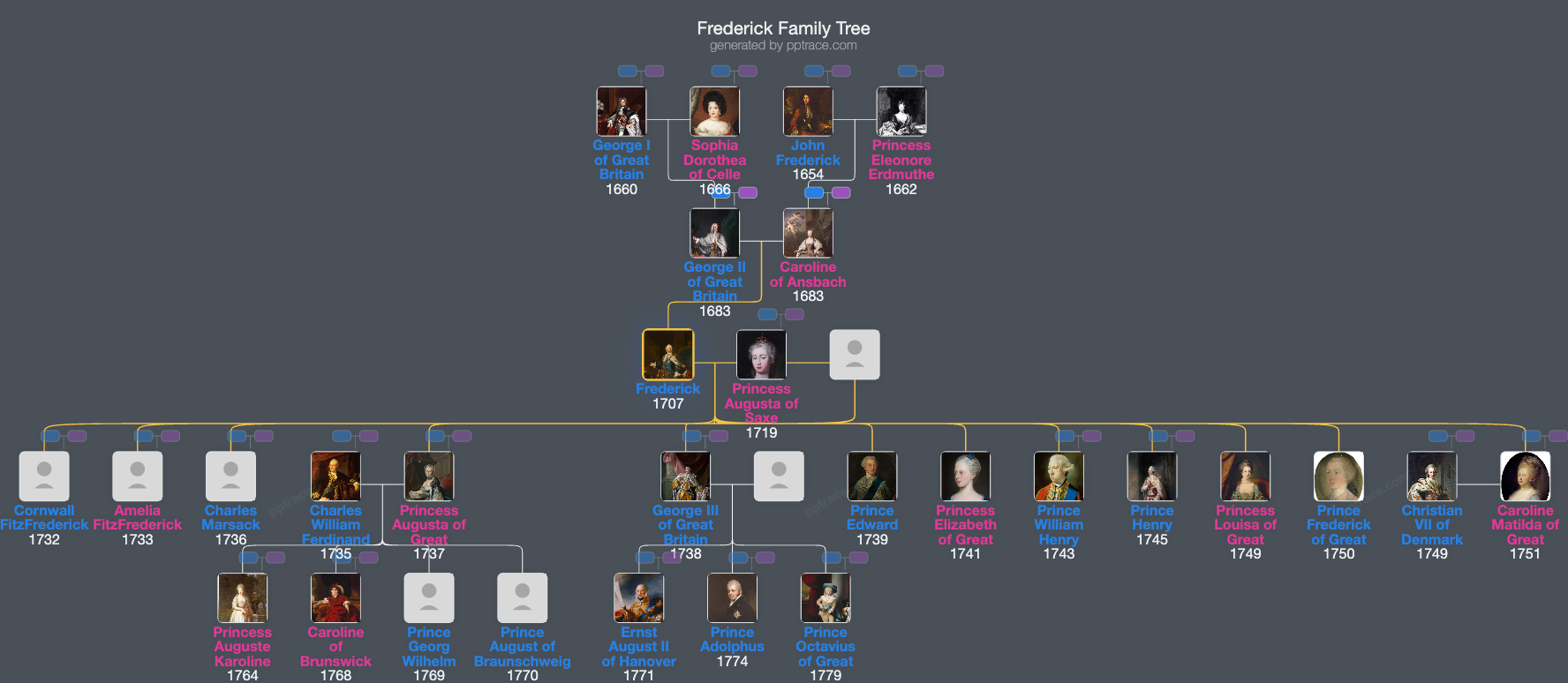
Children
- Princess Augusta Of Great Britain
- George III Of Great Britain
- Prince Edward, Duke Of York And Albany
- Charles Marsack
- Prince Frederick Of Great Britain
- Amelia FitzFrederick
- Caroline Matilda Of Great Britain
- Cornwall FitzFrederick
- Princess Elizabeth Of Great Britain
- Princess Louisa Of Great Britain
- Prince William Henry, Duke Of Gloucester And Edinburgh
- Prince Henry, Duke Of Cumberland And Strathearn