Charles Marsack
| Name | Charles Marsack |
| Title | (1736-1820) |
| Gender | Male |
| Birthday | 1736-00-00 |
| nationality | — |
| Source | https://www.wikidata.org/wiki/Q23806552 |
| pptrace | View Family Tree |
| LastUpdate | 2025-11-12T00:45:10.922Z |
Family Tree
Tap  to expand more relatives
Introduction
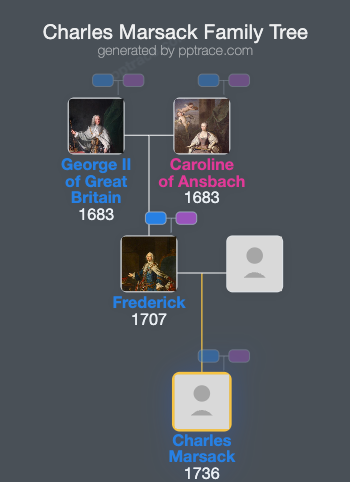
Charles Marsack (1747/8 – 22 December 1820) was an officer in the East India Company army and a landowner. His origins are believed to be modest, and he accumulated wealth in India. According to stories published in Burke's Landed Gentry in 1894, he was reputedly the son of Frederick, Prince of Wales, or of King George II, by an individual referred to as the Comtesse de Marsac. However, these claims lack documentary evidence and are considered to be folklore.
He was born approximately in 1735–36, based on his age at burial, but more likely between 1747 and 1748, inferred from his age at marriage. He married in 1783, contrasting with earlier reports that suggest a marriage year of 1767. His parents were Jean Charles Marsac (1708–1751), a servant to Joachim Lorentz Sollifoffer, a page to George II. Jean Charles Marsac was the son of a migrant from Poitou named Charles Marsac, a carpenter who arrived in England before 1704/5. Jean Charles was known as Charles Marsac and apprenticed as a weaver.
Jean Charles Marsac married Margaret Saunders at St Martin in the Fields in 1745/6. Margaret Saunders was possibly related to Thomas Saunders, a standing wardrobe keeper to George I and George II. After her first husband's death in 1751, Margaret married John Holcroft, who died in 1768. Margaret died in 1785; her estate was administered to Charles Marsac, her "natural and lawful son." Margaret and John Holcroft had a daughter, Margaretta Holcroft (1755–1785), who lived with William Roome and had illegitimate children by him. A story propagated through editions of Burke's Landed Gentry claimed that Margaretta was the daughter of Margaret, Comtesse de Marsac, though this is unsubstantiated.
Around 1760, Marsack traveled to India as an Ensign in the East India Company. He was later appointed Lieutenant and Surveyor of Oudh province and, by 1777, had become a Captain of a cavalry unit serving the Nabob of Oudh. He resigned his commission in 1779. In 1780, he undertook a notable journey from Lucknow to Delhi and back with a native companion, which he documented. In 1782, he was expelled from Oudh by Warren Hastings and provided evidence against Hastings at his trial.
In 1783, Marsack returned to England as a Major. Following his marriage, he received a substantial sum of £20,000 from his wife's trustees and purchased Caversham Park in Oxfordshire from Lord Cadogan. He restored and enlarged the estate, including the addition of a Greek-style structure with a Corinthian colonnade. The estate, previously described as having extensive gardens and park, is now located in Berkshire and was used by the BBC from 1943 to 2018. Caversham Park has been designated a Grade II listed building.
Marsack served as High Sheriff of Oxfordshire in 1787. He died at Caversham Park on 8 November 1820. His wife was Charlotte Becher (1767–1837), whom he married at Epsom, Surrey, in 1783. He was survived by seven of his eleven children: Richard Henry (1786–1852), George Hartwell (born circa 1791), Edward Claude (born circa 1794), and four daughters, Charlotte (born 1785), Caroline (1800–1836), Louisa (born circa 1802), and Mary Eleanor (born 1807). His eldest son, Charles, born in 1784, died in 1786. The estate passed to his eldest surviving son, Richard Henry, who was a Lieutenant-Colonel in the Grenadier Guards and sold Caversham Park in 1844 to William Crawshay.