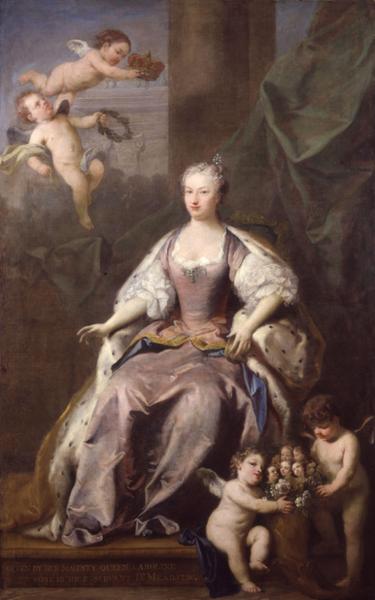
Caroline Of Ansbach
| Name | Caroline Of Ansbach |
| Title | Queen Consort of Great Britain and Electress Consort of Hanover (1683-1737) |
| Gender | Female |
| Birthday | 1683-03-01 |
| nationality | Holy Roman Empire |
| Source | https://www.wikidata.org/wiki/Q76961 |
| pptrace | View Family Tree |
| LastUpdate | 2025-11-12T01:15:22.044Z |
Family Tree
Tap  to expand more relatives
Introduction
Caroline of Brandenburg-Ansbach (Wilhelmina Charlotte Caroline; 1 March 1683 – 20 November 1737) was Queen of Great Britain and Ireland and Electress of Hanover from 11 June 1727 until her death. She was the wife of King George II.
Born at Ansbach, Caroline was the daughter of Margrave John Frederick of Brandenburg-Ansbach, a member of a branch of the House of Hohenzollern who governed the small German principality of Ansbach. Her mother was Princess Eleonore Erdmuthe of Saxe-Eisenach. Orphaned at a young age when her father died of smallpox in 1686, Caroline and her younger brother William Frederick moved with their mother to the court of Elector Frederick III of Brandenburg, later King Frederick I of Prussia, and Queen Sophia Charlotte. At the Prussian court, her education was enhanced, and she adopted the liberal outlook of Sophia Charlotte, who was a significant influence throughout her life.
In her youth, Caroline was considered a desirable bride. She was initially considered for marriage to Archduke Charles of Austria, a claimant to the Spanish throne, but she refused to convert from Lutheranism to Catholicism. Instead, in 1705, she married Prince George Augustus of Hanover, who was third in line to the English throne. Their marriage produced eight children, seven of whom reached adulthood: Frederick, Anne, Amelia, Caroline, George William, William, Mary, and Louise.
Caroline moved to Britain in 1714 when her husband became Prince of Wales following the accession of his father, King George I. As Princess of Wales, she was involved in political opposition activities alongside George Augustus, particularly rallying support against her father-in-law. She was associated with Robert Walpole, who later became Britain’s first de facto prime minister, and heavily influenced political affairs through her intellect and connections.
When George Augustus became King George II in 1727, Caroline was crowned Queen and served as Electress. Her relationship with her eldest son, Frederick, Prince of Wales, was strained; he represented opposition to her husband’s reign, and her influence was often exercised through and for Walpole, who was the leading minister. During George II’s absences in Hanover, Caroline acted as regent on four occasions, during which she managed diplomatic negotiations and promoted reforms in the penal system.
As queen, Caroline was active in court arts and culture, collecting artworks and commissioning busts and garden designs. She was also a patron of medical advancements, promoting variolation against smallpox, and supported the arts and sciences. Her correspondence and involvement in intellectual debates linked her to prominent philosophers like Gottfried Leibniz.
Caroline’s tenure as queen was marked by her political influence, her patronage of the arts, and her active role during regencies. She was known for her moral standards and support for religious and social causes, which garnered her respect from various political factions.
She died on 20 November 1737 at St James's Palace after suffering from a hernia and subsequent complications. Her death was widely mourned; she was buried in Westminster Abbey. King George II refused to remarry after her death. Her legacy includes an influence on the stability and establishment of the Hanoverian dynasty in Britain and a reputation for political and cultural contributions.
Caroline was titled Her Serene Highness Princess Caroline of Brandenburg-Ansbach from 1683 to 1705, Her Serene Highness The Electoral Princess of Hanover from 1705 to 1714, Her Royal Highness The Princess of Wales from 1714 to 1727, and Her Majesty The Queen from 1727 until her death. The constituency of Caroline County in Virginia was named in her honor in 1727. Her coat of arms was impaled with her father's heraldry, reflecting her familial lineage.