
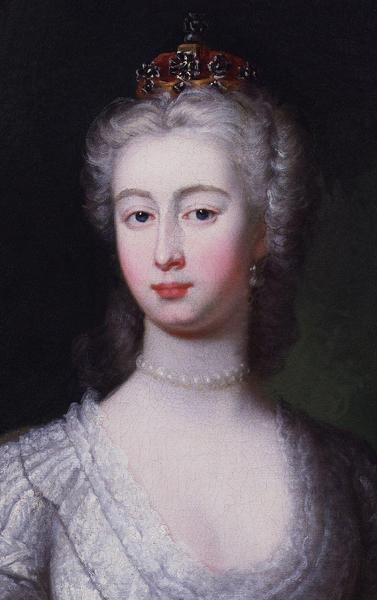
Princess Augusta Of Saxe-Gotha
| Name | Princess Augusta Of Saxe-Gotha |
| Title | German princess (1719-1772); Princess of Wales as wife of Frederick, Prince of Wales; mother of George III |
| Gender | Female |
| Birthday | 1719-11-30 |
| nationality | Germany |
| Source | https://www.wikidata.org/wiki/Q76967 |
| pptrace | View Family Tree |
| LastUpdate | 2025-11-12T01:16:09.612Z |
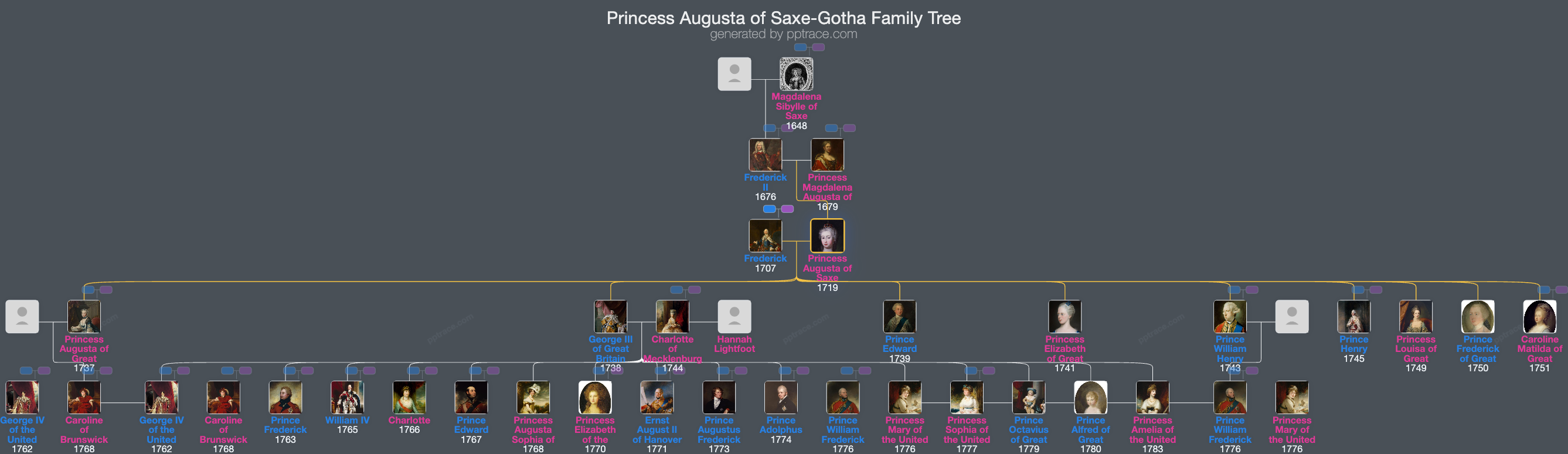
Family Tree
Tap  to expand more relatives
Introduction
Princess Augusta of Saxe-Gotha-Altenburg was born on 30 November 1719 (O.S. 19 November 1719) in Gotha. She was the daughter of Frederick II, Duke of Saxe-Gotha-Altenburg, and Magdalena Augusta of Anhalt-Zerbst. Her paternal grandfather was Frederick I, Duke of Saxe-Gotha-Altenburg, the eldest surviving son of Ernest I, Duke of Saxe-Gotha-Altenburg.
In 1736, a marriage was proposed between Augusta and Frederick, Prince of Wales, the eldest son and heir apparent of King George II of Great Britain. Originally, Frederick was intended to marry Princess Louisa Ulrika of Prussia. However, negotiations were affected by demands from the Prussian royal family, leading to the cancellation of that plan. Subsequently, Queen Caroline of Great Britain suggested Augusta as a suitable bride, and King George II visited Saxe-Gotha-Altenburg to assess her suitability. Augusta's family did not speak French or English, but she was not given language lessons prior to her departure. She arrived in Britain at age 16, speaking nearly no English.
The marriage took place on 8 May 1736 at the Chapel Royal in St James's Palace, London. Augusta, described as tall and slender with light brown hair and bright, expressive eyes, made a favorable impression during her arrival and wedding. She was introduced to the royal family and notably demonstrated respect by bowing deeply before them.
Augusta and Frederick had nine children together. During her marriage, she experienced challenges, including her husband's infidelity and political tensions within the royal family. Frederick employed his mistress, Lady Archibald Hamilton, as Augusta's First Lady of the Bedchamber, and there were reported attempts by Frederick to influence her behavior, including instructing her in court etiquette to snub the Queen and other courtiers.
Her first child, Princess Augusta, was born in 1737 under difficult circumstances, including a lack of proper medical preparation and a traumatic delivery. Despite these hardships, Augusta became known in society for her elegance and graciousness.
Frederick, Prince of Wales, died unexpectedly in 1751, leaving Augusta widowed at age 32. She was then styled as the Princess Dowager. Following her husband's death, she lived a largely secluded life with her children and was recognized for her role as mother to the heir apparent, her son George, who succeeded his grandfather as King George III in 1760.
Augusta held the position of prospective regent during her son’s minority, until he reached majority in 1760, although her influence was subject to political and courtly tensions. She was involved in court politics, including support for John Stuart, 3rd Earl of Bute, and her opposition to certain royal marriages and appointments.
She died of throat cancer on 8 February 1772 at Carlton House at the age of 52. She was interred at Westminster Abbey.
In her lifetime, Augusta also expanded Kew Gardens, overseeing the construction of several structures including the Great Pagoda built in 1761 by Sir William Chambers.
Several locations in British America, including Augusta, Georgia; Augusta County, Virginia; and Fort Augusta in Pennsylvania, were named in her honor.
Her legacy has been depicted in modern media, notably by Michelle Fairley, who portrayed a fictionalized version of Augusta in the 2023 series "Queen Charlotte: A Bridgerton Story."
Children
- Princess Augusta Of Great Britain
- George III Of Great Britain
- Prince Edward, Duke Of York And Albany
- Prince Frederick Of Great Britain
- Caroline Matilda Of Great Britain
- Princess Elizabeth Of Great Britain
- Princess Louisa Of Great Britain
- Prince William Henry, Duke Of Gloucester And Edinburgh
- Prince Henry, Duke Of Cumberland And Strathearn