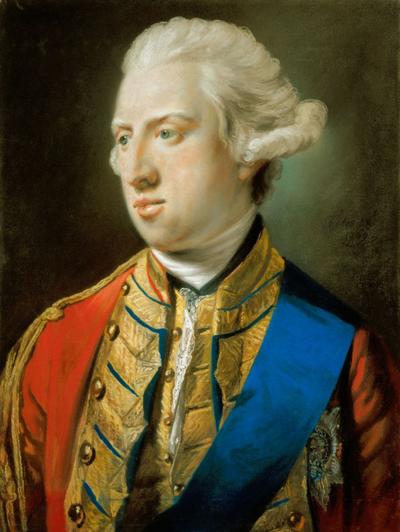
Prince William Henry, Duke Of Gloucester And Edinburgh
| Name | Prince William Henry, Duke Of Gloucester And Edinburgh |
| Title | British duke and field marshal |
| Gender | Male |
| Birthday | 1743-11-25 |
| nationality | United Kingdom of Great Britain and Ireland |
| Source | https://www.wikidata.org/wiki/Q680982 |
| pptrace | View Family Tree |
| LastUpdate | 2025-11-12T01:16:05.288Z |
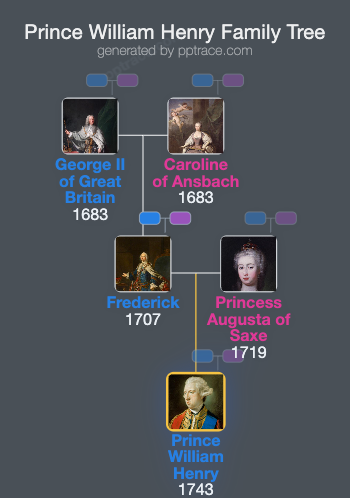
Family Tree
Tap  to expand more relatives
Introduction
Prince William Henry, Duke of Gloucester and Edinburgh, was born on 25 November 1743 at Leicester House, Westminster. He was the son of Frederick, Prince of Wales, and Princess Augusta of Saxe-Gotha. His paternal grandparents were King George II and Caroline of Ansbach. The Duke was baptized at Leicester House eleven days after his birth, with his godparents including the Prince of Orange, the Duke of Cumberland, and Princess Amelia. At birth, he was fourth in the line of succession to the British throne.
His father died in 1751, leading his elder brother, Prince George, to become heir apparent and later King George III in 1760. William Henry succeeded as Duke of Gloucester and Edinburgh and Earl of Connaught on 19 November 1764, shortly after George III's accession. He was invested as a Knight of the Garter on 22 September 1762.
In 1764, William Henry began a courtship with Maria Walpole, the Dowager Countess of Waldegrave, an illegitimate granddaughter of Sir Robert Walpole. The two married in secret at Pall Mall, a marriage only revealed to the King after the passing of the Royal Marriages Act 1772. The couple resided at St Leonard's Hill in Clewer, near Windsor, and had three children:
- Princess Sophia of Gloucester (born 29 May 1773, died 29 November 1844)
- Princess Caroline of Gloucester (born 24 June 1774, died 14 March 1775), who died at nine months old following smallpox inoculation
- Prince William Frederick (born 15 January 1776, died 30 November 1834)
The Duke initially aspired to serve actively in the military but was limited by health and capacity. Nonetheless, he was appointed colonel of the 13th Regiment of Foot in 1766 and later promoted to major-general. In the same year, he was appointed colonel of the 3rd Regiment of Foot Guards and served as Warden of Windsor Forest, residing at Cranbourne Lodge. In 1771, he became the thirteenth Chancellor of the University of Dublin, a position he held until his death in 1805.
In service, William Henry's military career included transferring to the 1st Regiment of Foot Guards, being promoted to field marshal on 18 October 1793, and commanding the Northern District from 1796 to 1802. Despite his desires to participate in conflicts such as the American War of Independence, he was unable to obtain a field command, as King George III disapproved.
He was interested in scientific pursuits, becoming a Fellow of the Royal Society in 1780. In 1797, he hosted Philip Meadows Martineau, a surgeon from Norwich, at Raynham Hall, connected through family relations to Lord Sydney, after whom Sydney, Australia, was named.
In 1782, an illegitimate daughter, Louisa Maria La Coast, was born to the Duke. Her mother was Lady Almeria Carpenter, a daughter of the Earl of Tyrconnell. Louisa married Godfrey Macdonald, 3rd Baron Macdonald, and died in 1835.
Prince William Henry died at Gloucester House in London on 25 August 1805. He was succeeded as duke by his son William Frederick. He was buried at St George's Chapel, Windsor Castle.
His titles and honors included:
- Styles: "His Royal Highness Prince William" (1743–1764) and "His Royal Highness The Duke of Gloucester and Edinburgh" (1764–1805)
- Knight of the Garter (KG)
- Privy Counsellor (PC)
- Fellow of the Royal Society (FRS)
He was granted arms differenced by a label argent of five points, with a fleur-de-lys azure in the center and crosses gules on the other points.