Prince Edward, Duke Of York And Albany
| Name | Prince Edward, Duke Of York And Albany |
| Title | British prince |
| Gender | Male |
| Birthday | 1739-03-25 |
| nationality | Great Britain |
| Source | https://www.wikidata.org/wiki/Q224215 |
| pptrace | View Family Tree |
| LastUpdate | 2025-11-12T01:16:02.113Z |
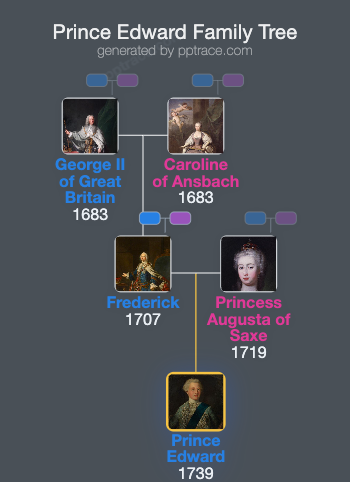
Family Tree
Tap  to expand more relatives
Introduction
Prince Edward, Duke of York and Albany (Edward Augustus), was born on 25 March 1739 and died on 17 September 1767. He was a member of the British royal family, the younger brother of King George III and the second son of Frederick, Prince of Wales, and Princess Augusta of Saxe-Gotha.
Early Life:
Edward Augustus was baptized at Norfolk House, where the Bishop of Oxford, Thomas Secker, performed the ceremony. His godparents included his great-uncle Frederick William I of Prussia (represented by proxy by Charles Douglas, 3rd Duke of Queensberry), Charles I, Duke of Brunswick-Wolfenbüttel (represented by Henry Brydges, Lord Carnarvon), and his maternal aunt Fredericka, Duchess of Saxe-Weissenfels (represented by Lady Charlotte Edwin). During childhood, Edward and his brother underwent extensive education in subjects including arithmetic, Latin, geometry, writing, religion, French, German, Greek, and dance.
Military Career and the Seven Years' War:
Edward displayed an interest in naval affairs and sought permission to serve with the Royal Navy. He participated in naval operations against France, such as the Raid on St Malo, which culminated in the Battle of St. Cast in 1758. His naval career saw several promotions: he was promoted to captain of HMS Phoenix on 14 June 1759, then to Rear-Admiral of the Blue in 1761, vice-admiral of the blue in 1762, and ultimately reached the rank of Admiral of the Blue in 1766.
Later Life:
On 1 April 1760, he was created Duke of York and Albany and Earl of Ulster by his grandfather, King George II. When his brother ascended to the throne on 25 October 1760 as King George III, Edward was appointed a privy counsellor. Between the accession and the birth of the future George IV on 12 August 1762, Edward was the heir presumptive to the British throne. He was initiated into the Masonic Order on 27 July 1765.
Death:
In late summer 1767, while traveling to Genoa, Edward fell ill and was brought ashore in Monaco. Despite medical treatment, he died in the Palace of Honoré III, Prince of Monaco, on 17 September 1767. The chamber of his death is known as the York Room. His body was transported back to London aboard HMS Montreal and was interred in Westminster Abbey.
Legacy:
In 1762, James Boswell published "The Cub at Newmarket," a poem dedicated to Edward without his prior consent. The poem references Boswell himself as "the Cub," and is a reflection of the prince's patronage. Edward is also depicted in Norah Lofts' 1969 historical novel "The Lost Queen," which recounts the life of his sister Caroline Matilda and mentions his close relationship with her. The novel also suggests, without firm historical evidence, that Edward planned to elope with a common woman and marry her in Russia.
Namesakes:
Various places and entities are named after Prince Edward, including Prince Edward County in Virginia, Cape York in Queensland, and the Duke of York Islands in Papua New Guinea. Other places include Fort Edward in New York.
Titles, Honours, and Arms:
From his birth until 1 April 1760, he was styled "His Royal Highness Prince Edward." After that date, he was known as "His Royal Highness The Duke of York and Albany." He received honours such as the Royal Knight Companion of the Garter (KG) in 1752, was named a Privy Counsellor in 1760, and became a Royal Fellow of the Royal Society (FRS) in 1760. His arms featured the royal coat of arms with a label argent of five points, bearing a cross gules in the center and gules cantons on each point.
Family and Ancestors:
Edward's ancestry includes members of the House of Hanover and related European royal families. His paternal grandfather was King George II of Great Britain, and his maternal lineage connected him to various German royal lines.
External Portraits:
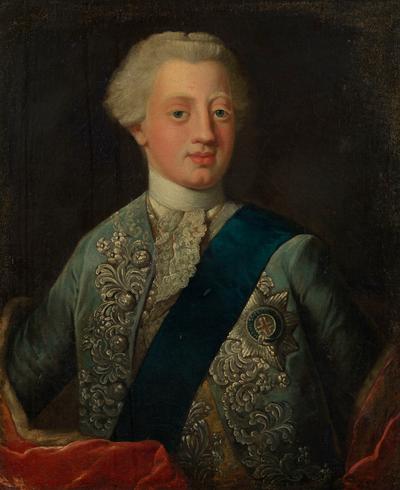
Numerous portraits of Prince Edward are held at the National Portrait Gallery in London.