Prince Henry, Duke Of Cumberland And Strathearn
| Name | Prince Henry, Duke Of Cumberland And Strathearn |
| Title | fourth son of Frederick, Prince of Wales (1745–1790) |
| Gender | Male |
| Birthday | 1745-11-07 |
| nationality | Great Britain |
| Source | https://www.wikidata.org/wiki/Q699738 |
| pptrace | View Family Tree |
| LastUpdate | 2025-11-12T01:16:06.129Z |
Family Tree
Tap  to expand more relatives
Introduction
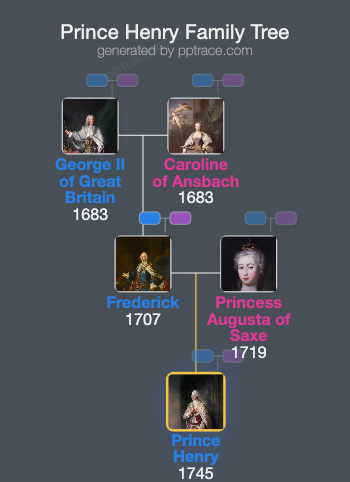
Prince Henry, Duke of Cumberland and Strathearn (Henry Frederick), was born on 7 November 1745 (Julian calendar date 27 October 1745) at Leicester House in London. He was the sixth child and fourth son of Frederick, Prince of Wales, and Princess Augusta of Saxe-Gotha. His paternal grandfather was King George II, and his mother was Princess Augusta of Saxe-Gotha.
On 22 October 1766, shortly before his twenty-first birthday, Prince Henry was granted the titles of Duke of Cumberland and Strathearn and Earl of Dublin. He held the position of Ranger of Windsor Forest and Great Park from 1766 until his death in 1790. In the same year, he was admitted to the Privy Council, and in 1767, he was appointed a Knight of the Garter.
There are historical claims that on 4 March 1767, Prince Henry may have married Olive Wilmot, a commoner, in a secret ceremony. A child reportedly named Olivia Wilmot was associated with this relationship; however, the paternity of this child was never conclusively proven, and a jury found that Olivia Wilmot had forged evidence related to this claim. Olivia Wilmot later married John Thomas Serres, a landscape painter and novelist, and assumed the title "Princess Olivia of Cumberland" at a later date.
Prince Henry maintained mistresses during his lifetime, including Ann Elliot, an actress. He provided for her in Soho, and she died in 1769 after an illness. He also faced a legal action in 1769 when Lord Grosvenor sued him for "criminal conversation" (adultery). Grosvenor was awarded damages of £10,000, with the total including costs reaching £13,000.
In 1768, at the age of 22, Prince Henry entered the Royal Navy as a midshipman aboard HMS Venus, which was sent to Corsica. The ship was recalled following the French invasion of Corsica, and Henry returned to England. He was promoted to Rear-Admiral in 1769 and Vice-Admiral in 1770.
On 2 October 1771, Prince Henry married Anne Horton, daughter of Irish peer and British Member of Parliament Simon Luttrell, 1st Earl of Carhampton, and widow of Christopher Horton. This marriage was viewed unfavorably by King George III and led to the passage of the Royal Marriages Act 1772, which stipulated that descendants of George II could not marry without the monarch's consent. The marriage was described as a "conquest at Brighthelmstone" and was notable for Anne Horton's reputation as a celebrated beauty; the artist Thomas Gainsborough painted her several times.
In 1775, Prince Henry founded the Cumberland Fleet, which later became the Royal Thames Yacht Club. He was promoted through various naval ranks: vice-admiral of the White in 1776, admiral of the Blue in 1778, and admiral of the White in 1782; however, he was prohibited from assuming active command.
He contributed to the development of Brighton as a resort town, first visiting in 1771 and later encouraging royal interest in the area. His nephew, the Prince of Wales, also visited Brighton in 1783.
Prince Henry died in London on 18 September 1790. His wife, Anne Horton, died in 1808.
His full style at his funeral was recorded as "Most High, Most Mighty and Illustrious Prince Henry Frederick, Duke of Cumberland and Strathearn, Earl of Dublin, Knight of the Most Noble Order of the Garter." His heraldic arms included the arms of the kingdom, differenced by a label argent with five points; the center bearing a cross gules and the four remaining points bearing Azure fleur-de-lys.
He was a descendant of the House of Hanover, with his ancestors including notable monarchs and noble families, detailed in genealogical records such as "Royal Genealogies, Part 10" by Henry Churchyard and "Big Combined Family Trees" by Sam Sloan.