
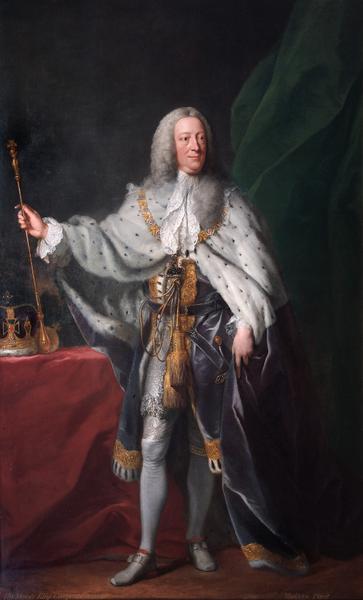
George II Of Great Britain
| Name | George II Of Great Britain |
| Title | King of Great Britain and Ireland from 1727 to 1760 |
| Gender | Male |
| Birthday | 1683-10-30 |
| nationality | Great Britain |
| Source | https://www.wikidata.org/wiki/Q131981 |
| pptrace | View Family Tree |
| LastUpdate | 2025-11-12T01:14:56.845Z |
Family Tree
Tap  to expand more relatives
Introduction
George II, born George Augustus on 30 October / 9 November 1683 in Hanover, Germany, died on 25 October 1760. He was King of Great Britain and Ireland, Duke of Brunswick-Lüneburg (Hanover), and prince-elector of the Holy Roman Empire from 11 June 1727 until his death in 1760.
Family and Early Life:
He was the son of George Louis, Hereditary Prince of Brunswick-Lüneburg—later King George I of Great Britain—and Sophia Dorothea of Celle. His parents' marriage was dissolved in 1694, and they were confined to separate residences. George spoke only French until age four, after which he learned German, English, and Italian, and studied genealogy, military history, and battle tactics. His parents both engaged in adultery, and he and his sister Sophia Dorothea were likely raised apart from their mother, who was confined at Ahlden House.
Lineage and Succession:
His grandmother was Sophia of Hanover, whose Protestant descendants were designated by the Act of Settlement 1701 as heirs to the British throne, following Queen Anne, who had no surviving issue from her seventeen pregnancies. George was naturalized as an English subject in 1705 and, following the unification of England and Scotland in 1707, he became part of the succession to the British throne.
Marriage and Children:
In 1705, George married Princess Caroline of Ansbach; they had eight children, with seven surviving to adulthood. Their children included Frederick, Prince of Wales (who predeceased George), and their grandson, George III, who succeeded George II.
Time in Britain and Relationships:
George and Caroline moved to Britain in 1714 when his father became King George I. He was given the title Prince of Wales and was involved in governing during his father's absences but faced tensions with his father and political opposition. His relationship with his son Frederick was strained, and they did not meet for many years. Caroline died in 1737, and George was later known for having had several mistresses.
Reign as King:
George II ascended the throne after George I's death in 1727. His coronation took place at Westminster Abbey. His early reign saw the dominance of Sir Robert Walpole, considered Britain’s first Prime Minister, who controlled domestic policy and largely advised George. George had limited control over domestic affairs but was more involved in foreign policy and military matters as elector of Hanover.
Military and Foreign Policy:
He participated personally in the Battle of Dettingen (1743), making him the last British monarch to lead troops into battle. During his reign, Britain fought in the War of the Austrian Succession, which included the Jacobite rising of 1745 led by Charles Edward Stuart, which was ultimately defeated at the Battle of Culloden in 1746. During the Seven Years' War (1756–1763), Britain engaged in hostilities against France and allied powers, achieving victories in North America and India, including the Battle of Plassey (1757) and the capture of Quebec (1759).
Political Life and Administration:
George's influence on domestic policy was limited, as power was exercised by ministers and Parliament. His relationship with political figures shifted over time, and he often influenced foreign appointments and military commands. His relationship with his son Frederick, Prince of Wales, deteriorated over political disputes and personal disagreements.
Death and Succession:
By 1760, George II was blind in one eye and hard of hearing. He died on 25 October 1760 at the age of nearly 77, from a thoracic aortic dissection. His remains were interred in Westminster Abbey. His grandson, George III, succeeded him as king.
Legacy:
Historically, George II was often depicted as ineffective, but later scholarship suggests he exercised greater influence, especially in foreign and military affairs. He contributed to the expansion of British influence abroad and the consolidation of constitutional governance. Notably, he donated the royal library to the British Museum in 1757 and founded the Georg August University of Göttingen in 1737. The province of Georgia was named after him.
Titles and Arms:
As prince, he held titles including Duke and Marquess of Cambridge, Earl of Milford Haven, Viscount Northallerton, and Baron Tewkesbury. Upon accession, his full style was "George the Second, by the Grace of God, King of Great Britain, France and Ireland, Defender of the Faith, Duke of Brunswick-Lüneburg, Archtreasurer and Prince-Elector of the Holy Roman Empire." His coat of arms was differenced as prince and used undifferenced as monarch.
Family (Ancestors and Issue):
He fathered eight children with Caroline, including notable figures such as Frederick, Prince of Wales, and his grandson George III. His ancestry traces back through the House of Hanover, linked to Queen Sophia of Hanover.
References and further details are available in historical texts and biographies, including works by Ashley, Best, Black, Cannon, and others.

Children
- Prince William, Duke Of Cumberland
- Anne, Princess Royal And Princess Of Orange
- Stillborn Son Hanover
- Princess Amelia Of Great Britain
- Louise Of Great Britain
- Frederick, Prince Of Wales
- Princess Mary Of Great Britain
- Princess Caroline Of Great Britain
- Johann Ludwig, Reichsgraf Von Wallmoden-Gimborn
- Prince George William Of Great Britain