Princess Augusta Of Great Britain
| Name | Princess Augusta Of Great Britain |
| Title | British princess (1737-1813) |
| Gender | Female |
| Birthday | 1737-07-31 |
| nationality | United Kingdom of Great Britain and Ireland |
| Source | https://www.wikidata.org/wiki/Q238458 |
| pptrace | View Family Tree |
| LastUpdate | 2025-11-12T01:16:04.465Z |
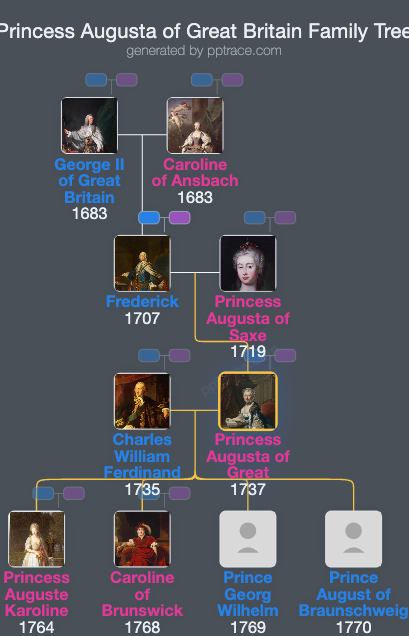
Family Tree
Tap  to expand more relatives
Introduction
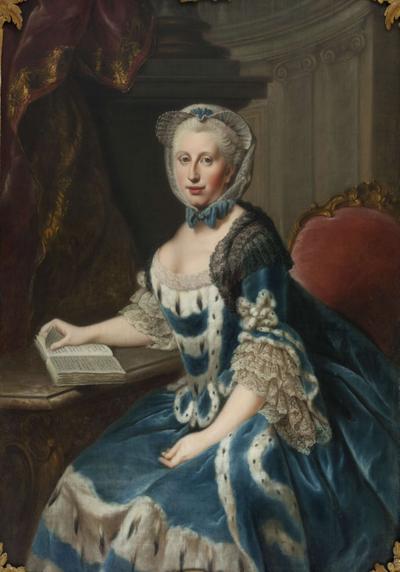
Augusta of Great Britain (Augusta Frederica), born on 31 July 1737 at St. James's Palace, was a British princess and the granddaughter of King George II. She was the only elder sibling of King George III. Her parents were Frederick, Prince of Wales, and Princess Augusta of Saxe-Gotha. Augusta died on 23 March 1813.
As the firstborn child of Frederick and Princess Augusta of Saxe-Gotha, she was initially second in line to the British throne. This ranking changed in 1738 with the birth of her brother, Prince George, later King George III. Her early life included a notable episode surrounding her birth, when her father smuggled her out of Hampton Court Palace to avoid her witnessing her birth, which was considered a traumatic event due to the disorganized circumstances of her delivery.
She was christened at St. James's Palace, with her godparents being her paternal grandfather, King George II, and her grandmothers, Queen Caroline and the Dowager Duchess of Saxe-Gotha. Her education was described as careful, though her physical appearance was noted as not particularly exceptional.
Between 1761 and 1763, negotiations took place for her marriage to Charles William Ferdinand, Duke of Brunswick-Wolfenbüttel, who was her second cousin. The negotiations faced resistance primarily from her mother, due to political concerns regarding the House of Brunswick. The marriage was ultimately arranged, and it took place on 16 January 1764 at the Chapel Royal of St James's Palace. After the wedding, they participated in various ceremonies and celebrations before departing from Harwich on 26 January.
Following her marriage, Augusta lived in Brunswick, where she held the title of Duchess of Brunswick-Lüneburg and Princess of Brunswick-Wolfenbüttel. She faced challenges adapting to life in Brunswick, maintaining a strong affection for Great Britain. She possessed maintained a distinctly English identity, even after many years abroad.
Her relationship with the court at Brunswick was characterized by her disapproval of court etiquette and her preference for her own social activities. She built Schloss Richmond as a summer retreat, reflecting her attachment to England. Her marriage to Charles was initially viewed as for dynastic purposes, but she reportedly found him physically attractive and expressed satisfaction with their relationship early on.
Augusta had four sons, of whom three were born with disabilities. Her elder sons included the Hereditary Prince and Prince Georg. She also maintained familial connections with other European royal families, including visits to Queen Caroline Matilda of Denmark, her sister.
In 1780, her husband inherited the title of Duke of Brunswick, making her Duchess consort. Throughout her later life, she experienced personal and political upheavals, including her husband's death in 1806 at the Battle of Jena during the Napoleonic Wars. She then lived in various locations, including Augustenborg and London, where she resided at Montagu House and later Brunswick House in Greenwich.
Augusta died in 1813 at the age of 75 and was buried in the Royal Vault at St George's Chapel, Windsor Castle. She was a matrilineal ancestor to several contemporary European royal families through her descendants. Her arms included the royal arms differenced by a silver label of five points, with a red cross and roses on each point.
Her ancestry traces back to the House of Hanover and other European noble lines, connecting her lineage to various royal and noble families across Europe.