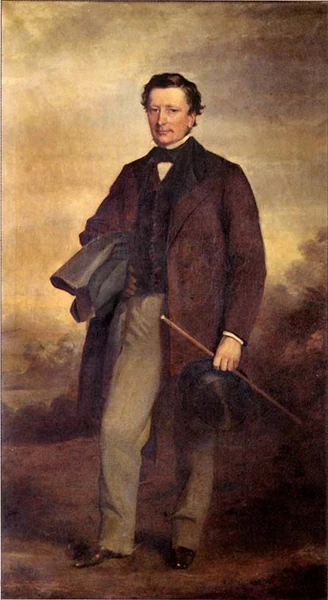
Samuel Morton Peto
| Name | Samuel Morton Peto |
| Title | British politician, building contractor, railway contractor (1809-1889) |
| Gender | Male |
| Birthday | 1809-08-04 |
| nationality | United Kingdom |
| Source | https://www.wikidata.org/wiki/Q149062 |
| pptrace | View Family Tree |
| LastUpdate | 2025-11-26T23:31:19.970Z |
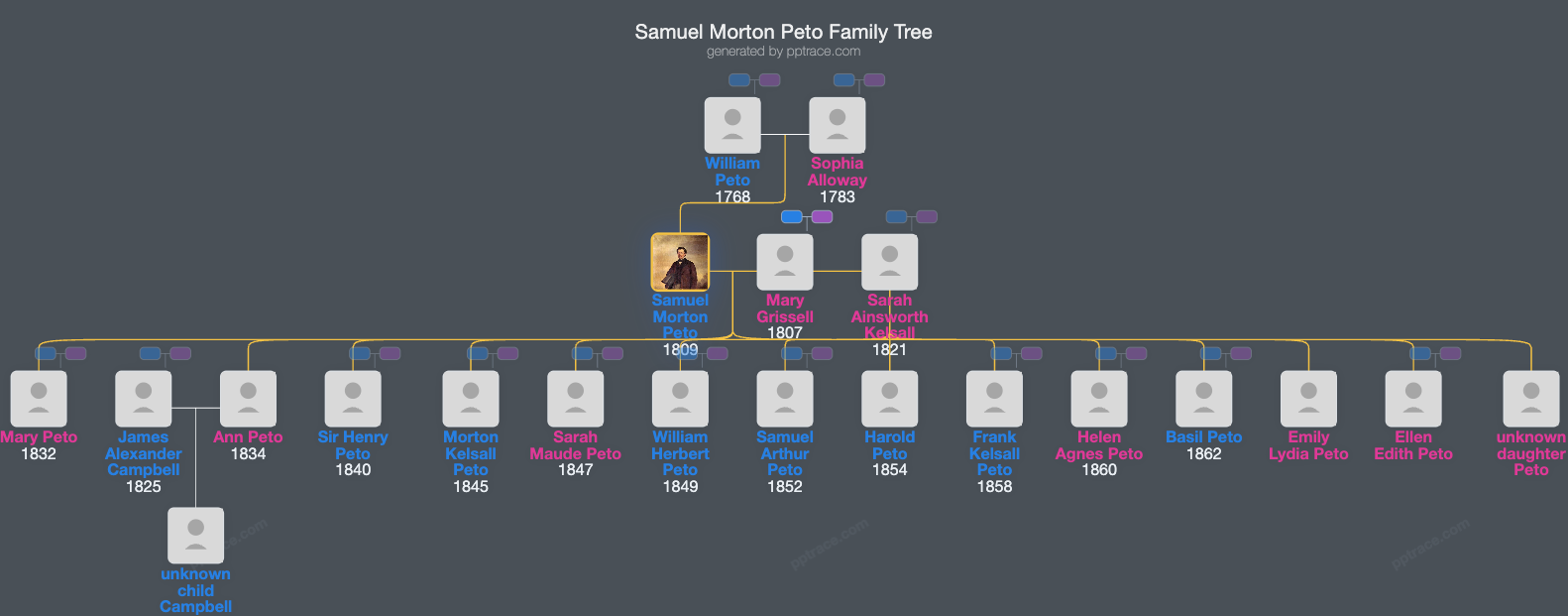
Family Tree
Tap  to expand more relatives
Introduction
Sir Samuel Morton Peto, 1st Baronet (4 August 1809 – 13 November 1889), was an English entrepreneur, civil engineer, and railway developer. He served as a Member of Parliament (MP) for over twenty years. Peto was born in Woking, Surrey, and was initially apprenticed as a bricklayer to his uncle, Henry Peto, who operated a building firm in London.
In 1830, following his uncle's death, Peto formed a partnership with his older cousin, Thomas Grissell. This partnership, known as Grissell and Peto, was active from 1830 to 1847. The firm undertook the construction of several notable buildings and infrastructure projects in London, including the Reform Club, the Oxford & Cambridge Club, the Lyceum Theatre, St James's Theatre, Hungerford Market, Nelson's Column, and the new Houses of Parliament completed in 1843. They also constructed the London brick sewer and the Bloomsbury Baptist Chapel in 1848, which was distinguished by twin spires.
In 1834, Peto and Grissell became founding members of the Chartered Institute of Building. He recognized the potential of the expanding railway industry and dissolved his partnership with Grissell to establish himself as an independent railway contractor. His initial railway projects included constructing two stations on Curzon Street, Birmingham, and building the Hanwell and Langley section of the Great Western Railway, which featured the Wharncliffe Viaduct. Due to growing risks, the partnership between Peto and Grissell was dissolved in 1846.
Subsequently, Peto partnered with Edward Betts in 1848, forming Peto and Betts. The firm also frequently collaborated with Thomas Brassey. They completed significant railway projects, including the Grand Crimean Central Railway during the Crimean War in 1854, transporting supplies to troops at Sevastopol. During this period, Peto was recognized by the British government and was created a baronet in 1855. He also contributed to railway development in Denmark, notably the Flensburg–Husum–Tönning Railway, and built the Homburg Railway between 1859 and 1860. The partnership faced insolvency in 1866 due to banking failures and involvement in railway financial failures.
Beyond engineering, Peto acquired Somerleyton Hall, Suffolk, in 1844, rebuilding it with modern amenities and developing the surrounding village. He was involved in philanthropic efforts, serving as co-treasurer and then sole treasurer of the Baptist Missionary Society between 1846 and 1867, resigning due to personal financial difficulties. In 1855, he took over the lease of The Diorama in Regent's Park, converting it into a Baptist Chapel.
As a politician, Peto was elected as a Liberal MP for Norwich (1847–1854), Finsbury (1859–1865), and Bristol (1865–1868). He participated in supporting the 1851 Great Exhibition by guaranteeing financial backing for the Crystal Palace. He was created a baronet in 1855. His businesses encountered financial troubles in the 1860s, leading to the sale of Somerleyton Hall in 1863 and his bankruptcy in 1866. Following financial insolvency related to the London, Chatham and Dover Railway and the failure of Peto and Betts, his reputation was damaged.
In the late 1860s, Peto exiled himself to Budapest and attempted to promote railway projects in Russia and Hungary. He later served as the main contractor for the Cornwall Minerals Railway, which opened in 1874. However, the associated Cornish Consolidated Iron Mines Corporation failed, resulting in significant financial losses. The railway line survived and was leased by the Great Western Railway in 1877, but Peto's financial difficulties persisted until his death.
Peto married Mary Grissell in 1831, with whom he had four children before her death in 1842. He subsequently married Sarah Ainsworth Kelsall, with whom he had multiple children. His descendants include Ralph Peto, maternal grandfather of John Edward Hollister Montagu, 11th Earl of Sandwich, and Basil Edward Peto, created a baronet in 1927.
He died in 1889 and is commemorated by various landmarks, including portraits at Norwich railway station and a bust at Regent's Park College, Oxford. Several roads in the UK, such as Peto Way in Lowestoft and Samuel Peto Way in Ashford, Kent, are named in his honor.