Harold Peto
| Name | Harold Peto |
| Title | architect and garden designer (1854-1933) |
| Gender | Male |
| Birthday | 1854-07-11 |
| nationality | France |
| Source | https://www.wikidata.org/wiki/Q3127629 |
| pptrace | View Family Tree |
| LastUpdate | 2025-11-26T12:49:36.967Z |
Family Tree
Tap  to expand more relatives
Introduction
Harold Ainsworth Peto FRIBA (11 July 1854 – 16 April 1933) was a British architect, landscape architect, and garden designer. His professional work encompassed projects in Britain and in Provence, France. Notable gardens designed by Peto include Iford Manor in Wiltshire; Buscot Park in Oxfordshire; West Dean House in Sussex; and Ilnacullin in County Cork, Ireland.
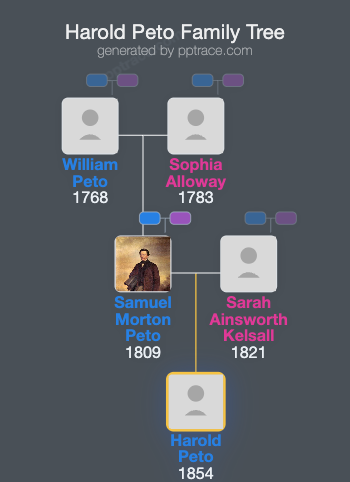
Born in London on 11 July 1854, Harold Ainsworth Peto was the son of Samuel Morton Peto, a builder, engineer, and railway contractor. His mother was Sarah Ainsworth (née Kelsall), Samuel Peto's second wife. HaroId had four step-siblings and ten full siblings. His childhood was spent at Somerleyton Hall in Lowestoft, Suffolk, a Neo-Renaissance style house rebuilt in the 1840s, featuring a large winter garden and a parterre designed by William Andrews Nesfield. In 1855, his father was made a baronet. However, during the 1860s, Samuel Peto's business ventures encountered financial difficulties, leading to the sale of Somerleyton Hall in 1863 and bankruptcy in 1866.
Harold Ainsworth Peto attended Harrow School briefly from 1869 to 1871 but left at age seventeen without pursuing higher education. Following his departure, he was apprenticed to a joiner for nearly a year and subsequently entered the practice of architect J. Clements in Lowestoft. He later joined the London architect firm Karslake and Mortimer. In 1876, Peto formed a partnership with architect Ernest George, which lasted for sixteen years. During this period, he designed houses in Kensington and Chelsea, as well as country estates.
In 1883, Peto was elected a Fellow of the Royal Institute of British Architects (RIBA). Due to ill health, he ceased working in London and undertook extensive travels across Europe, North America, and Greece, recording these journeys in diaries. In 1892, he ended his partnership with Ernest George and based himself in Kent from 1892 to 1895, then at Landford Lodge near Salisbury from 1896 to 1899. His travels continued to include Egypt, Italy, Germany, France, and Japan, notably during his 1898 round-the-world tour.
In 1899, Peto purchased Iford Manor in west Wiltshire after visiting the property with his friend Henry Avray Tipping. He established his permanent residence there, redesigning and expanding the garden in an Arts and Crafts style. The garden incorporated artifacts collected during his travels.
Most of Peto's major architectural and landscape projects occurred between 1900 and 1914. These included work at Easton Lodge in Essex; West Dean House in Sussex; Crichel House in Dorset; Petwood in Lincolnshire; High Wall in Oxford; and numerous country houses such as Hartham Park (Wiltshire), Bourton Hall (Warwickshire), Bridge House (Surrey), Heale House and Wayford Manor House (Wiltshire and Somerset respectively). In Ireland, he designed Ilnacullin in County Cork. His garden designs extended to the Mediterranean coast of France, with projects at Cannes the Isola Bella, and at Cap Ferrat the villas Sylvia, Maryland, and Rosemary.
A prominent example of his garden architecture is West Dean House in Sussex, now housing West Dean College. The gardens feature a notable 300-foot pergola designed by Peto. Additionally, Peto and Ernest George directed an extension of West Dean House for William James, which included the Oak Room, the old dining room, and a staircase, all still present within West Dean College. Peto also engaged in interior design; in 1907, he was commissioned to design the first-class accommodation aboard the transatlantic liner RMS Mauretania.
Harold Ainsworth Peto died at Iford Manor on 16 April 1933.