Kuni Asahiko
| Name | Kuni Asahiko |
| Title | Japanese prince |
| Gender | Male |
| Birthday | 1824-03-27 |
| nationality | Japan |
| Source | https://www.wikidata.org/wiki/Q5370435 |
| pptrace | View Family Tree |
| LastUpdate | 2025-11-17T10:09:14.109Z |
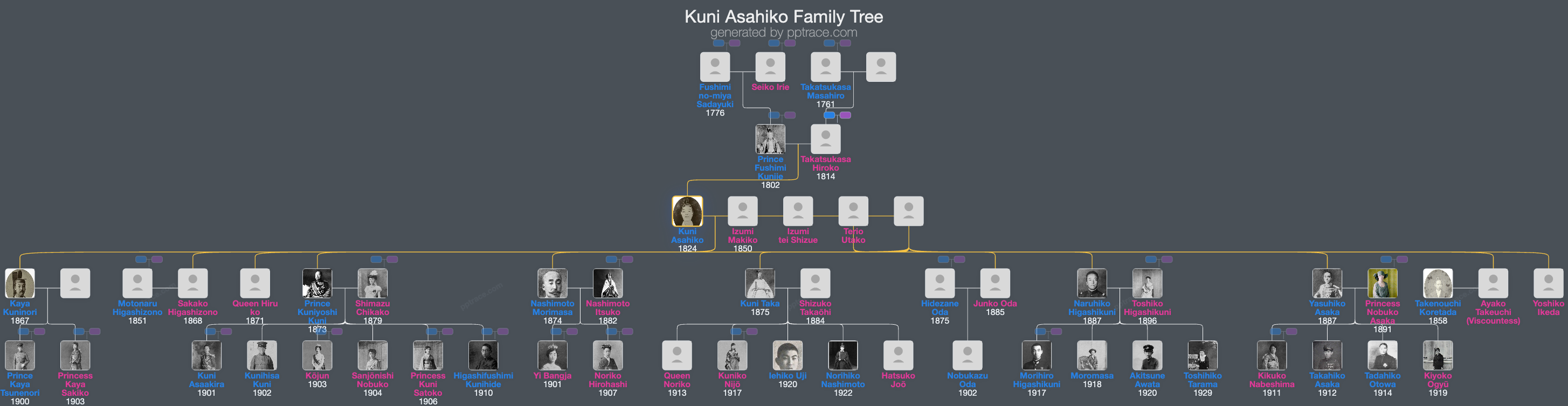
Family Tree
Tap  to expand more relatives
Introduction
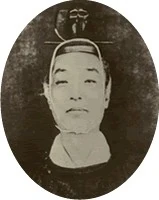
Asahiko, Prince Kuni (久邇宮 朝彦親王, Kuni-no-miya Asahiko shinnō), was born on 27 February 1824 and died on 25 October 1891. He was a member of a collateral branch of the Japanese imperial family and played a notable role during the period of the Meiji Restoration. Prince Asahiko was an adopted son of Emperor Ninkō and later served as a close advisor to Emperors Kōmei and Meiji. He is recognized as the great-great-grandfather of Japan's current Emperor, Naruhito.
Born in Kyoto, he was the fourth son of Prince Fushimi Kuniye, who was the twentieth head of the Fushimi-no-miya. The Fushimi-no-miya was the oldest of the four branches of the imperial dynasty authorized to provide a successor to the Chrysanthemum Throne if the main imperial line failed to produce an heir. Throughout his life, he was known by several titles and names, including Prince Asahiko (Asahiko Shinnō), Prince Nakagawa (Nakagawa-no-miya), Awata no miya, or Awataguchi no miya, reflecting various affiliations and locations.
During his early years, Prince Asahiko was groomed for a career as a Buddhist priest, a traditional path for non-heir sons in the Edo period's sesshu shinnōke. He was initially sent as an acolyte to Honnō-ji in 1831 and later transferred to Ichijō-in, an abbacy of Kōfuku-ji in Nara, in 1836. In 1838, he was adopted by Emperor Ninkō and succeeded an uncle as the abbot of Kōfuku-ji, officially entering the priesthood under the title Sonya Hoshinnō. In 1852, Emperor Kōmei transferred him to Shōren-in, a significant Tendai sect monzeki temple in Kyoto, where he took the title Shōren no miya Son'yu.
Asahiko was an advocate of the sonnō jōi movement, which aimed at expelling foreigners from Japan. His outspoken stance gained popularity among the Ishin Shishi, nationalist patriots supporting the imperial court. This political stance led to his detention during the Ansei Purge initiated by Ii Naosuke, the Tairō, during the final illness of Shōgun Tokugawa Iesada. He was confined at Shōkoku-ji for over two years in a small, dilapidated hut. The treatment of Prince Asahiko incited outrage among his supporters, who sought his release.
In 1862, he was permitted to return to secular status, receiving the title Nakagawa no miya. This change was part of a broader amnesty related to the marriage of Shōgun Tokugawa Iemochi to Kazu-no-miya, the half-sister of Emperor Kōmei. Following his return to Kyoto, he became a close advisor to the Emperor and acquired the title Kaya-no-miya. In September 1863, Emperor Kōmei formalized his name as "Asahiko" and bestowed upon him the status of a shinnō, or imperial prince of the shinnōke, appointing him Danjō no in, a high court position reserved for princes of the blood.
After Emperor Kōmei's death and Emperor Meiji's ascension, Prince Asahiko continued to hold this position, but political conflicts affected his status. In 1868, he was stripped of his princely titles and exiled to Hiroshima on allegations of plotting against the government. These charges were later pardoned by Emperor Meiji in February 1872, restoring his princely status and enabling him to establish a new collateral branch of the imperial family, the Kuni-no-miya.
In his final years, Prince Kuni Asahiko served as the lord custody priest (saishu) of the Ise Grand Shrine. He passed away in Tokyo in 1891. His descendants included several prominent figures: his sons Prince Kaya Kuninori, Prince Kuni Taka, and Prince Nashimoto Morimasa served successively as the shrine's custodians between 1891 and 1947; his son Prince Kuni Kuniyoshi was the father of Princess Nagako, who married Emperor Shōwa.
Prince Kuni Asahiko was married to Izumitei Shizue, and they had at least eighteen children—nine sons and nine daughters—by various court ladies. His progeny contributed to the establishment of multiple collateral branches of the imperial family, including the Kaya-no-miya, Asaka-no-miya, Higashikuni-no-miya, and Nashimoto-no-miya houses. His family lineage links directly to modern Japanese imperial succession and aristocratic structures.
**Family**:
- Wife: Izumitei Shizue
- Children include:
- Princess Chita (died young)
- Prince Muchimaro (died young)
- Prince Kaya Kuninori
- Prince Kuni Taka
- Prince Nashimoto Morimasa
- Prince Kuni Kuniyoshi
- Princess Sakako
- Princess Akiko
- Princess Hiroko
- Princess Ayako
- Princess Motoko
- Princess Natsuo (died young)
- Princess Suzuko
- Princess Atsuko
- Prince Higashikuni Naruhiko
- Prince Asaka Yasuhiko
**References and Further Reading**:
- Keene, Donald. *Emperor of Japan: Meiji and His World, 1852–1912*. Columbia University Press, 2002.
- Lebra, Takie Sugiyama. *Above the Clouds: Status Culture of the Modern Japanese Nobility*. University of California Press, 1993.
- Papinot, Edmond. *Historical and Geographical Dictionary of Japan*. F. Ungar Pub. Co., 1948.
- Genealogy of House of Fushimi (archived).