Yasuhiko Asaka
| Name | Yasuhiko Asaka |
| Title | Japanese prince (1887-1981) |
| Gender | Male |
| Birthday | 1887-10-20 |
| nationality | Japan |
| Source | https://www.wikidata.org/wiki/Q701503 |
| pptrace | View Family Tree |
| LastUpdate | 2025-11-29T01:01:31.300Z |
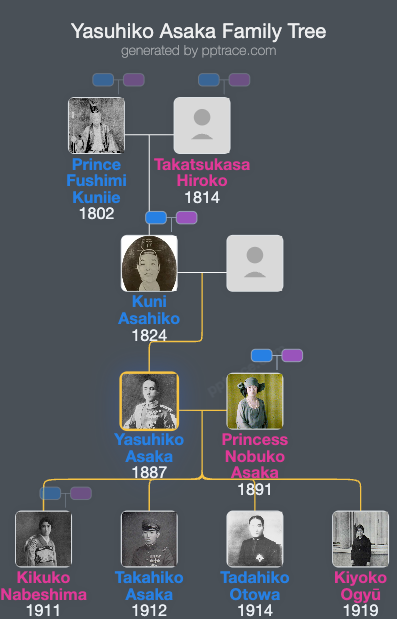
Family Tree
Tap  to expand more relatives
Introduction
Prince Yasuhiko Asaka (朝香宮鳩彦王, Asaka-no-miya Yasuhiko-ō) was born on October 20, 1887, in Kyoto, Japan, and died on April 12, 1981. He was a member of the collateral branch of the Imperial Family established by Emperor Meiji and was a son of Prince Kuni Asahiko, the youngest prince of the Fushimi-no-miya line. The Fushimi-no-miya was one of the four shinnōke, or branch houses, eligible to provide an heir to the Japanese throne. Prince Yasuhiko’s mother was Tsunoda Sugako, a court lady.
In 1872, Emperor Meiji granted his father the title Kuni-no-miya, enabling the establishment of a new collateral branch of the imperial family. Yasuhiko was therefore a half-brother to other notable imperial figures, including Prince Higashikuni Naruhiko, Prince Nashimoto Morimasa, Prince Kaya Kuninori, and Prince Kuni Kuniyoshi, who was the father of Empress Kōjun, consort of Emperor Shōwa (Hirohito).
On March 10, 1906, Emperor Meiji granted Yasuhiko the title Asaka-no-miya, creating a new princely branch within the imperial family. He married Nobuko, Princess Fumi, on May 6, 1909. Nobuko was the eighth daughter of Emperor Meiji. The couple had four children: Princess Kikuko, Prince Takahiko, Prince Tadahiko, and Princess Kiyoko. Princess Kikuko married Marquis Nabeshima Naoyasu; Prince Takahiko married Todo Chikako and had children, including Fukuko, Minoko, and Tomohiko; Prince Tadahiko renounced imperial status in 1936 to become Marquis Otowa and was killed in 1944 during the Battle of Kwajalein; Princess Kiyoko married Count Ogyu Yoshiatsu.
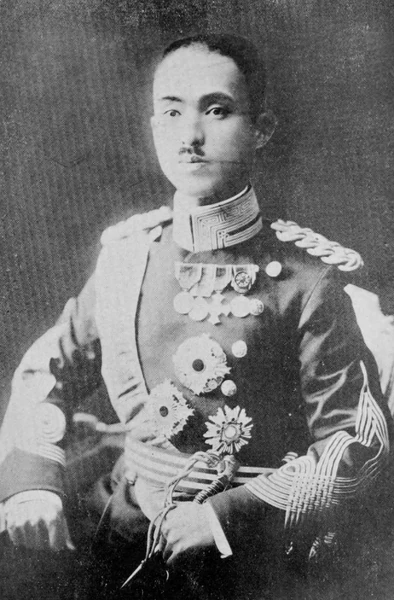
Prince Yasuhiko pursued a military career in accordance with customs for members of the imperial family at the time. He received early education at the Gakushūin Peers' School and the Central Military Preparatory School before graduating from the Imperial Japanese Army Academy in 1908. His military progression included promotions to lieutenant in 1910, captain in 1913, major in 1918, and lieutenant-colonel in 1922.
Between 1920 and 1923, he studied military tactics at France's École spéciale militaire de Saint-Cyr alongside his half-brother Prince Naruhiko Higashikuni and cousin Prince Naruhisa Kitashirakawa, who died in a car accident in Normandy in 1923. The accident resulted in Yasuhiko sustaining a lifelong limp.
During the 1920s, Yasuhiko and his wife visited France and the United States, developing an interest in Art Deco design. They constructed a mansion in Tokyo's Shirokanedai neighborhood, completed in 1933, now serving as the Tokyo Metropolitan Teien Art Museum. His marriage ended with the death of Princess Fumi in 1933.
Yasuhiko’s military ranks advanced steadily. He was promoted to colonel in 1925, major general in 1929, and lieutenant general in 1933, when he took command of the Imperial Guards Division. He joined the Supreme War Council in 1935, gaining influence with Emperor Hirohito. However, his political stance during the February 26 Incident in 1936—favoring the appointment of a government acceptable to rebel factions—caused a rift with the Emperor, leading to his transfer in 1937 to command forces in China.
In November 1937, Yasuhiko was appointed temporary commander of Japanese forces outside Nanjing during the subsequent assault on the city. He issued orders during the final days of the battle that sanctioned the mass killing and atrocities against Chinese captives, events that have become known as the Nanjing Massacre. After his recall to Japan in February 1938, he remained part of the Supreme War Council until August 1945. He was promoted to general in 1939. In 1944, Yasuhiko collaborated with other pro-war figures to influence Japan's wartime government.
Following Japan’s defeat in World War II, General Douglas MacArthur granted immunity to members of the Imperial Family, including Yasuhiko. Consequently, he was not prosecuted for his role in the Nanjing Massacre. On October 14, 1947, he and his children lost their imperial status and privileges as collateral branches were abolished under Allied occupation policies. His mansion was seized by the government and now functions as a museum.
Yasuhiko converted to Catholicism in December 1951, becoming the first member of the Imperial Family to do so. He spent his later years engaging in leisure activities such as golf and contributed to golf course development, including designing the Plateau Golf Course at the Dai-Hakone Country Club. He died of natural causes at age 93 at his residence in Atami, Shizuoka Prefecture.
He was awarded numerous honors, including the Grand Cordon of the Order of the Chrysanthemum (1917) and the Order of the Golden Kite, 1st Class (1942). He also received the Grand Cordon of the Order of Leopold from Belgium in 1925.