Prince Kuniyoshi Kuni
| Name | Prince Kuniyoshi Kuni |
| Title | Japanese prince |
| Gender | Male |
| Birthday | 1873-06-23 |
| nationality | Q188712 |
| Source | https://www.wikidata.org/wiki/Q1038766 |
| pptrace | View Family Tree |
| LastUpdate | 2025-11-29T01:01:32.169Z |
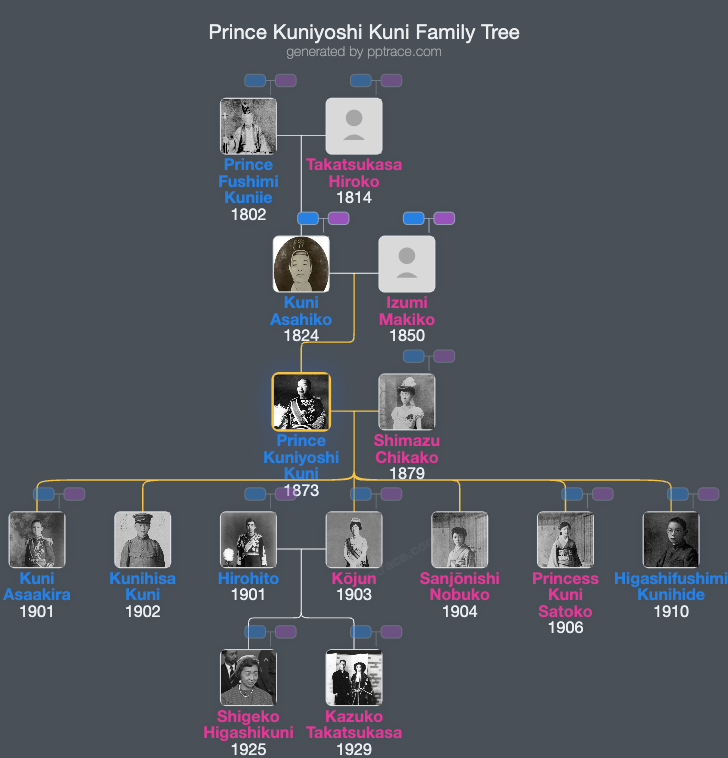
Family Tree
Tap  to expand more relatives
Introduction
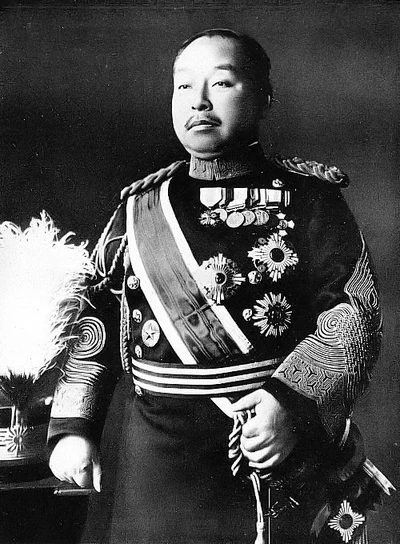
Kuniyoshi, Prince Kuni (久邇宮邦彦王, Kuni-no-miya Kuniyoshi ō), was born on June 23, 1873, in Kyoto and died on January 27, 1929. He was a member of the Japanese imperial family and served as a field marshal in the Imperial Japanese Army during the Meiji and Taishō periods.
Family Background and Early Life:
He was the third son of Prince Kuni Asahiko (also known as Shōren-no-miya Sun'yu or Nagakawa-no-miya Asahiko) and his court lady Isume Makiko. His paternal grandfather was Prince Fushimi Kuniye, head of the Fushimi-no-miya branch, one of the ōke houses that could provide heirs to the Japanese throne. In 1872, Emperor Meiji conferred the title "Kuni-no-miya" upon his father, establishing a new branch of the imperial family. Kuniyoshi succeeded to this title after his father's death on October 29, 1891. His half-brothers, including Prince Asaka Yasuhiko, Prince Higashikuni Naruhiko, Prince Nashimoto Morimasa, and Prince Kaya Kuninori, also founded separate branches of the imperial family during the Meiji era.
Military Career:
Kuniyoshi graduated from the 7th class of the Imperial Japanese Army Academy in 1897, receiving the rank of second lieutenant. He was promoted to lieutenant in February 1899 and to captain in March 1901. During the Russo-Japanese War (1904–1905), he was assigned to the staff of General Kuroki Tamemoto, commander of the IJA 1st Army, and was awarded the Order of the Golden Kite (4th class) for his service. He furthered his military education at the Army War College and was attached to the Second Regiment of the Prussian Foot Guards in Germany from 1907 to 1910. His promotions continued with lieutenant colonel in April 1908 and colonel in December 1910.
Following his return to Japan, Kuniyoshi was promoted to major general in August 1913 and commanded the 38th Infantry Regiment. He later commanded the Imperial Guard of Japan. He was promoted to lieutenant general in August 1917 and took command of the IJA 15th Division. Additionally, he held the position of chief priest at Meiji Shrine. In August 1923, he became a full general and joined the Imperial Japanese Army General Staff. An advocate of military aviation, he mentored Yamamoto Isoroku, who later became a prominent admiral and the commander-in-chief of the Imperial Japanese Navy.
He was promoted posthumously to the rank of field marshal on the day of his death, January 27, 1929, by Emperor Hirohito, and was awarded the Grand Cordon of the Supreme Order of the Chrysanthemum. His death occurred shortly after arriving at his villa in Atami due to an unspecified illness. He was also the target of a failed assassination attempt by Cho Myeongha in Taichung.
Honors:
Kuniyoshi received numerous orders and decorations throughout his career, details of which are documented in various sources.
Marriage and Family:
On December 13, 1889, he married Shimazu Chikako (October 19, 1879 – September 9, 1956), the seventh daughter of Prince Shimazu Tadayoshi, the last daimyō of Satsuma Domain. This marriage forged an alliance between the imperial family and the Satsuma clan.
His children included:
- Prince Kuni Asaakira (February 2, 1901 – December 3, 1959)
- Marquis Kuni Kunihisa (March 20, 1902 – March 5, 1935)
- Princess Kuni Nagako (March 6, 1903 – June 16, 2000), who married Crown Prince Hirohito (later Emperor Shōwa) in 1924.
- Princess Kuni Nobuko (March 30, 1904 – November 8, 1945)
- Princess Kuni Satoko (September 1, 1906 – November 15, 1989)
- Count Higashifushimi Kunihide (May 10, 1910 – January 1, 2014)
References:
Sources include the Harper Encyclopedia of Military Biography by Trevor N. Dupuy (1992) and Splendid Monarchy: Power and Pageantry in Modern Japan by T. Fujitani and Alvin D. Cox (1998).