Naruhiko Higashikuni
| Name | Naruhiko Higashikuni |
| Title | Japanese prince (1887-1990) |
| Gender | Male |
| Birthday | 1887-12-03 |
| nationality | Japan |
| Source | https://www.wikidata.org/wiki/Q315717 |
| pptrace | View Family Tree |
| LastUpdate | 2025-11-29T01:01:26.927Z |
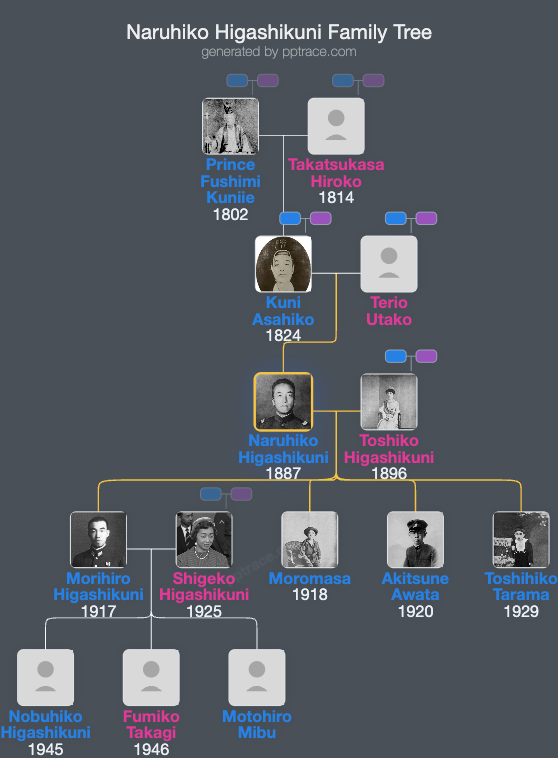
Family Tree
Tap  to expand more relatives
Introduction
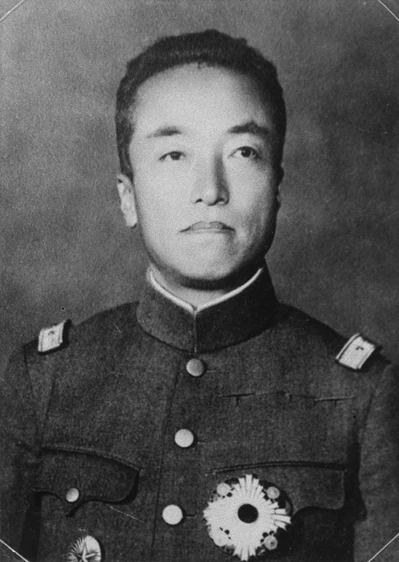
Naruhiko, Prince Higashikuni (東久邇宮稔彦王, Higashikuni-no-miya Naruhiko Ō), was born on December 3, 1887, in Kyoto, Japan, and died on January 20, 1990. He was a member of the Japanese imperial family and served as a general in the Imperial Japanese Army. He held the position of Prime Minister of Japan from August 17, 1945, to October 9, 1945, a tenure lasting 54 days, which is the shortest in Japanese history. He was the only member of the imperial family to head a cabinet.
He was the ninth son of Prince Kuni Asahiko and the court lady Terao Utako. His paternal lineage connected him to the Fushimi-no-miya, the oldest branch of the imperial dynasty. His half-brother was Prince Kuni Kuniyoshi, the father of Empress Kōjun, wife of Emperor Shōwa. His other half-brothers included Prince Asaka Yasuhiko, Prince Nashimoto Morimasa, and Prince Kaya Kuninori.
On November 3, 1906, Emperor Meiji granted him the title Higashikuni-no-miya, establishing a new branch of the imperial family. He married Toshiko, Princess Yasu, the ninth daughter of Emperor Meiji, on May 18, 1915. The couple had four sons: Prince Higashikuni Morihiro (born 1916), who married Shigeko, Princess Teru; Prince Moromasa (born 1918), who died in 1923; Prince Akitsune (born 1920), who later renounced his imperial title and became Marquis Awata Akitsune; and Prince Toshihiko (born 1929), who also renounced his status and became Count Tarama Toshihiko.
His military career began with his graduation from the Imperial Japanese Army Academy in 1908, followed by graduation from the Army War College in 1914. He studied military tactics in France from 1920 to 1926 at the École Spéciale Militaire de Saint-Cyr and École Polytechnique. He was promoted through various ranks, becoming a second lieutenant in 1908, captain in 1913, major in 1915, lieutenant-colonel in 1920, colonel in 1926, major-general in 1930, and a full general in August 1939.
During his service, he held several key military positions, including commander of the 5th Infantry Brigade (1930–1934), commander of the IJA 4th Division (1934–1937), head of the Imperial Japanese Army Air Service (1937–1938), and commander of the IJA 2nd Army stationed in China (1938–1939). He was promoted to full general in 1939 and was awarded the Order of the Golden Kite, 1st Class, in 1940. He was involved in controversial activities, including authorizing the use of poison gas against Chinese forces in 1938 and overseeing human experimentation related to chemical agents.
In the political sphere, in October 1941, Prime Minister Fumimaro Konoe proposed Prince Higashikuni as his successor for prime minister. However, the Emperor and other officials declined, believing it inappropriate for a member of the imperial family to serve in such a political role during wartime. Subsequently, Hideki Tōjō was appointed as Prime Minister. During the early Pacific War, Prince Higashikuni commanded the General Defense Command from 1941 to 1944 and opposed Japan's involvement in the war. He was involved in conspiracies to depose Emperor Shōwa and proposed placing Crown Prince Akihito on the throne as regent near the end of the war.
Following Japan's surrender in 1945, Emperor Shōwa appointed him as Prime Minister to oversee the surrender process and demobilization. His cabinet aimed to stabilize Japan and reassure the population about the imperial institution. He resigned in October 1945 due to disagreements with the Allied occupation over the repeal of the Peace Preservation Law.
In 1946, he publicly expressed support for Emperor Shōwa’s abdication plan and inquired about becoming a commoner, a request denied by the emperor. In 1947, following the dissolution of the princely houses under the American occupation, he lost his imperial title and most of his wealth. He later founded a Buddhist sect and lived until the age of 102, passing away in 1990.