
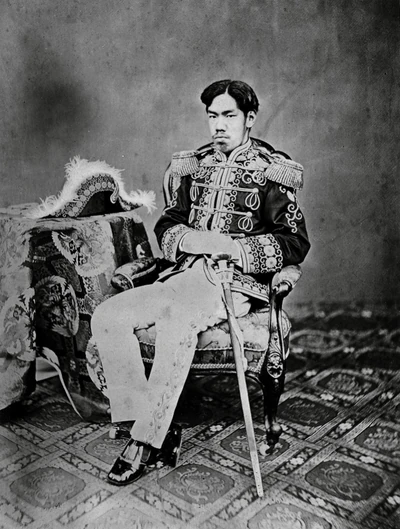
Emperor Meiji
| Name | Emperor Meiji |
| Title | Emperor of Japan from 1867 until 1912 |
| Gender | Male |
| Birthday | 1852-11-03 |
| nationality | Japan |
| Source | https://www.wikidata.org/wiki/Q174231 |
| pptrace | View Family Tree |
| LastUpdate | 2025-11-17T06:48:31.609Z |
Family Tree
Tap  to expand more relatives
Introduction
Mutsuhito (3 November 1852 – 29 July 1912), who was posthumously known as Emperor Meiji, was the 122nd emperor of Japan according to the traditional order of succession. His reign lasted from 1867 until his death in 1912 and is marked by the transformative period known as the Meiji Restoration.
Born in Kyoto, Mutsuhito was the son of Emperor Kōmei and Nakayama Yoshiko, a concubine of the emperor. His birth took place on 3 November 1852 in a location outside the Imperial Palace due to cultural customs associated with childbirth at the time. He received the title Sachi-no-miya, meaning Prince Sachi, and was later adopted by his father. On 16 August 1860, he was proclaimed prince of the blood and heir to the throne. Subsequently, on 11 November of the same year, he was given the adult name Mutsuhito and formally appointed as crown prince.
Prior to his accession, Japan was under the rule of the Tokugawa shogunate, which had established a feudal system characterized by autonomous domains governed by daimyōs and a shōgun who held actual political power. The emperor's role was largely ceremonial, with limited influence over governance, and emperors traditionally engaged in scholarly and artistic pursuits. The shogunate controlled foreign trade and policy, with Japan maintaining a policy of national seclusion (sakoku), restricting interaction with Western powers and barring Christian missionaries, except for Dutch trade at Dejima.
The arrival of Commodore Matthew Perry’s fleet in 1853 marked a turning point, leading to the opening of Japan to Western influence and the signing of unequal treaties. Political unrest grew during the 1860s, with groups such as the shishi advocating for modernization and opposing the shogunate's handling of foreign relations. These tensions culminated in the overthrow of the Tokugawa regime and the restoration of imperial rule.
Emperor Kōmei died on 30 January 1867. In a brief ceremony, the throne was succeeded by the teenage crown prince, who formally ascended as Emperor Meiji on 13 February 1867. During his early reign, Japan faced significant internal and external challenges, including domestic unrest, foreign military threats, and pressure to modernize. The emperor’s education during this period focused on classical studies, including waka poetry, under the guidance of his court teachers.
The Meiji era commenced officially with the emperor’s accession, characterized by political reforms such as the establishment of a Cabinet in 1885, the creation of the Privy Council in 1888, and the Imperial Diet in 1890. These institutions laid the foundation for modern parliamentary governance. Mutsuhito's reign was also marked by military victories over China during the First Sino-Japanese War (1894–1895) and over Russia during the Russo-Japanese War (1904–1905). Japan expanded its territory through the annexation of Taiwan in 1895 and Korea in 1910.
Mutsuhito died on 29 July 1912 at the age of 59. He was succeeded by his eldest son, Yoshihito.
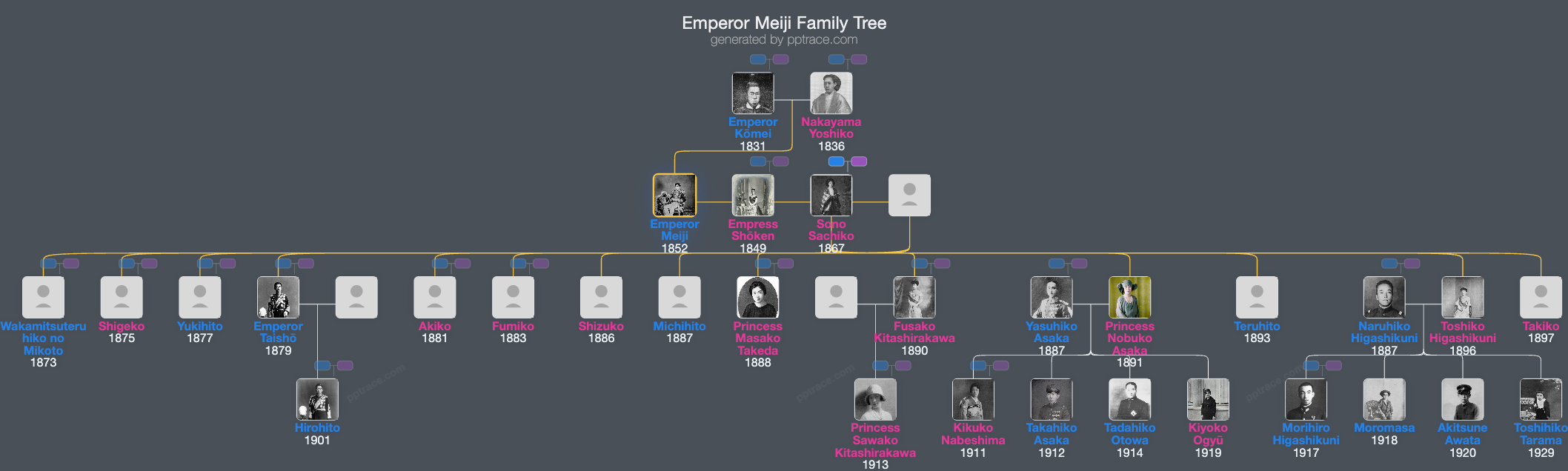
Parents
Children
- Wakamitsuteru-hiko No Mikoto
- Michihito, Prince Aki
- Toshiko Higashikuni
- Princess Nobuko Asaka
- Shizuko, Princess Hisa
- Princess Masako Takeda
- Fusako Kitashirakawa
- Emperor Taishō
- Shigeko, Princess Ume
- Yukihito, Prince Take
- Teruhito, Prince Mitsu
- Takiko, Princess Sada
- Akiko, Princess Shige
- Fumiko, Princess Masu