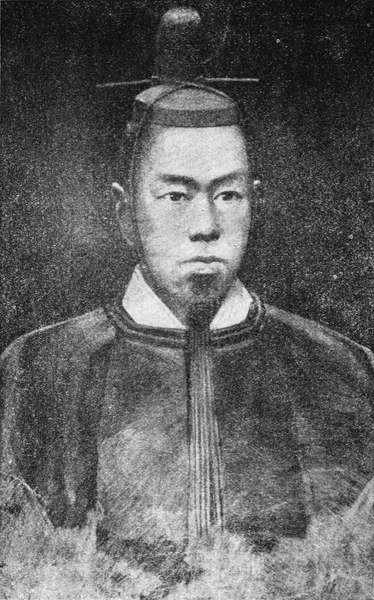
Emperor Kōmei
| Name | Emperor Kōmei |
| Title | Emperor of Japan from 1846 to 1867 |
| Gender | Male |
| Birthday | 1831-07-22 |
| nationality | Japan |
| Source | https://www.wikidata.org/wiki/Q299179 |
| pptrace | View Family Tree |
| LastUpdate | 2025-11-29T01:01:53.121Z |
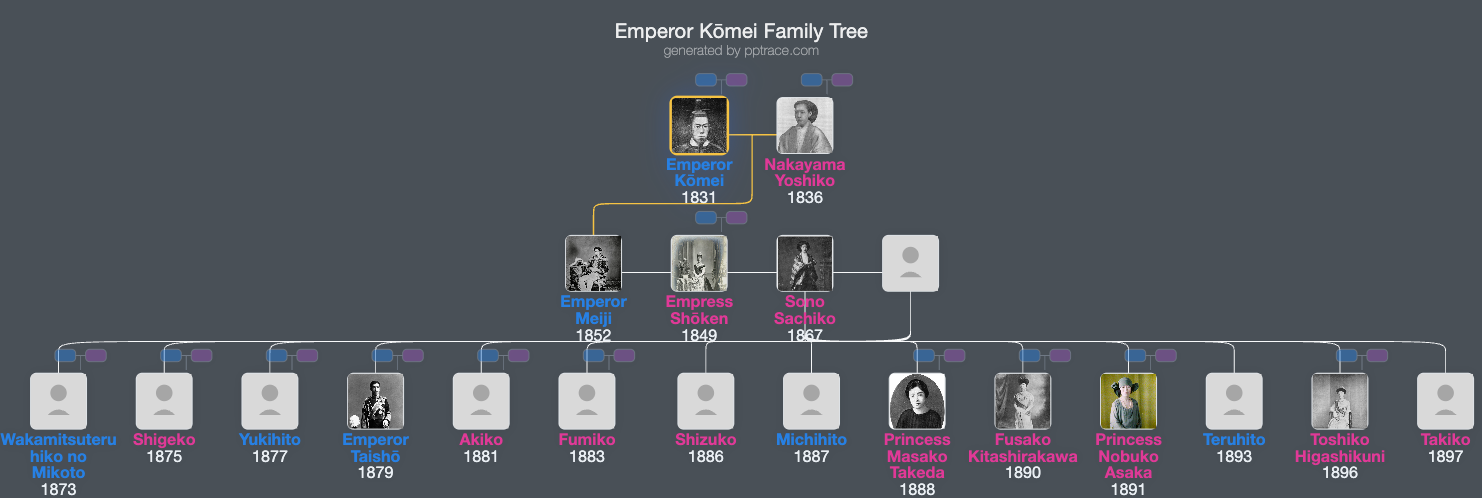
Family Tree
Tap  to expand more relatives
Introduction
Osahito (統仁), born on 22 July 1831, was the fourth son of Emperor Ninkō and his consort Ōgimachi Naoko. Prior to his accession to the throne, his personal name was Osahito and his title was Hiro-no-miya (煕宮). He resided with his family in the Dairi of the Heian Palace.
He was enthroned as Emperor Kōmei on 10 March 1846 following the death of his father, Emperor Ninkō. His reign lasted until his death on 30 January 1867, encompassing a period marked by significant internal and external upheavals during the late Edo period. During his reign, the Tokugawa shogunate was led by successive shoguns: Tokugawa Ieyoshi, Tokugawa Iesada, Tokugawa Iemochi, and Tokugawa Yoshinobu.
A notable event during his reign was the arrival of US Commodore Matthew Perry's "Black Ships" in 1853 and 1854, which pressured Japan to open its ports to Western trade after a lengthy period of national seclusion. The Tokugawa shogunate, which held de facto power, became increasingly unable to resist Western demands. Although the Emperor's role was largely symbolic at this time, he began to assert more influence indirectly in response to these external pressures.
In October 1858, Hayashi Akira, a Neo-Confucian scholar and bureaucrat, was dispatched from Edo to Kyoto to seek the Emperor’s advice on foreign relations, marking one of the first times the Emperor's counsel was formally sought since the establishment of the Tokugawa regime. This consultation was related to the signing of the Treaty of Amity and Commerce (the Harris Treaty), which Kōmei ultimately approved in February 1859 after initial skepticism.
He also opposed the marriage of his sister, Princess Kazu-no-Miya Chikako, to Tokugawa Iemochi, a shogunate noble, viewing it as a political marriage that might influence court-shogunate relations. Despite his opposition to foreign influence, the signing of unequal treaties allowed foreign citizens residence and trade rights in key Japanese ports, often accompanied by extraterritorial rights for foreign residents.
Kōmei was highly critical of Western interference and treaties, expressing opposition through his "Order to expel barbarians" in 1863. Though the Shogunate did not enforce this order, it incited violence, including attacks on foreigners and incidents such as the killing of British trader Charles Lennox Richardson, for which Japan paid indemnities. These crises highlighted Japan’s military limitations in resisting Western powers.
In January 1867, Emperor Kōmei was diagnosed with smallpox; he died on 30 January 1867 after suffering a violent bout of illness, with symptoms including purple spots on his face. Rumors circulated suggesting assassination or foul play, but it is widely accepted that his death was the result of a pandemic. His passing occurred during a period of political instability as Japan faced external threats and internal conflicts.
Following his death, his kami was enshrined at the Imperial mausoleum Nochi no Tsukinowa no Higashi no misasagi, located at Sennyū-ji in Higashiyama-ku, Kyoto. The mausoleum also contains the remains of his immediate predecessors and Empress Dowager Eishō. Kōmei was the last emperor to be given a posthumous name after his death; subsequent emperors were named in advance reflecting their reign titles.
His successor was his son, Imperial Prince Mutsuhito, who was crowned as Emperor Meiji on 12 September 1868.