Emperor Taishō
| Name | Emperor Taishō |
| Title | Emperor of Japan from 1912 until 1926 |
| Gender | Male |
| Birthday | 1879-08-31 |
| nationality | Japan |
| Source | https://www.wikidata.org/wiki/Q157052 |
| pptrace | View Family Tree |
| LastUpdate | 2025-11-17T06:47:16.774Z |
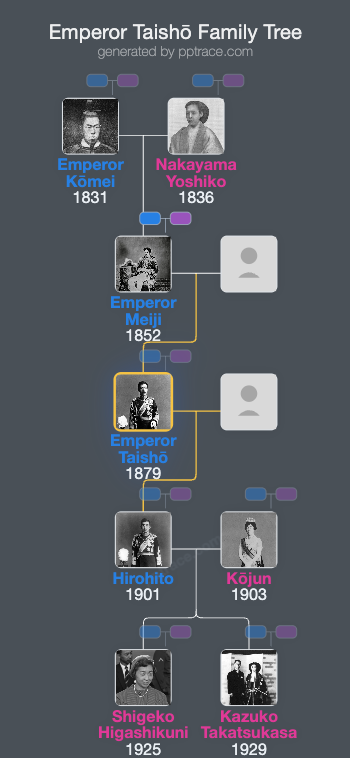
Family Tree
Tap  to expand more relatives
Introduction
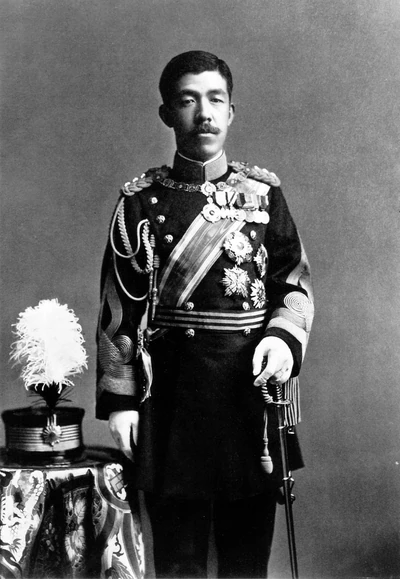
Yoshihito (嘉仁; August 31, 1879 – December 25, 1926) was the 123rd emperor of Japan according to the traditional order of succession. He reigned from 1912 until his death in 1926, and posthumously received the name Emperor Taishō (大正天皇, Taishō Tennō). His reign period is known as the Taishō era.
Born at Tōgū Palace in Akasaka, Tokyo, Yoshihito was the only surviving son of Emperor Meiji and Yanagiwara Naruko, a concubine with the official title gon-no-tenji (imperial concubine). Empress Shōken, the wife of Emperor Meiji, was regarded as Yoshihito’s mother in official circles. His birth name was Yoshihito Shinnō, and he was also given the title Haru-no-miya by Emperor Meiji on September 6, 1879. His two older siblings died in infancy, and Yoshihito himself was afflicted with health issues early in life, including cerebral meningitis within three weeks of birth.
From infancy, Yoshihito was entrusted to his great-grandfather, Marquess Nakayama Tadayasu, who had also raised Emperor Meiji. He lived in Nakayama’s residence until age seven. Starting in March 1885, he was educated at the Aoyama Detached Palace, where his instruction included reading, writing, arithmetic, morals, and physical activities. Progress was slow due to his health problems, and he was later taught alongside a small group of peers from the higher peerage at the Gogakumonsho school within the Aoyama Palace.
Yoshihito was officially declared heir apparent on August 31, 1887, and received his formal investiture as crown prince on November 3, 1888. During his youth, he was often called Tōgu, a metonym for the heir to the throne derived from China's Han dynasty tradition.
Educationally, Prince Yoshihito faced challenges due to health problems that led to his withdrawal from Gakushuin middle school in 1894. Nonetheless, he demonstrated an aptitude for languages, receiving private tutoring in French, Chinese, and history at the Akasaka Palace. Influenced by Itō Hirobumi, he began attending sessions of the House of Peers of the Diet of Japan in 1898 to observe and learn about the country’s political and military affairs. That same year, he undertook official visits to foreign diplomats, engaging in diplomatic exchanges.
In 1900, Yoshihito married Sadako Kujō, the daughter of Prince Kujō Michitaka of the Fujiwara clan. She was 15 years old at the time. The couple resided at the Akasaka Palace, built between 1899 and 1909 in a European rococo style, serving as the Crown Prince’s official residence. They had four sons, named Hirohito, Yasuhito, Nobuhito, and Takahito.
Yoshihito’s military rank was raised to colonel in the Imperial Japanese Army and captain in the Imperial Japanese Navy in 1903, although his duties were primarily ceremonial. In October 1907, he participated in a tour of Korea, accompanied by notable military figures, which marked the first visit of an heir apparent to leave Japan. During this period, he also studied the Korean language.
Ascending to the throne on July 29, 1912, following the death of Emperor Meiji, Yoshihito’s health issues significantly limited his public appearances and political involvement. His physical and neurological conditions caused him to play a minimal role in governance; from 1919 onward, he undertook no official duties. His son, Crown Prince Hirohito, was appointed regent in 1921.
Yoshihito’s reign encompassed several major events, including Japan’s participation in World War I, the Spanish flu pandemic, and the 1923 Great Kantō earthquake. Despite widespread reports of health decline, he remained largely secluded, with decisions about state affairs increasingly managed by his advisers. In December 1926, Yoshihito died of a heart attack at the Hayama Imperial Villa at the age of 47. He was succeeded by his eldest son, Hirohito (Emperor Shōwa). His funeral procession featured a four-mile-long route attended by 20,000 mourners, with the coffin transported to his mausoleum in the suburbs of Tokyo.