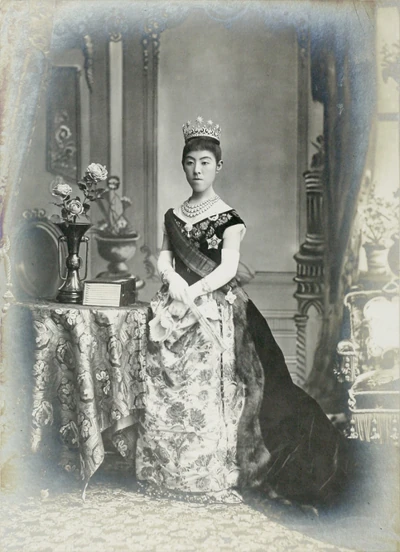
Empress Shōken
| Name | Empress Shōken |
| Title | Japanese empress (1849-1914) |
| Gender | Female |
| Birthday | 1849-05-09 |
| nationality | Japan |
| Source | https://www.wikidata.org/wiki/Q269520 |
| pptrace | View Family Tree |
| LastUpdate | 2025-11-29T01:01:53.960Z |
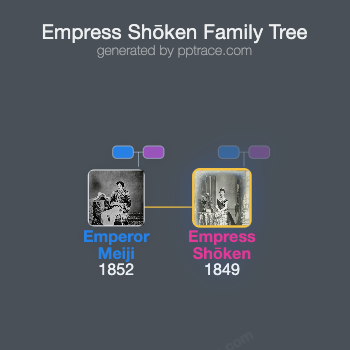
Family Tree
Tap  to expand more relatives
Introduction
Masako Ichijō (一条勝子, Ichijō Masako) was born on 9 May 1849 in Heian-kyō, Japan, and died on 9 April 1914. She was the third daughter of Tadayoshi Ichijō, a former Minister of the Left and the head of the Fujiwara clan's Ichijō branch. Her adoptive mother was one of the daughters of Prince Fushimi Kuniie, while her biological mother was Tamiko Niihata, the daughter of a doctor from the Ichijō family.
In her childhood, Masako demonstrated notable intellectual abilities; she was able to read poetry from the Kokin Wakashū by age four and had composed waka verses by age five. By the age of seven, she could read some texts in classical Chinese with assistance and studied Japanese calligraphy. She also studied the koto and was interested in Noh drama. Her education included finance, ikebana, and the Japanese tea ceremony.
Her official birth date was later changed from 1849 to 1850 to address concerns regarding her suitability as a future empress consort due to her age relative to Emperor Meiji. She became engaged to Emperor Meiji on 2 September 1867. Upon this engagement, she adopted the given name Haruko (美子), reflecting her serene beauty and small stature. The Tokugawa Bakufu promised a wedding dowry of 15,000 ryō in gold and an annual income of 500 koku, but these promises were not fulfilled due to the political upheavals of the Meiji Restoration.
Her marriage to Emperor Meiji was officially celebrated on 11 January 1869. She was the first imperial consort in several centuries to receive the titles of both nyōgō and kōgō, indicating her status as empress consort. She was unable to bear children, although Emperor Meiji had 12 children by his concubines. Nevertheless, she adopted Yoshihito, her husband's eldest son by Yanagihara Naruko, who became Crown Prince.
In 1869, the imperial capital was transferred from Kyoto to Tokyo. Emperor Meiji emphasized the importance of education and invited her and senior ladies-in-waiting to attend lectures about national and international affairs. She participated in various diplomatic activities, including hosting foreign visitors such as the wife of U.S. President Ulysses S. Grant during his visit in 1879 and meeting Hawaiian King Kalākaua in 1881. She also hosted the princes Albert Victor and George, future British monarchs, who presented her with pet wallabies from Australia.
Empress Haruko was prominent in adopting Western fashion, attending the Peeresses School's graduation in Western clothing in 1886 and hosting a Western music concert. By January 1887, she issued a memorandum supporting the wearing of Western attire over traditional kimonos, citing its suitability for modern life and historical attire.
Her diplomatic engagements included visiting navies and military exercises, such as observing torpedo tests in Yokosuka in 1886, and participating in official visits to various regions. During the First Sino-Japanese War (1894–95), she was active in charitable work, notably in establishing the Japanese Red Cross Society and creating a fund, later called "The Empress Shōken Fund," to support international welfare activities.
In 1895, she accompanied Emperor Meiji during his relocation to Hiroshima to oversee military operations and visited hospitals supporting wounded soldiers. She also visited Shinto shrines during this period.
Following the death of Emperor Meiji in 1912, she was granted the title Empress Dowager (皇太后, Kōtaigō) by her adoptive son, Emperor Taishō. She died in 1914 at the Imperial Villa in Numazu, Shizuoka. She was buried in the East Mound of the Fushimi Momoyama Ryo in Fushimi, Kyoto, alongside her husband. The Meiji Shrine in Tokyo was later dedicated to her and Emperor Meiji.
Her honors included the Grand Cordon of the Order of the Precious Crown (1888) and various foreign decorations, such as the Grand Cross of the Order of St. Catherine from Russia and the Dame of the Order of Queen Maria Luisa from Spain.