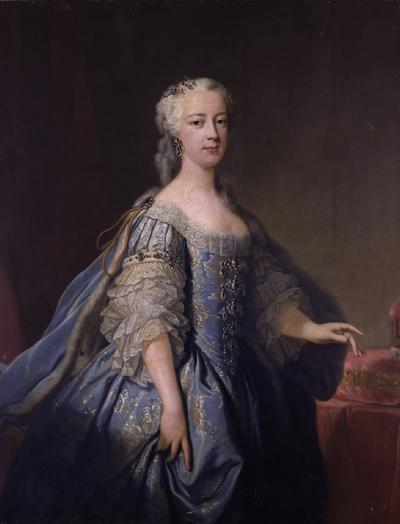
Princess Amelia Of Great Britain
| Name | Princess Amelia Of Great Britain |
| Title | Princess of Great Britain (1711-1786) |
| Gender | Female |
| Birthday | 1711-06-10 |
| nationality | Holy Roman Empire |
| Source | https://www.wikidata.org/wiki/Q62393 |
| pptrace | View Family Tree |
| LastUpdate | 2025-11-12T01:15:20.364Z |
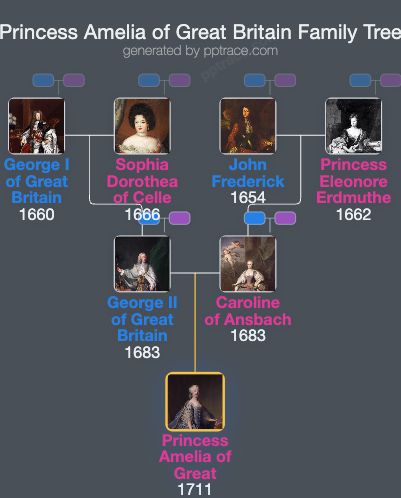
Family Tree
Tap  to expand more relatives
Introduction
Princess Amelia of Great Britain (Amelia Sophia Eleonore) was born on 10 June 1711 (Old Style) in Herrenhausen Palace, Hanover, Germany. She was the second daughter of King George II of Great Britain and Queen Caroline. At the time of her birth, her father was the Hereditary Prince of Brunswick-Lüneburg, son and heir of the Elector of Hanover, and her mother was Caroline of Ansbach, daughter of Johann Friedrich, Margrave of Brandenburg-Ansbach. The family referred to her as Emily.
Following the death of Queen Anne of Great Britain and Ireland on 1 August 1714, her grandfather, Elector George Louis, ascended the throne as George I of Great Britain, in accordance with the Act of Settlement 1701. Consequently, Princess Amelia's family relocated to Great Britain, residing at St James's Palace in London. Her father was declared Duke of Cornwall and created Prince of Wales on 27 September 1714.
As a child, Amelia was comparatively unwell; her mother sought treatments from Johann Georg Steigerthal and Hans Sloane and secretly consulted physician John Freind. In 1722, her mother arranged for her and her sister Caroline to be inoculated against smallpox via variolation, an early immunization brought to England from Constantinople by Lady Mary Wortley Montagu and Charles Maitland.
On 11 June 1727, King George I died and her father succeeded him as King George II. Amelia then lived with her father until his death in 1760. She was considered to be a healthy adult, although her childhood was marked by illness. Her aunt, Sophia Dorothea, Queen of Prussia, once proposed Amelia as a wife for her son Frederick, later known as Frederick the Great. Negotiations for this marriage commenced in 1723 but were ultimately abandoned in 1732 when Frederick William I of Prussia married Elisabeth Christine of Brunswick-Bevern.
In 1724, Amelia and her sister Princess Royal were among the final candidates for marriage to Louis XV of France; however, her conversion to Catholicism was a barrier, leading her father to prevent the match. Amelia enjoyed riding and hunting but was not well-regarded by certain courtiers such as Lord Hervey and Lady Pomfret, who noted her individuality and honesty.
In 1738 or thereabouts, Lady Isabella Finch became her Lady of the Bedchamber. Records suggest that Amelia may have had an illegitimate child, Samuel Arnold (1740–1802), the composer, through an affair with a commoner named Thomas Arnold.
In 1751, she was appointed ranger of Richmond Park following the death of Robert Walpole, 2nd Earl of Orford. Her decision to restrict public access to the park caused controversy until 1758, when a court ordered the restrictions lifted. She was known for charitable donations, including £100 to support the education of poor orphans of clergymen in 1760, and later, a subscription of £25 annually to the County Infirmary in Northampton.
In 1761, Amelia acquired the Gunnersbury Estate in Middlesex, which she used as a summer residence. She added a chapel to the estate and, between 1777 and 1784, commissioned a bathhouse, now a Grade II English Heritage listed site known as Princess Amelia's Bathhouse.
She also owned a property in Cavendish Square, Soho, London. Amelia died unmarried on 31 October 1786 in this property. Her death marked her as the last surviving child of King George II and Queen Caroline. A miniature of her first cousin, Frederick the Great, was found on her body. She was buried in the Henry VII Lady Chapel in Westminster Abbey.
Her legacy includes the naming of Amelia Island in Florida and Amelia County in Virginia. On 31 January 1719, she was granted the use of the arms of the realm, differenced by a label argent of five points ermine, which was later changed to a label of three points ermine on 30 August 1727.
She was an ancestor of various European and British noble families and remains a figure of historical interest primarily through her familial connections and estates.