Anne, Princess Royal And Princess Of Orange
| Name | Anne, Princess Royal And Princess Of Orange |
| Title | British princess (1709-1759); eldest daughter of George II |
| Gender | Female |
| Birthday | 1709-11-02 |
| nationality | Great Britain |
| Source | https://www.wikidata.org/wiki/Q239487 |
| pptrace | View Family Tree |
| LastUpdate | 2025-11-12T01:15:21.215Z |
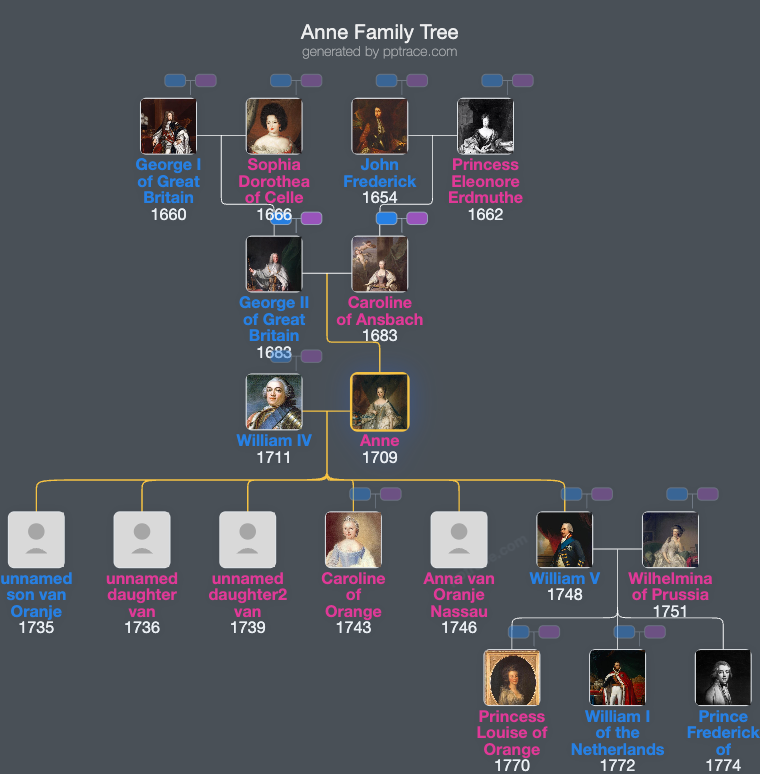
Family Tree
Tap  to expand more relatives
Introduction
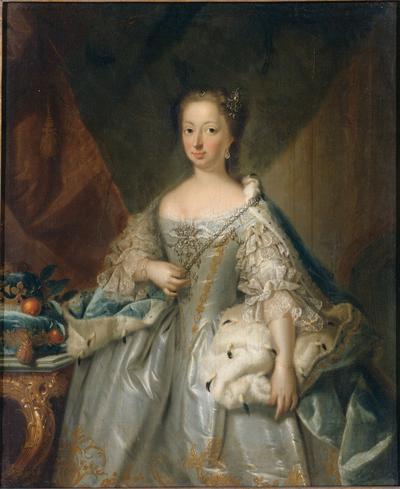
Anne, Princess Royal, was born on 2 November 1709 (Old Style: 22 October 1709) at Herrenhausen Palace in Hanover. She was the second child and eldest daughter of King George II of Great Britain and his consort Caroline of Ansbach. Her baptism took place shortly after her birth at Herrenhausen Palace. She was named after her paternal grandfather's second cousin, Queen Anne of Great Britain.
Her early education included learning German, French, and English languages. She received musical instruction from Georg Friedrich Händel, who taught her singing, harpsichord, and composition. Händel maintained a lifelong support for her, often attending her interests in music and subscribing to his works.
In 1720, Anne contracted smallpox and survived the illness, which left her face scarred. Her mother, Caroline, later promoted variolation, an early form of immunization, which she observed in Constantinople. Convinced of its benefits, Caroline arranged for Anne and her younger sisters, Amelia and Caroline, to be inoculated with successful outcomes.
In 1727, her father, King George II, granted her the title Princess Royal. Early plans considered a marriage alliance with King Louis XV of France, but disagreements over religious conversion requirements led to the discontinuation of this proposal.
On 25 March 1734 (Old Style: 14 March 1734), Anne married William IV, Prince of Orange, at the Chapel Royal at St. James's Palace. Following her marriage, she adopted the style of Princess of Orange. The marriage was marked by the composition of Handel's "This is the day," set to her own words, and the performance of the opera "Parnasso in Festa" in her honor.
William IV suffered from a spinal deformity, and Anne was reported to have expressed her commitment to the marriage regardless of his appearance. Her motivations for marriage included a desire to avoid spinsterhood and her status as a suitable Protestant match, as well as her strained relationship with her father and brother. The couple traveled to the Netherlands after their honeymoon and resided initially in Leeuwarden.
Anne experienced pregnancies that resulted in a stillborn daughter in 1736 and believed herself to be pregnant in 1735, though she was not actually expecting at that time. Her relationship with her mother-in-law, Marie Louise of Hesse-Kassel, was strained, though she developed a closer bond with her husband, William.
William advanced to become stadtholder of all seven provinces of the Dutch Republic in 1747, and a constitutional reform made this position hereditary. Anne played a significant role in cultural life, notably inviting Händel to the Hague in 1750.
William IV died on 22 October 1751, and Anne was appointed regent for her son, William V, until her death in 1759. Her regency was characterized by efforts to reinforce the authority of the hereditary stadtholderate and by policies that favored alignment with Britain. Her rule was met with resistance and contributed to internal conflicts within the Dutch Republic. She died of dropsy on 12 January 1759 in The Hague. Following her death, her mother-in-law succeeded her as regent, and subsequently, her daughter Carolina served as regent until William V reached majority.
Anne was also a visual artist, having taken drawing and painting lessons from Herman van der Mijn. A self-portrait she created in 1740 is part of the House of Orange-Nassau historic collections.
The town of Princess Anne, Maryland, is named after her. On 31 January 1719, as a grandchild of the sovereign, she was granted personal arms differenced by a label argent of five points, each bearing a cross gules. This differencing was changed on 30 August 1727 when she became a child of the sovereign, to a label argent of three points, each bearing a cross gules.
Her children and specific genealogical details are documented, but no information about her issue is provided here.