George I Of Great Britain
| Name | George I Of Great Britain |
| Title | King of Great Britain and Ireland (r. 1714–27), Elector of Hanover (r. 1698–1727) |
| Gender | Male |
| Birthday | 1660-05-28 |
| nationality | Q706018 |
| Source | https://www.wikidata.org/wiki/Q130805 |
| pptrace | View Family Tree |
| LastUpdate | 2025-11-12T01:14:52.887Z |
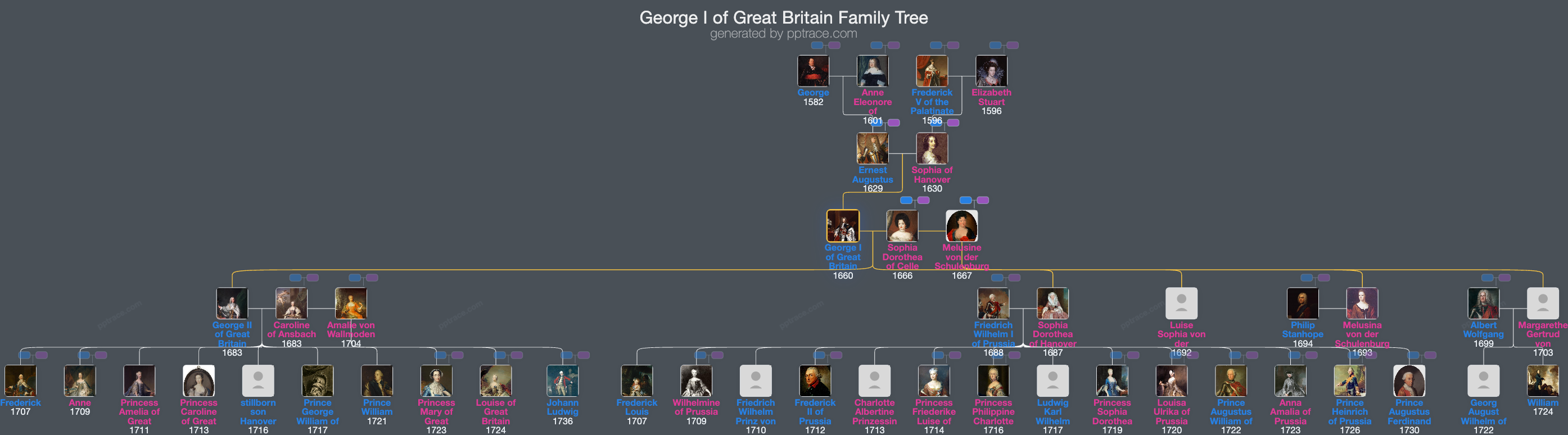
Family Tree
Tap  to expand more relatives
Introduction
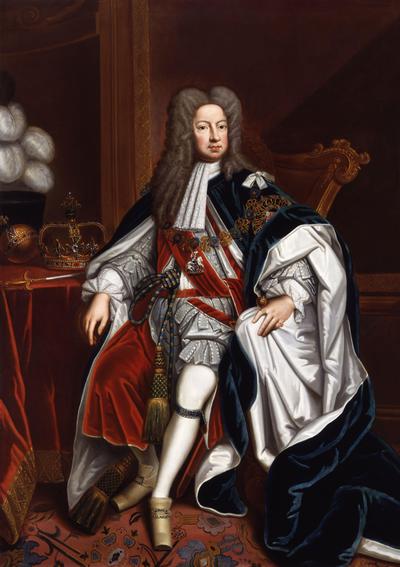
George I (George Louis; German: Georg Ludwig; 28 May 1660 – 11 June 1727) was a monarch who served as King of Great Britain and Ireland from 1 August 1714 until his death in 1727. He was also the ruler of the Electorate of Hanover within the Holy Roman Empire from 23 January 1698 to 1727. He was the first British monarch of the House of Hanover.
Born in Hanover, he was the eldest son of Ernest Augustus, Duke of Brunswick-Lüneburg, and Sophia of Hanover. His maternal grandfather was King James I of England, through his mother Elizabeth Stuart, Queen of Bohemia. In 1682, he married his cousin, Sophia Dorothea of Celle, with whom he had two children—George Augustus, who later became George II, and a daughter. Additionally, he had three daughters with his mistress Melusine von der Schulenburg. His marriage to Sophia Dorothea was dissolved in 1694.
George inherited the titles and territories of the Duchy of Brunswick-Lüneburg among his family, including the Electorate of Hanover, which was ratified in 1708. In 1682, he married Sophia Dorothea of Celle, to secure a stable income and the eventual unification of Hanover and Celle. Their marriage produced a son, George Augustus, and a daughter. The couple became estranged after the birth of their second child, and George preferred the company of his mistress, Melusine von der Schulenburg. Sophia Dorothea was imprisoned in Ahlden House after their divorce, where she remained until her death.
George's political and territorial career expanded during his lifetime, especially amidst European wars. Following the death of his mother and his second cousin Queen Anne in 1714, he inherited the British throne as the senior Protestant descendant of James VI and I. The Act of Settlement 1701 specifically ensured that the succession to the British crown would pass to him and his descendants, bypassing those with Catholic claims.
His accession marked the beginning of the Hanoverian dynasty's rule in Great Britain. His coronation took place at Westminster Abbey on 20 October 1714. George’s reign saw a decline in the power of the monarchy, with Britain transitioning to parliamentary government led by a prime minister, Robert Walpole, who is considered the first de facto prime minister.
The period was also marked by Jacobite rebellions, notably the Jacobite rising of 1715 ("The Fifteen"), which aimed to replace him with James Francis Edward Stuart. The rebellion was unsuccessful, and after its suppression, George’s government implemented policies that favored Whig dominance and religious toleration.
During his rule, George I governed in Hanover independently within the Holy Roman Empire, with personal control over the government in Hanover, but exercised limited direct influence over British domestic politics, which was increasingly managed by Parliament and the prime minister. His foreign policy involvement included the creation of alliances such as the Triple Alliance (1717) and the Quadruple Alliance (1718). He participated in the War of the Quadruple Alliance, which aimed to counterbalance French and Spanish ambitions.
George I died in 1727 while traveling to Hanover and was buried there. He was the most recent British monarch to be buried outside the United Kingdom. His death led to the accession of his son, George Augustus, who became George II.
Among his impacts, George I's accession maintained the Protestant succession, ensuring political stability after the Stuarts, and facilitated the development of constitutional monarchy in Britain. His limited personal involvement in politics contributed to the rise of parliamentary government and the office of the prime minister. Despite criticisms of his foreign origins and occasional unpopularity, his reign set the stage for the future of the British constitutional system.