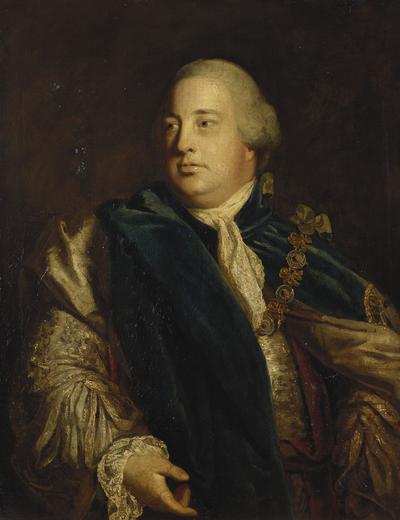
Prince William, Duke Of Cumberland
| Name | Prince William, Duke Of Cumberland |
| Title | British Army general; (1721-1765) |
| Gender | Male |
| Birthday | 1721-04-26 |
| nationality | Great Britain |
| Source | https://www.wikidata.org/wiki/Q378088 |
| pptrace | View Family Tree |
| LastUpdate | 2025-11-12T01:15:19.432Z |
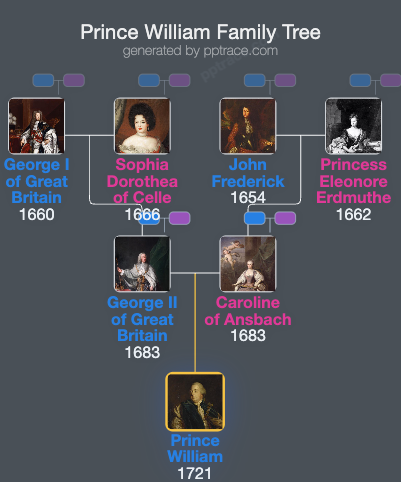
Family Tree
Tap  to expand more relatives
Introduction
William Augustus, Duke of Cumberland, was born on 15 April 1721 (New Style) and died on 31 October 1765. He was the youngest son of King George II of Great Britain and Ireland and Queen Caroline of Ansbach. Cumberland was created Duke of Cumberland on 27 July 1726, at the age of five.
He was born in Leicester House, located in Leicester Fields (now Leicester Square), Westminster, London. His early childhood education was overseen by notable tutors, including Edmond Halley, appointed by his mother. Apartments were specially designed for him at Hampton Court Palace by William Kent. An initial political proposal by his elder brother, Frederick, Prince of Wales, suggested dividing the British and Hanoverian realms, with William receiving Hanover, but this plan was never enacted.
Cumberland’s military career began early; he was enrolled in the 2nd Foot Guards and was made a Knight of the Bath at age four. His initial military service included sailing as a volunteer in the fleet under Sir John Norris in 1740. Subsequently, he secured the post of colonel of the First Regiment of Foot Guards on 20 February 1741.
During the War of the Austrian Succession, Cumberland achieved the rank of major-general in December 1742, and in 1743, he participated in the Battle of Dettingen, where he was wounded in the leg by a musket ball. After this battle, he was promoted to lieutenant general. In 1745, he was appointed Captain-General of British land forces and served as Commander-in-Chief of the Pragmatic Army, which included British, Hanoverian, Austrian, and Dutch troops in Flanders. He aimed to take offensive action against France but was ultimately defeated at the Battle of Fontenoy on 11 May 1745.
Cumberland played a significant role in suppressing the Jacobite rising of 1745–1746. Upon recalling from Flanders, he pursued Prince Charles Edward Stuart’s Jacobite army as it advanced into England. His forces retreated to Scotland after the Battle of Clifton Moor in December 1745, and Cumberland was subsequently recalled to London. In 1746, he arrived in Edinburgh to assume command. On 16 April 1746, he engaged the Jacobite army near Culloden and achieved a decisive victory in a battle that lasted approximately one hour.
Following the Battle of Culloden, Cumberland’s forces undertook a brutal campaign to pacify the Scottish Highlands. He ordered the treatment of wounded Jacobites and oversaw the execution and imprisonment of suspected rebels, significantly impacting public perception. His actions during this period earned him nicknames such as “Butcher Cumberland,” a term used by Tory opponents, while Whig supporters affectionately called him “Sweet William.”
After Culloden, Cumberland’s military ambitions declined. He did not participate in the Flanders campaign of 1746 and experienced a defeat at the Battle of Lauffeld near Maastricht in 1747. The Treaty of Aix-la-Chapelle in 1748 marked the end of this conflict, and Cumberland returned to Britain.
In peacetime, Cumberland’s unpopularity related to his harsh actions in Scotland hampered his political influence. He was involved in efforts to reform the army, advocating for the end of practices like purchase and for establishing a ready-standing force. His reforms faced opposition from Whigs wary of militarization.
During the Seven Years’ War, Cumberland served in North America, proposing a multinational, overwhelming assault on French holdings, and was appointed to command in North America. His plans included striking at multiple French forts simultaneously and developing light infantry. In 1757, he commanded the Hanoverian Army of Observation to defend Hanover from France but was defeated at the Battle of Hastenbeck. He subsequently agreed to the Convention of Klosterzeven, leading to the disbandment of his army and French occupation of Hanover.
Cumberland's final years saw him become an influential advisor to King George III. He briefly participated in politics and ministerial affairs, notably supporting the First Rockingham Ministry. His health declined after a stroke in August 1760, and he remained obese. Cumberland died on 31 October 1765 at his residence on Upper Grosvenor Street. He was unmarried and was interred in Westminster Abbey beneath the Lady Chapel of Henry VII.
His legacy includes place names such as Prince William County in Virginia and Cumberland County in several U.S. states. Memorials and statues dedicated to him have been erected, though some, like the equestrian statue in London's Cavendish Square, were later removed. He was also posthumously rated by some sources as an infamous figure of the 18th century.