
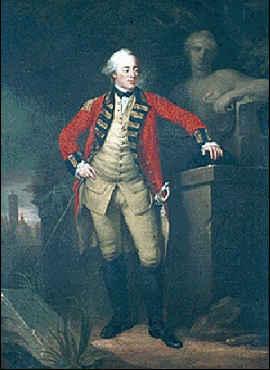
Johann Ludwig, Reichsgraf Von Wallmoden-Gimborn
| Name | Johann Ludwig, Reichsgraf Von Wallmoden-Gimborn |
| Title | German lieutenant-general and art collector (1736-1811); illegitimate son of George II of Great Britain by his mistress Amalie von Wallmoden |
| Gender | Male |
| Birthday | 1736-04-22 |
| nationality | Germany |
| Source | https://www.wikidata.org/wiki/Q216300 |
| pptrace | View Family Tree |
| LastUpdate | 2025-11-12T01:15:13.825Z |
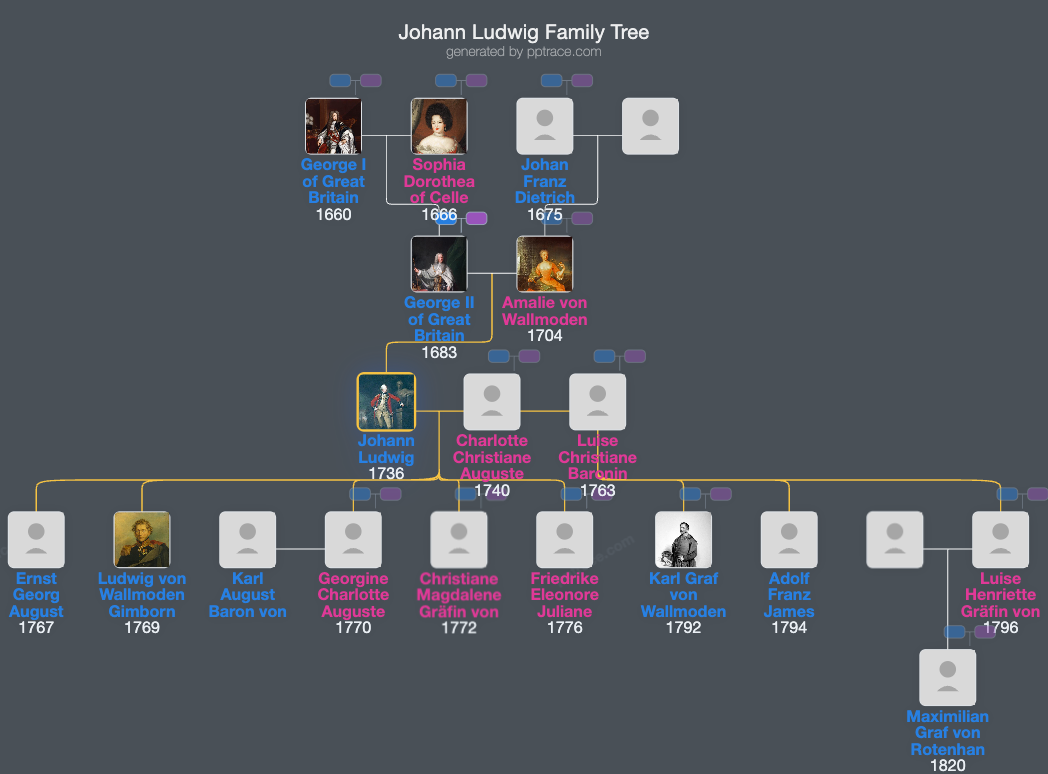
Family Tree
Tap  to expand more relatives
Introduction
Johann Ludwig Reichsgraf von Wallmoden-Gimborn was born on 22 April 1736 and died on 10 October 1811. He was a military officer in the Hanoverian Army and held the rank of major general.
Early Life:
Wallmoden was the illegitimate son of King George II of Great Britain and his mistress Amalie von Wallmoden. Amalie was married to Adam Gottlieb, Count Wallmoden (1704–1752). A payment of 1000 Ducats was made to Count Wallmoden, who was prepared to defer his claims on his wife, leading to her separation from him in 1740. After Queen Caroline's death in 1737, Robert Walpole, the Prime Minister, suggested bringing Amalie from Hanover to Britain to serve as the primary mistress of George II. During this period, Lady Deloraine, a courtesan with whom George II had a distant relationship, temporarily filled this role. Johann Ludwig was conceived in England and grew up at St. James’s Palace and Kensington Palace. As an illegitimate son of the king, he received a comprehensive education and later undertook a Grand Tour to Italy, acquiring an extensive collection of classical sculptures and reliefs. Upon returning to Hanover, he joined the Hanoverian Army and attained the rank of major general.
Career:
In the early 1800s, several noblemen’s estates were established in the flood plain of the Leine River. In 1768, Wallmoden acquired parts of these gardens and combined them into the Wallmodengarten, later known as the Georgengarten. In 1782, he constructed the Wallmoden-Schloss to house his collection of antiquities. Also in 1782, he purchased the Reichsherrschaft Gimborn in Westphalia from Prince Johann I of Schwarzenberg. On 17 January 1783, he was elevated to the nobility of the Holy Roman Empire by Emperor Joseph II, with the title of Reichsgraf (Imperial Count) of Wallmoden-Gimborn and an augmented coat of arms. Simultaneously, he gained a seat on the Westphalian College of Imperial Counts, representing his noble estate within the Reichsstandschaft.
He served as guardian to George William (1784–1860), the younger son and heir of Count Philipp II of Schaumburg-Lippe, after the latter’s death in 1787. From 1790 until 1811, Wallmoden was an honorary member of the Prussian Academy of Arts in Berlin. He held the position of Oberbefehlshaber (commander-in-chief) of the Hanoverian army and is noted for signing the Convention of Artlenburg on 5 July 1803, which capitulated the Hanoverian forces before the arrival of Napoleon's troops.
Personal Life:
Wallmoden-Gimborn's first marriage took place in Hanover on 18 April 1766 to Charlotte Christiane Auguste Wilhelmine von Wangenheim (1740–1783). They produced five children:
- Ernst Georg August (1767–1792)
- Ludwig Georg Thedel (1769–1862), who became an Austrian General of Cavalry
- Georgine Charlotte Auguste (1770–1859), who was married twice, first to Baron Karl August von Lichtenstein and later to Count Friedrich Abraham Wilhelm von Arnim, and then to Marquis le Marchant de Charmont
- Wilhelmine Magdalene Friederike (1772–1819), who married Baron Heinrich Friedrich Karl vom Stein
- Friedrike Eleonore Juliane (1776–1826), who married Ludwig Friedrich Count von Kielmansegg and was the mother of Eduard von Kielmansegg
His second marriage was on 3 August 1788 in Bückeburg to Baroness Luise Christiane von Lichtenstein (1763–1809). They had three children:
- Karl August Ludwig (1792–1883), an Austrian Privy Councillor and Lieutenant-General, married Zoe, Countess von Grünne
- Adolf Franz James Wilhelm (1794–1825)
- Luise Henriette (1796–1851)
Following Wallmoden-Gimborn's death, his collection of antiquities and over 8,000 volumes of books were acquired by his nephew, King George III, and later became part of the collection of the Archeological Institute in Göttingen in 1979.
Descendants:
From his son Karl August Ludwig, the Oberhaus Wallmoden line descends.
Children
- Georgine Charlotte Auguste Gräfin Von Wallmoden
- Christiane Magdalene Gräfin Von Wallmoden
- Friedrike Eleonore Juliane Gräfin Von Wallmoden
- Ludwig Von Wallmoden-Gimborn
- Adolf Franz James Wilhelm Graf Von Wallmoden
- Karl Graf Von Wallmoden-Gimborn
- Ernst Georg August Graf Von Wallmoden
- Luise Henriette Gräfin Von Wallmoden