Louise Of Great Britain
| Name | Louise Of Great Britain |
| Title | daughter of George II of Great Britain; Queen consort of Denmark and Norway |
| Gender | Female |
| Birthday | 1724-12-07 |
| nationality | Great Britain |
| Source | https://www.wikidata.org/wiki/Q168667 |
| pptrace | View Family Tree |
| LastUpdate | 2025-11-12T01:15:15.657Z |
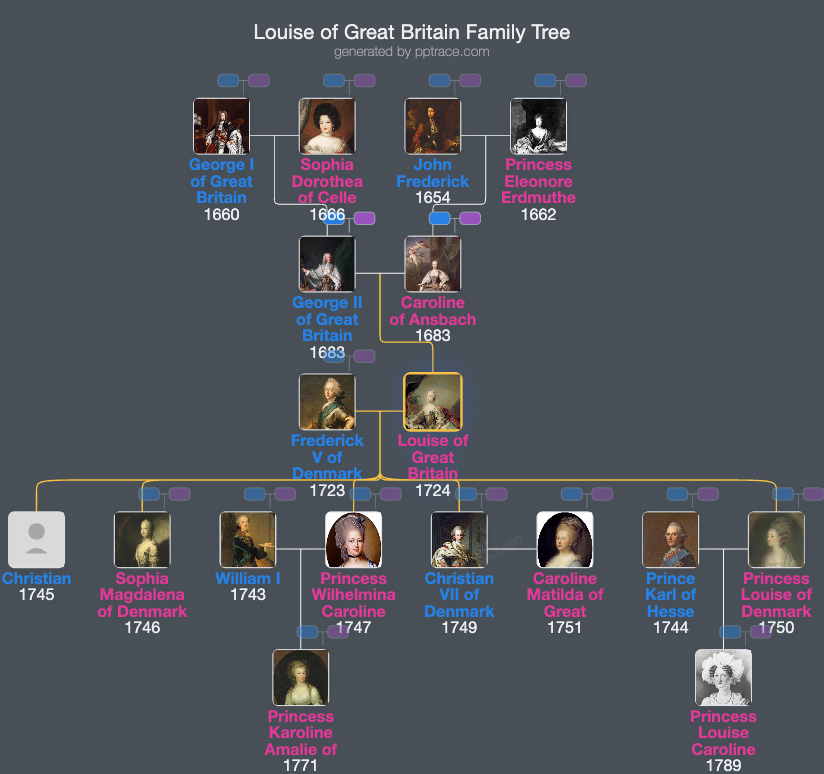
Family Tree
Tap  to expand more relatives
Introduction
Louise of Great Britain, also known as Louisa, was born on 18 December 1724 (O.S. 7 December 1724) at Leicester House in Westminster, London. She was the youngest surviving daughter of King George II of Great Britain and Queen Caroline of Ansbach. Her paternal grandparents were Elector George Louis of Hanover, who became King George I of Great Britain in 1714, and her paternal lineage connected her to the House of Hanover.
Her early childhood was marked by family instability; her father, Prince of Wales, experienced strained relationships with his own father, King George I. After a quarrel in 1717, her father was banished from court and resided at Leicester House, which became a hub for political opponents. Louise was baptized as "Louisa" on 22 December in Leicester House, with her godparents including her elder sister and notable relatives such as Princess Amelia of Great Britain, Princess Louisa Ulrika of Prussia, and Frederick, Prince Royal of Prussia.
Louise had six older siblings who survived into adulthood, primarily from her mother's numerous pregnancies, particularly with her mother, Queen Caroline, who experienced 11 pregnancies, losing four children. She spent her childhood in London, primarily at Leicester House, and later at St James's Palace after her father became King George II in 1727. Her upbringing was influenced by her family’s aristocratic environment. Her mother died in 1737, when Louise was nearly 13 years old, after which she was mainly raised by her older sister, Princess Caroline.
In 1743, a dynastic marriage was arranged between Louise and Crown Prince Frederick of Denmark and Norway. The proposal was motivated by political interests of Great Britain and Denmark-Norway, with alliances forming against common rivals. The marriage negotiations commenced in 1743, and on 14 September of that year, the agreement was finalized. Louise departed from London on 19 October 1743, traveling via Hanover for a proxy wedding in Hanover on 10 November, where her brother, the Duke of Cumberland, represented her future husband. She then traveled to Altona in the Danish Duchy of Holstein, where she met her husband for the first time a week after her wedding ceremony. Subsequently, she and Frederick traveled to Copenhagen, arriving on 11 December 1743, for their official entry into the city. On that same day, they held a second wedding ceremony at Christiansborg Palace.
Following her marriage, Louise resided initially at Charlottenborg Palace in Copenhagen. Their marriage was reportedly amicable during the early years; the couple had five children, although their eldest son, Crown Prince Christian, did not survive infancy. Queen Louise was known for her European education, good conversational skills, and her efforts to learn Danish, which was appreciated by the court and the Danish population.
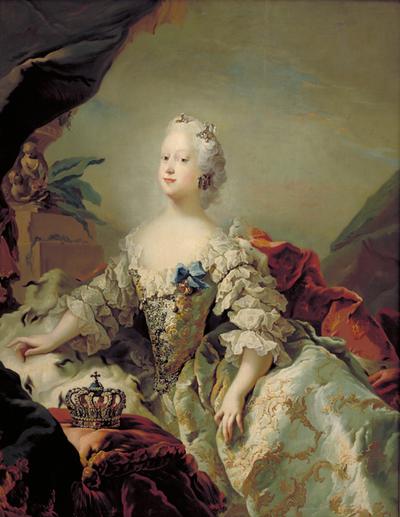
Upon the death of Christian VI on 6 August 1746, her husband ascended the throne as King Frederick V. Louise became Queen of Denmark and Norway at the age of 21. The couple moved into Christiansborg Palace, and her coronation was held in September 1747. Her tenure as queen saw a shift toward more festive and social court life, characterized by less strict etiquette compared to her predecessors. Louise was considered popular and was described as well-educated, good at conversation, and personally interested in music, dance, and theatre. She arranged cultural events, including performances by Italian opera companies and French theatrical troupes.
In 1748, she opposed the planned marriage of her five-year-old daughter, Princess Sophie Magdalene, to the Swedish Crown Prince Gustav, due to concerns over her daughter’s treatment and political implications. In 1751, Louise fell ill during pregnancy with her sixth child, suffering from a hernia, which led to her death at Christiansborg Palace on 19 December 1751, shortly after her 27th birthday. Her death was mourned widely, and she was interred in Roskilde Cathedral.
After her death, King Frederick V remarried in 1752 to Duchess Juliana Maria of Brunswick-Wolfenbüttel. Louise’s legacy persisted as a beloved figure, and her memory was honored in contemporary poetry and cultural history. A county in Virginia, Louisa County, was named after her in 1742.