
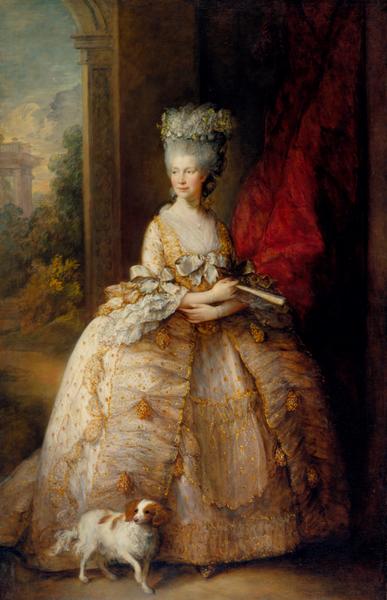
Charlotte Of Mecklenburg-Strelitz
| Name | Charlotte Of Mecklenburg-Strelitz |
| Title | Queen consort of Great Britain and Ireland as the wife of King George III |
| Gender | Female |
| Birthday | 1744-05-19 |
| nationality | United Kingdom of Great Britain and Ireland |
| Source | https://www.wikidata.org/wiki/Q161159 |
| pptrace | View Family Tree |
| LastUpdate | 2025-11-12T01:16:35.751Z |
Family Tree
Tap  to expand more relatives
Introduction
Charlotte of Mecklenburg-Strelitz, also known as Sophia Charlotte, was born on 19 May 1744 in Mirow, a small duchy in northern Germany within the Holy Roman Empire. She was the youngest daughter of Duke Charles Louis Frederick of Mecklenburg and Princess Elisabeth Albertine of Saxe-Hildburghausen. Her family resided at the Unteres Schloss in Mirow.
Education in her youth was described as "mediocre," though her parents commissioned tutors to instruct her in literature, botany, natural history, and multiple languages including French, Italian, and Latin. She also received training in embroidery, dancing, singing, household management, religion, and played the harpsichord under Johann Georg Linike. Her early life was modest, with her first exposure to princely duties only after her brother, Adolphus Frederick, became duke in 1752.
In 1760, the British throne was inherited by the 17-year-old George III following the death of his grandfather, George II. As George was unmarried and considered inexperienced in politics, a marriage was arranged with Charlotte, a minor German princess with no political ambitions. Their marriage took place on 8 September 1761 at Kew Palace, shortly after Charlotte’s arrival in England. She was 17 years old at the time. The marriage was performed at the Chapel Royal, St. James's Palace, with only close family and officials present.
As Queen of Great Britain and Ireland, Charlotte became the wife of King George III and the mother of 15 children, of whom 13 survived to adulthood. Her children included two future British monarchs, George IV and William IV; Charlotte, Princess Royal, who became Queen of Württemberg; and Prince Ernest Augustus, who became King of Hanover. Her official residence was St. James's Palace, but she preferred Buckingham House (later Buckingham Palace) and Queen's Lodge at Windsor, where she was responsible for interior decoration and gardening.
Charlotte was a patron of the arts and an amateur botanist, significantly contributing to the expansion of Kew Gardens. She is credited with introducing the Christmas tree tradition into Britain, first decorating a yew branch at Windsor in 1800. Her interests also extended to music, with a particular admiration for Handel, and she hosted performances by Wolfgang Amadeus Mozart during his visit to Britain.
Her relationship with her mother-in-law, Princess Augusta, was initially strained due to court etiquette and interference with her household. Charlotte’s influence on political affairs was indirect and discreet; she maintained correspondence with her brother Charles of Mecklenburg-Strelitz and offered recommendations for appointments. She took a particular interest in German issues and supported British intervention during the Bavarian Succession.
Charlotte's husband's mental health issues, beginning in 1765 and notably deteriorating between 1788 and 1789, profoundly affected her life. She was distressed by his episodes of physical and mental illness, which led to the declaration of the Regency Bill in 1789, placing her under the guardianship of her son, the Prince of Wales, later George IV. During the King's illness, her relationship with her children and her public role became strained.
During George III’s recurring mental health crises, Charlotte was involved in the management of court affairs but largely avoided regular visits with her husband after 1812. From 1811 until her death, she served as regent during his incapacity. She continued to participate in royal events and supervised her granddaughter’s upbringing until her death.
Charlotte died on 17 November 1818 at Kew Palace, with her eldest son, the Prince Regent, present. She was buried at St. George's Chapel, Windsor Castle. Her tenure as queen consort lasted for 57 years and 70 days, making her the longest-serving queen consort in British history up to that time. Her legacy includes place names across British colonies, contributions to the arts and botany, and the introduction of the Christmas tree tradition in Britain.

Parents
Children
- Prince Alfred Of Great Britain
- Charlotte, Princess Royal
- Princess Sophia Of The United Kingdom
- Prince Frederick, Duke Of York And Albany
- Prince Adolphus, Duke Of Cambridge
- Princess Amelia Of The United Kingdom
- Princess Elizabeth Of The United Kingdom
- Princess Mary Of The United Kingdom
- Princess Augusta Sophia Of The United Kingdom
- Prince Augustus Frederick, Duke Of Sussex
- Ernst August II Of Hanover
- Prince Edward, Duke Of Kent And Strathearn
- George IV Of The United Kingdom
- William IV
- Prince Octavius Of Great Britain