Prince Augustus Frederick, Duke Of Sussex
| Name | Prince Augustus Frederick, Duke Of Sussex |
| Title | British prince (1773–1843) |
| Gender | Male |
| Birthday | 1773-01-27 |
| nationality | United Kingdom of Great Britain and Ireland |
| Source | https://www.wikidata.org/wiki/Q375467 |
| pptrace | View Family Tree |
| LastUpdate | 2025-11-12T01:16:28.771Z |
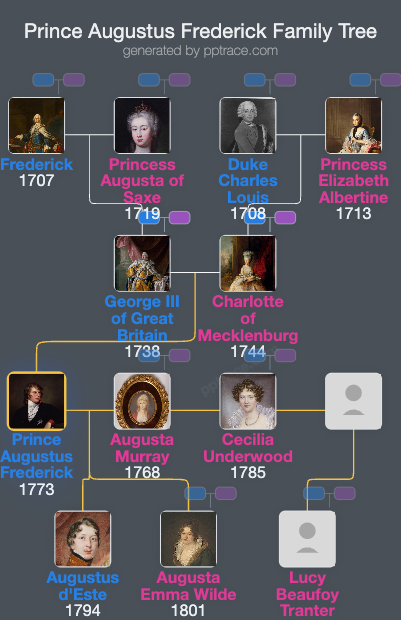
Family Tree
Tap  to expand more relatives
Introduction
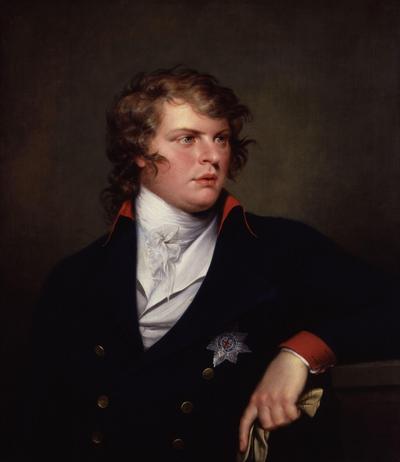
Prince Augustus Frederick, Duke of Sussex (27 January 1773 – 21 April 1843), was the sixth son and ninth child of King George III and Queen Charlotte of Mecklenburg-Strelitz. He was born at Buckingham House in London and was the only surviving son of George III who did not pursue a career in the army or navy. His early education was conducted at home, followed by studies at the University of Göttingen in Germany commencing in the summer of 1786. Unlike his brothers, he did not undergo military training in Hanover due to health issues such as asthma. He briefly considered becoming a cleric in the Church of England and served as Lieutenant-Colonel Commandant of the "Loyal North Britons" Volunteers regiment during the Napoleonic Wars in 1805.
His baptization took place in the Great Council Chamber at St James's Palace on 25 February 1773, officiated by Archbishop of Canterbury Frederick Cornwallis. His godparents included various relatives and prominent figures, such as the Duke of Saxe-Gotha-Altenburg, Duke George Augustus of Mecklenburg, and Princess Charles of Hesse-Cassel.
In his personal life, Augustus Frederick married Lady Augusta Murray in Rome on 4 April 1793, in a secret marriage. They later married publicly at St George's, Hanover Square, Westminster, on 5 December 1793, without the King's consent. This led to the nullification of his first marriage by the Court of Arches in August 1794, owing to the Royal Marriages Act 1772. Despite this, he continued to cohabitate with Lady Augusta until their separation in 1801. They had two children, Augustus Frederick d'Este and Augusta Emma d'Este, both descended from the House of Este. Lady Augusta was later permitted to adopt the surname "de Ameland" in 1806.
His peerage titles included Duke of Sussex, Earl of Inverness, and Baron Arklow, conferred on 24 November 1801. The title of Duke of Sussex became extinct upon his death as he had no legitimate heirs. He was invested as a Knight of the Garter in 1786 and held prominent positions in Freemasonry, serving as Grand Master of the United Grand Lodge of England from 1813 until his death. In 1815, he became a patron of the Jews' Hospital and Orphan Asylum, which later became Norwood.
Following the death of Lady Augusta Murray, he married Lady Cecilia Letitia Buggin, on 2 May 1831, again contrary to the Royal Marriages Act. Lady Cecilia was the daughter of Arthur Gore, 2nd Earl of Arran, and widow of Sir George Buggin. She was granted the title of Duchess of Inverness in her own right by Queen Victoria in 1840, though she was never formally titled as Duchess of Sussex.
Throughout his later years, he was appointed to several royal and honorary posts, including Chief Ranger and Keeper of St James's Park and Hyde Park by William IV and Governor of Windsor Castle by Queen Victoria in 1842. He was president of the Royal Society between 1830 and 1838 and was known for his interest in biblical studies, Hebrew manuscripts, and the sciences. His personal library reportedly contained over 50,000 theological manuscripts.
He was the favorite uncle of Queen Victoria, notably giving her away at her wedding to Prince Albert in 1840. Prince Augustus Frederick died at Kensington Palace in 1843 at the age of 70 from erysipelas. His remains were interred at Kensal Green Cemetery, where he was buried opposite the tomb of his sister Princess Sophia. His widow, the Duchess of Inverness, resided at Kensington Palace until her death in 1873.
His honours included being a Knight of the Garter, Knight Grand Cross of the Royal Guelphic Order, Knight of the Thistle, and Knight Grand Cross of the Bath, among others. His arms as a son of the sovereign featured the royal arms differenced by a silver label with two hearts and crosses.