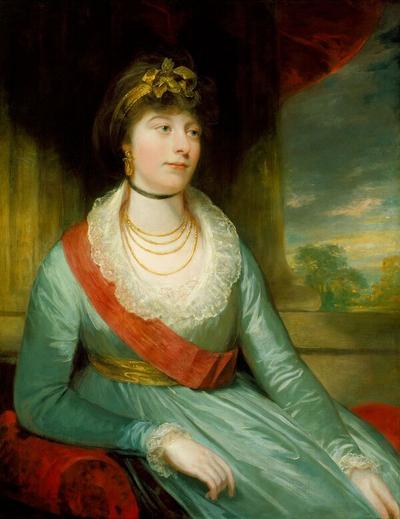
Charlotte, Princess Royal
| Name | Charlotte, Princess Royal |
| Title | British princess (1766-1828); eldest daughter of George III |
| Gender | Female |
| Birthday | 1766-09-29 |
| nationality | United Kingdom of Great Britain and Ireland |
| Source | https://www.wikidata.org/wiki/Q57536 |
| pptrace | View Family Tree |
| LastUpdate | 2025-11-12T01:16:34.888Z |
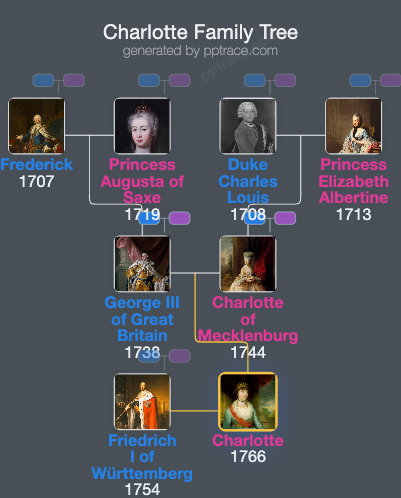
Family Tree
Tap  to expand more relatives
Introduction
Charlotte, Princess Royal (full name: Charlotte Augusta Matilda), was born on 29 September 1766 at Buckingham House in London. She was a member of the British royal family as the eldest daughter and fourth child of King George III and Queen Charlotte of Mecklenburg-Strelitz. She was christened on 27 October 1766 at St James's Palace, with her godparents including her paternal aunt and uncle, Queen Caroline Matilda and King Christian VII of Denmark, as well as her paternal aunt Louisa. Proxy witnesses for her baptism included the Duke of Portland, Lord Chamberlain, and the Dowager Countess of Effingham.
Charlotte was officially designated as Princess Royal on 22 June 1789. Her early childhood was characterized by inoculation against smallpox in December 1768, alongside her brother William. Her education was prioritized from a young age, beginning when she was only eighteen months old, as she was expected to be positioned for a significant marriage alliance on the European continent. Despite her status as the eldest daughter, her appearance was often contrasted with that of her younger sister Augusta Sophia, with contemporary observers noting differences in beauty and personality, particularly in regard to shyness. Charlotte also had a stammer, which was addressed during her childhood.
Her family expanded with the birth of Princess Elizabeth in 1770, forming a family grouping that included fifteen royal children overall. Charlotte's upbringing was at Buckingham House, Kew Palace, and Windsor Castle, where she was cared for by a wet nurse, Frances, wife of James Muttlebury. Her parents favored spending time with their children over courtly pursuits.
On 18 May 1797, Charlotte married Frederick, Hereditary Prince of Württemberg, at the Chapel Royal, St James's Palace, London. He was the eldest son of Frederick II Eugene, Duke of Württemberg, and his wife, Margravine Sophia Dorothea of Brandenburg-Schwedt. Following her husband's accession to the ducal throne in 1797 as Duke Frederick III, the couple's marriage produced one stillborn daughter on 27 April 1798.
In 1800, during the French Revolutionary Wars, Württemberg was occupied by French forces, prompting the Duke and Duchess to flee to Vienna. The following year, Duke Frederick negotiated territorial exchanges, ceding Montbéliard to France and acquiring Ellwangen. He assumed the title of Elector of Württemberg on 25 February 1803. Subsequently, in recognition of supporting France with auxiliary forces, Napoleon recognized Württemberg as a kingdom on 26 December 1805, and Frederick was crowned King of Württemberg on 1 January 1806. Charlotte then became queen consort.
Württemberg's political trajectory included separating from the Holy Roman Empire and joining Napoleon's Confederation of the Rhine. This alliance caused diplomatic discomfort with her father, King George III, who initially refused to address her as Queen of Württemberg. In 1813, King Frederick switched allegiance to the Allies, and after Napoleon's defeat, he attended the Congress of Vienna, where his kingship was confirmed. He died in October 1816.
After her husband's death, Charlotte remained in Württemberg as the Dowager Queen at Ludwigsburg Palace. She maintained familial connections with her siblings and served as a proxy godmother during her niece Princess Victoria's christening in 1819. In 1827, she traveled back to Britain for health reasons, intending to undergo surgery for dropsy. Her journey commenced on 31 May aboard the steamboat Friedrich Wilhelm, traveling down the Rhine to Bath. Due to weather complications, she returned to Ludwigsburg on 24 October 1827.
Charlotte died at Ludwigsburg Palace on 6 October 1828 and was interred in the palace's royal vault. Her royal honors included the Royal Family Order of King George IV and the Dame Grand Cross of the Order of Saint Catherine, awarded on 5 April 1797. Her arms as a daughter of the monarch featured the arms of the kingdom with specific heraldic differences, including a label argent with a red rose and crosses.
Her ancestry traces back to both British and German royal lines, with her father, George III, and her mother, Charlotte of Mecklenburg-Strelitz, representing significant royal bloodlines across Europe.