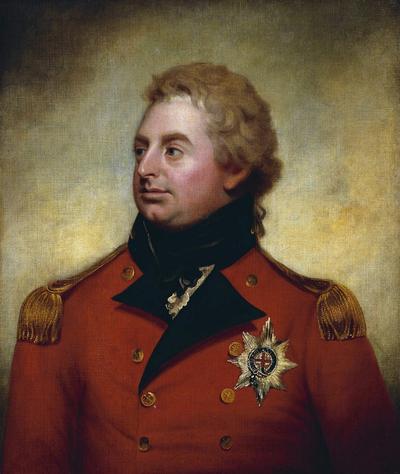
Prince Frederick, Duke Of York And Albany
| Name | Prince Frederick, Duke Of York And Albany |
| Title | British prince (1763-1827) |
| Gender | Male |
| Birthday | 1763-08-16 |
| nationality | United Kingdom of Great Britain and Ireland |
| Source | https://www.wikidata.org/wiki/Q213573 |
| pptrace | View Family Tree |
| LastUpdate | 2025-11-12T01:16:27.962Z |
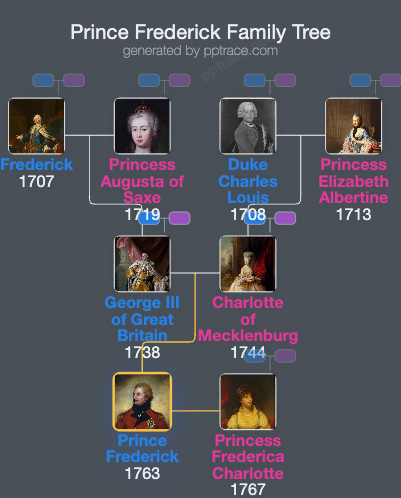
Family Tree
Tap  to expand more relatives
Introduction
Frederick Augustus, Duke of York and Albany, was born on 16 August 1763 at St. James's Palace in London. He was the second son of King George III of the United Kingdom and Hanover and his consort, Queen Charlotte (née Princess of Mecklenburg-Strelitz). His family belonged to the House of Hanover.
At six months old, on 27 February 1764, Frederick became Prince-Bishop of Osnabrück following the death of Clemens August of Bavaria. This position was part of the German mediatisation and was recognized by the Peace of Westphalia, which stipulated that the city of Osnabrück would alternate between Catholic and Protestant rulers. As Prince-Bishop, Frederick received substantial income from the position, which he retained until 1803 when Osnabrück was incorporated into Hanover.
He was invested as a Knight of the Most Honourable Order of the Bath on 30 December 1767 and as a Knight of the Order of the Garter on 19 June 1771.
Frederick was educated in Hanover from 1781 to 1787, studying at the University of Göttingen alongside his younger brothers, Prince Edward, Prince Ernest, Prince Augustus, and Prince Adolphus. He was appointed colonel of the 2nd Horse Grenadier Guards on 26 March 1782 and promoted to major-general later that year, on 20 November. He was further promoted to lieutenant general on 27 October 1784 and became colonel of the Coldstream Guards on 28 October 1784. On 27 November 1784, he was created Duke of York and Albany and Earl of Ulster, and took his seat in the House of Lords.
His military career included early service in Flanders during the War of the First Coalition. He was promoted to full general on 12 April 1793, and in the same year, he led British forces in the Flanders campaign. Notable battles include the Siege of Valenciennes in July 1793, the Battle of Beaumont in April 1794, and the Battle of Willems in May 1794. He faced defeat at the Battle of Hondschoote in September 1793 and at the Battle of Tourcoing in 1794, leading to the British evacuation of Dutch-held territories in 1795.
Following his return to Britain, Frederick was promoted to field marshal on 18 February 1795 and was appointed Commander-in-Chief of the British Army on 3 April 1795, a position he held until 1809, with a brief hiatus. He was also colonel of the 60th Regiment of Foot from 1797.
In 1799, he commanded British forces in the Anglo-Russian invasion of Holland, which experienced setbacks and was ultimately withdrawn after the Convention of Alkmaar on 17 October 1799. This campaign highlighted deficiencies within the British Army, which Frederick sought to address through significant reforms, including assistance in establishing the Royal Military College at Sandhurst in 1801 and founding the Royal Military Asylum.
He was granted the honorary title of Warden of Windsor Forest on 14 September 1805. His resignation as Commander-in-Chief occurred on 25 March 1809 amid a scandal involving his mistress, Mary Anne Clarke, who was accused of selling army commissions. Although Frederick was acquitted of receiving bribes, he resigned; he was later reinstated in 1811 after Clarke was found to have received payments from his former chief accuser.
Frederick's residences included a country estate at Oatlands near Weybridge, Surrey, and later a London residence at 8 South Audley Street, Mayfair. Construction of a new London house, York House (later Lancaster House), began in 1825 but was incomplete at his death in 1827.
Following the death of his niece Princess Charlotte of Wales in 1817, Frederick became second in line to the British throne. In 1820, upon the death of his father, George III, he became heir presumptive. He held this position until his death.
Frederick married Princess Frederica Charlotte of Prussia on 29 September 1791 in Charlottenburg, Berlin. The marriage was not successful, and the couple separated; Frederica retired to Oatlands Palace until her death in 1820.
He died on 5 January 1827 of dropsy and cardiovascular disease at the home of the Duke of Rutland in Arlington Street, London. His remains were interred in St George's Chapel at Windsor Castle.
His honours included membership in the Order of the Garter, the Order of the Bath, the Royal Guelphic Order, and various foreign orders such as the Prussian Black Eagle, the French Saint-Esprit, and Russian orders of St. Andrew and St. Alexander Nevsky.
Numerous locations and institutions were named in his honour, including Fredericton in Canada, York County and towns in Western Australia, and the Duke of York's Royal Military School in Dover. In addition, statues and memorials were erected, such as the Duke of York Column in London. The city of Albany in Western Australia and Fort Frederick in Port Elizabeth, South Africa, also bear his name.