Princess Amelia Of The United Kingdom
| Name | Princess Amelia Of The United Kingdom |
| Title | daughter of King George III of the United Kingdom |
| Gender | Female |
| Birthday | 1783-08-07 |
| nationality | Great Britain |
| Source | https://www.wikidata.org/wiki/Q257604 |
| pptrace | View Family Tree |
| LastUpdate | 2025-11-12T01:16:32.146Z |
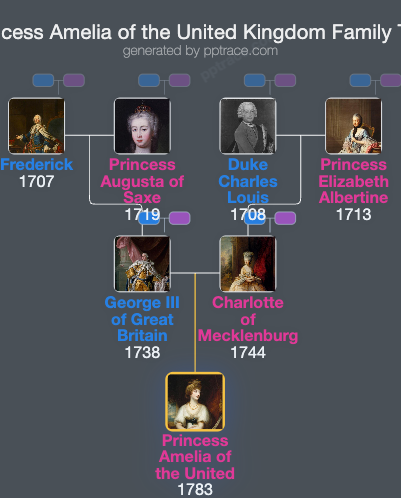
Family Tree
Tap  to expand more relatives
Introduction
Princess Amelia of the United Kingdom (7 August 1783 – 2 November 1810) was the fifteenth and last child of King George III of the United Kingdom and Charlotte of Mecklenburg-Strelitz. She was born at Royal Lodge in Windsor within Windsor Great Park, approximately three miles south of Windsor Castle. Amelia was the sixth daughter among her parents’ children and was their third to die before their parents.
Her baptism took place at the Chapel Royal, St James's Palace, on 17 September 1783, with Archbishop John Moore officiating. Her godparents were her siblings George, Charlotte, and Augusta Sophia. Amelia was confirmed by the Archbishop on 24 December 1799. She was nicknamed "Emily" by her father, who ascribed a special favor to her. Amelia's birth followed the deaths of her elder brothers Octavius and Alfred, which created a significant familial gap. Her elder siblings included King George III and Princess Charlotte of Wales.
As a young child, Amelia was regarded as her father's favorite. She was described as beautiful, charming, and engaging, qualities that led Princess Charlotte to write to her brother William that Amelia was "without exception one of the prettiest children I have ever seen." Her initial education was somewhat informal, with her care and upbringing influenced by the policies of her family and the constraints of her parents’ health. She was baptised and confirmed in the Anglican tradition, with her early life marked by periods of ill health.
Amelia grew up in a family environment heavily affected by her father's recurring mental health crises. Beginning at age five, she experienced her father’s first episodes of madness, which resulted in a life of relative emotional distance and limited parental attention. Her early life was characterized by the protection and isolation consistent with royal policies of the time, especially given the Queen's own health issues.
In her adolescence, Amelia suffered from recurrent health problems, including episodes of joint pain and tuberculosis symptoms. She was sent to seaside resorts such as Worthing and Weymouth for recovery and health improvement. She developed an affection for Charles FitzRoy, an equerry 21 years her senior, with whom she contemplated marriage; however, her potential marriage was thwarted by the Royal Marriages Act, meaning she required the approval of her father's government after reaching the age of 25.
During her lifetime, Amelia's health continued to decline. She contracted measles in 1808, and her condition worsened notably in 1810 when she was struck by erysipelas (sometimes referred to as St. Anthony's fire). In October 1810, her health rapidly deteriorated, and she was confined to bed until her death. Amelia died at 12:00 pm on 2 November 1810, which was also the birthday of her brother Edward. She was buried in the Royal Vault at St George's Chapel, Windsor, with a mourning ring made of her hair and diamonds given to her father.
Following her death, there were attempts by her family's bailiff to blackmail the royal couple with letters belonging to Amelia, after the loss of a significant sum of money in his control. Her death is considered to have contributed to her father King George III's further decline in mental health, which eventually led to the Regency Act of 1811.
Amelia was known for her physical beauty and spirited personality. She was described as amiable, intelligent, and spirited, sometimes turbulent but also unselfish. Her younger sister-in-law Princess Caroline notably called her "the most amiable of the bunch." She was a favorite among her brothers, particularly the Prince of Wales and the Duke of Sussex, and was deeply mourned by those who knew her.
As a daughter of the sovereign, Amelia bore the arms of the kingdom differenced by a label argent with specific symbols: a central rose gules and each outer point bearing a heart gules. Her ancestry includes King George III and Charlotte of Mecklenburg-Strelitz, with her lineage linking to various European royal families.
[Word count: approximately 580 words]