
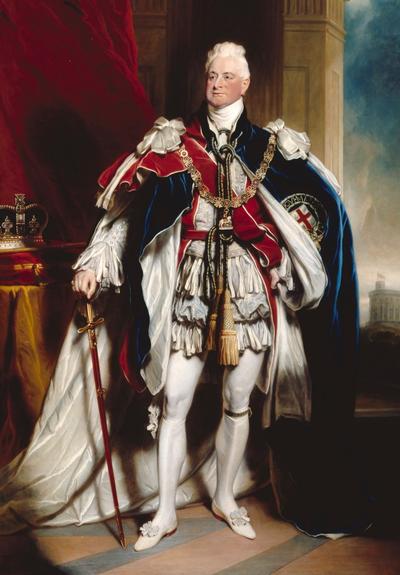
William IV
| Name | William IV |
| Title | King of the United Kingdom of Great Britain and Ireland and of Hanover from 1830 to 1837 |
| Gender | Male |
| Birthday | 1765-08-21 |
| nationality | United Kingdom of Great Britain and Ireland |
| Source | https://www.wikidata.org/wiki/Q130822 |
| pptrace | View Family Tree |
| LastUpdate | 2025-11-12T01:16:29.595Z |
Family Tree
Tap  to expand more relatives
Introduction
William IV, born William Henry on 21 August 1765 at Buckingham House, was the third son of King George III and Queen Charlotte of the United Kingdom. His early education was provided by private tutors in Richmond and Kew Palace. He entered the Royal Navy at age thirteen and served as a midshipman under Admiral Robert Digby, participating in the Battle of Cape St Vincent in 1780. During the American Revolution, he served in North America and was present in New York, where a British plot to kidnap him was contemplated by George Washington, though it was never executed.
He was promoted to lieutenant in 1785 and to captain in 1786, commanding ships such as the HMS Pegasus and HMS Valiant. William developed a close friendship with Horatio Nelson during his naval service in the West Indies. He was made Duke of Clarence and St Andrews and Earl of Munster in 1789. Throughout this period, he maintained a political profile, aligning publicly with the Whigs, despite his father’s opposition to certain policies.
William cohabited with actress Dorothea Jordan from 1791 to 1811, with whom he fathered ten illegitimate children, all given the surname FitzClarence. In 1818, he married Princess Adelaide of Saxe-Meiningen, with whom he had two daughters and experienced two miscarriages. His marriage lasted nearly twenty years until his death.
William’s naval career slowed by 1790, but during the Napoleonic Wars, he was appointed an admiral in 1798, although he was not given active commands. In 1811, he was declared Admiral of the Fleet. Although he distinguished himself by promoting naval reforms and commissioning steam warships, he did not participate in direct combat during this period.
In 1820, William became second in line to the throne after the death of his older brother, Prince Frederick. Following the death of King George III in 1827, William succeeded to the throne at age 64, becoming King of the United Kingdom and of Hanover, where he was also known as King William IV. His accession marked a shift toward more conservative, accessible kingship, and he was characterized by a reluctance for pomp and ceremony.
William’s reign was marked by political reform, including the passage of the Reform Act 1832, which restructured the electoral system and expanded voting rights. He was the last British monarch to appoint a prime minister contrary to the wishes of Parliament, notably appointing Sir Robert Peel in 1834. He initially opposed the abolition of slavery and held conservative views on various issues but supported reforms such as the Poor Law and restrictions on child labor.
As King of Hanover, he signed a constitution in 1833, which empowered the middle classes. However, later in his reign, he was involved in conflicts with ministers over policy, notably dismissing the Whig government in 1834 and appointing Tory Sir Robert Peel, leading to political instability.
William died at Windsor Castle on 20 June 1837. He was buried in St George's Chapel. As he had no legitimate heirs, the throne passed to Queen Victoria, his niece, ending the personal union between Britain and Hanover. His illegitimate children, particularly those with Mrs. Jordan, included notable descendants, among them modern figures such as British Prime Minister David Cameron.

Children
- Henry FitzClarence
- Princess Elizabeth Of Clarence
- Amelia Cary, Viscountess Falkland
- Lord Frederick FitzClarence
- Elizabeth Hay, Countess Of Erroll
- Stillborn Son Hanover
- Princess Charlotte Of Clarence
- Stillborn Son Hanover
- George FitzClarence, 1st Earl Of Munster
- Sophia Sidney, Baroness De L'Isle And Dudley
- William Henry Courtnay
- Lord Adolphus FitzClarence
- Lord Augustus FitzClarence
- Mary Fox
- Augusta FitzClarence Kennedy-Erskine