Princess Elizabeth Of The United Kingdom
| Name | Princess Elizabeth Of The United Kingdom |
| Title | Member of the British Royal Family (1770-1840) |
| Gender | Female |
| Birthday | 1770-05-22 |
| nationality | United Kingdom of Great Britain and Ireland |
| Source | https://www.wikidata.org/wiki/Q234482 |
| pptrace | View Family Tree |
| LastUpdate | 2025-11-12T01:16:33.045Z |
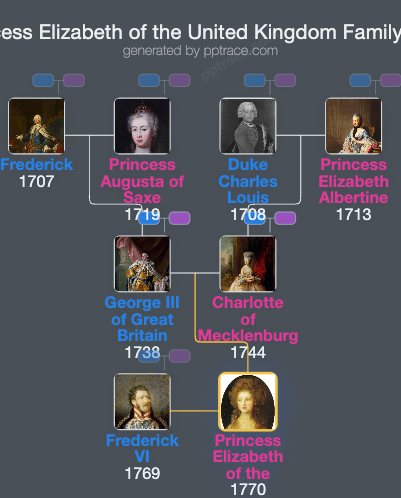
Family Tree
Tap  to expand more relatives
Introduction
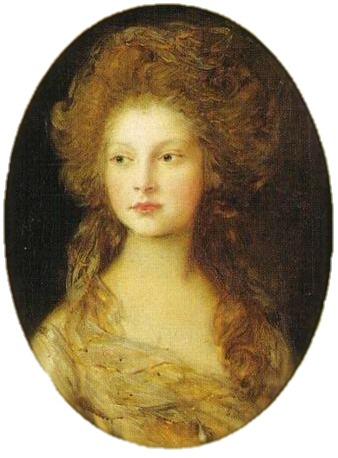
Princess Elizabeth (22 May 1770 – 10 January 1840), known as Eliza, was the seventh child and third daughter of King George III of the United Kingdom and Queen Charlotte (née Princess Charlotte of Mecklenburg-Strelitz). She was born at Buckingham House in London and was baptized in the Great Council Chamber at St. James's Palace on 17 June 1770. Her godparents included the Hereditary Prince of Hesse-Cassel, the Princess of Nassau-Weilburg, and the Crown Princess of Sweden, all of whom were her paternal first cousins once-removed.
Elizabeth's early education was characterized by a sheltered upbringing, largely spent with her parents and sisters. King George III and Queen Charlotte prioritized her protection from public life, although in 1812, she purchased The Priory at Old Windsor as her private residence.
Throughout her life, Elizabeth maintained a variety of artistic and horticultural interests. She produced engraved works for charity, painted, and learned printmaking, silhouette cutting, upholstery decoration, embroidery, architecture, and gardening. She was acquainted with court painters including Benjamin West, Thomas Gainsborough, and William Beechey, as well as engraver Francesco Bartolozzi. She was the only one among George III's children to share her father's interest in agriculture: she operated a model farm near Old Windsor, where she engaged in activities like tending her garden and livestock, including poultry, dairy cows, and other animals. Elizabeth was known for her sense of humor, her straightforward manner, and her dislike of excessive court politeness. She was closest to her siblings Augusta and Adolphus, Duke of Cambridge, as well as to her brother Edward, Duke of Kent, and was particularly attached to her mother, Queen Charlotte.
There have been claims of a romantic relationship with diplomat Alleyne Fitzherbert, 1st Baron St. Helens, who was a respected court figure and a close confidant of Elizabeth. She referred to him affectionately and commissioned a portrait of him from Henry Pierce Bone. St. Helens also kept a miniature of Elizabeth, illustrating their mutual regard.
In 1808, Elizabeth declined a marriage proposal from the exiled Duke of Orléans (later King Louis Philippe I of France) due to religious and family considerations. Her noteworthy romantic involvement was with Prince Frederick of Hesse-Homburg, heir to the Landgraviate of Hesse-Homburg. They met in 1814 and married on 7 April 1818 in a private ceremony at Buckingham Palace. Elizabeth was then 48 years old. The marriage was based on mutual respect and understanding, and it was not characterized as a romantic match in the traditional sense. The couple honeymooned at the Royal Pavilion in Brighton.
Frederick succeeded his father as Landgrave of Hesse-Homburg on 20 January 1820. Elizabeth moved to Germany, where she played an active role in local development, including building roads, restoring historic sites, overseeing gardens and estates, and engaging in charitable work. She possessed a large library and porcelain collection, and continued her artistic pursuits. Her financial expenditure on projects increased her landgravial debts during this period.
After her husband's death in 1829, Elizabeth resided alternately in Homburg, in Frankfurt, and at her brother Prince Adolphus’s court in Hanover, while maintaining regular travel to London. She founded a care center and school in Hanover for children of working mothers, reflecting her ongoing interest in charitable activities. She lived to see the further succession of Queen Victoria and her brother Ernest Augustus in Hanover in 1837.
Elizabeth died in Frankfurt on 10 January 1840 at age 69 and was buried in the crypt of Homburg Castle. Her artistic and collection estate was inherited by her niece, Princess Caroline of Reuss-Greiz, and later came to Greiz around 1848.
Her life and works have been documented in exhibitions, such as the 2010 display titled "Das graphische Werk der Landgräfin Elizabeth 1770–1840" at the Museum im Gotischen Haus in Bad Homburg, Germany.