Princess Augusta Sophia Of The United Kingdom
| Name | Princess Augusta Sophia Of The United Kingdom |
| Title | sixth child and second daughter of King George III and Queen Charlotte |
| Gender | Female |
| Birthday | 1768-11-08 |
| nationality | United Kingdom |
| Source | https://www.wikidata.org/wiki/Q241233 |
| pptrace | View Family Tree |
| LastUpdate | 2025-11-12T01:16:27.164Z |
Family Tree
Tap  to expand more relatives
Introduction
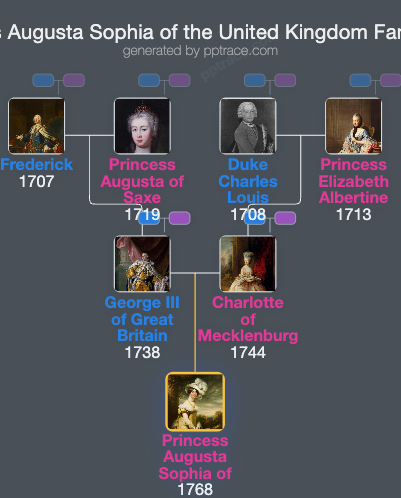
Princess Augusta Sophia was born on 8 November 1768 at Buckingham House in Westminster. She was the sixth child and second daughter of King George III of the United Kingdom and Queen Charlotte. Her father was born in 1738 and died in 1820, while her mother, Queen Charlotte, was née Sophia Charlotte of Mecklenburg-Strelitz.
Her christening took place on 6 December 1768 in the Great Council Chamber at St. James's Palace. The archbishop Frederick Cornwallis officiated, with her godparents including Prince Charles of Mecklenburg, the Queen of Denmark, and the Hereditary Duchess of Brunswick-Lüneburg.
Augusta was part of a sibling group that included her older sister Charlotte, born in 1766, and her younger sister Elizabeth, born in 1770. She was the middle daughter among six siblings. Her early education began in 1771 under Lady Charlotte Finch and Miss Frederica Planta, focusing on deportment, music, dancing, arts, and languages such as English, French, and German. Martha Goldsworthy, known as "Gouly," became her head governess in 1774.
Her personality was characterized as shy, with a tendency to be both troublesome and well-mannered. She experienced difficulty speaking in unfamiliar circumstances and was known to have bouts of tantrums. Augusta was family-oriented and enjoyed collecting coins. She disliked political tensions within the royal family and preferred private pursuits, maintaining correspondence with her attendants.
In 1782, Augusta made her social debut during King George III's birthday celebrations. That year also marked the death of her youngest brother, Alfred, and later her next youngest brother, Octavius. She and her sisters were deeply affected by their brothers' portraits at the Royal Academy exhibition in 1783. The same year, her youngest sister Amelia was born, and Augusta served as a godmother during her christening.
During her adolescence, Augusta and her sister Charlotte spent significant time with their parents at court, attending events like the theatre, opera, and court functions. She and her sisters often dressed alike in public, with slight variations in color, but preferred the comfort of her home life, especially with her younger brothers Ernest, Augustus, and Adolphus, and her sister Elizabeth. Charlotte, the Princess Royal, was considered more haughty and conscious of her rank.
By 1783, Augusta and Charlotte were considered potential marriage prospects for foreign princes. The Crown Prince of Denmark showed interest in Augusta, but political considerations prevented a match. In 1797, she received a proposal from Prince Frederick Adolf of Sweden, though it was made without full royal approval.
In her early adulthood, Augusta maintained correspondence with her brother William, then in Hanover for military training. As she approached marriageable age, her attire and court presentation became more formal, and her expenses increased, reflecting her public visibility.
Her romantic involvement with Sir Brent Spencer, an officer in the British Army and equerry to the king, began around 1800 and developed into an understanding by 1803. Despite their close relationship, no official record of marriage exists. Spencer died in 1828, reportedly holding a locket with Augusta’s picture at the time of his death.
In her later years, Augusta was a patron of various activities, including L. Bertolotto's flea circus. She attended significant royal events such as the coronation of Queen Victoria in 1838 and Victoria's wedding to Prince Albert in 1840.
Princess Augusta Sophia died on 22 September 1840 at Clarence House in London, aged 71. She was buried in the Royal Vault at St. George's Chapel, Windsor, on 2 October 1840. Her arms as a daughter of the sovereign featured a differenced version of the royal arms, with a silver and red rose label indicating her status.
Her ancestry traces back to the House of Hanover through her father, King George III, and the House of Mecklenburg-Strelitz through her mother.