Prince Octavius Of Great Britain
| Name | Prince Octavius Of Great Britain |
| Title | British prince |
| Gender | Male |
| Birthday | 1779-02-23 |
| nationality | Great Britain |
| Source | https://www.wikidata.org/wiki/Q2013921 |
| pptrace | View Family Tree |
| LastUpdate | 2025-11-12T01:16:19.710Z |
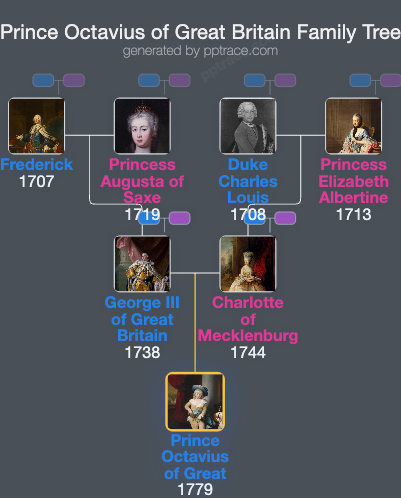
Family Tree
Tap  to expand more relatives
Introduction
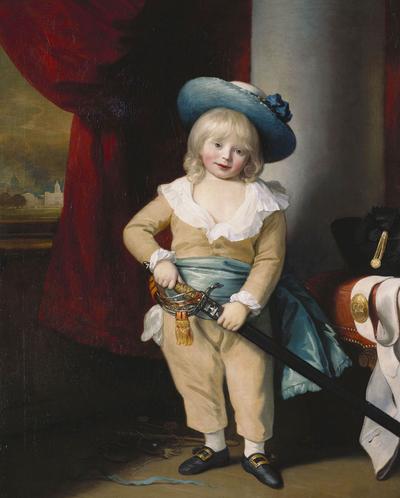
Prince Octavius of Great Britain was born on 23 February 1779 at Buckingham House in London. He was the thirteenth child and eighth son of King George III and Queen Charlotte of Mecklenburg-Strelitz. His name is derived from the Latin word "octavus," meaning "eighth," indicating his position among his siblings. Octavius was christened on 23 March 1779 in the Great Council Chamber at St James's Palace, with Frederick Cornwallis, Archbishop of Canterbury, officiating. His godparents included the Duke of Brunswick-Wolfenbüttel, the Duke of Mecklenburg-Schwerin, and the Duchess of Saxe-Weimar-Eisenach, who attended via proxies.
Early accounts describe Octavius as "a lovely child of sweet disposition," with Queen Charlotte and King George III showing particular affection toward him. The King was known for being more indulgent with his youngest children compared to his eldest, often participating in their activities and celebrations. Witnesses recorded instances of King George carrying Octavius and his siblings, engaging with them in a familial manner uncommon at the time. Queen Charlotte noted that Octavius and his immediate family often played together in the evenings, and the royal children participated in outings such as visits to Eastbourne in Sussex.
Octavius developed a close attachment to his sister Sophia, who referred to him as "her son." The family experienced the birth of Prince Alfred when Octavius was nineteen months old; subsequent to Alfred's death on 20 August 1782, Octavius became the youngest member of the royal family once again. Chroniclers such as Horace Walpole and Edward Holt described him as docile and good-natured, and a delight to those around him.
In 1783, when Octavius was four years old, he was inoculated against smallpox, a common preventative measure of the period. The procedure was conducted at Kew Palace, where his sister Sophia recovered without incident, but Octavius became suddenly ill and died on 3 May 1783 at approximately eight in the evening. His death was reported by Lady Charlotte Finch, the governess of the royal children, who stated there was no hope for his recovery once he became ill. There was no formal mourning for children of that age, and the circumstances of his death often were attributed to illness or other causes rather than the inoculation.
Prince Octavius was interred on 10 May 1783 at Westminster Abbey, alongside his brother Alfred. His remains were later transferred to St. George's Chapel at Windsor Castle in 1820, following the accession of his eldest brother as King George IV. Queen Charlotte expressed her grief over his sudden passing, describing it as an unexpected event that struck her without warning. The death of Octavius profoundly affected King George III, who reportedly declared that he would have died if his son had also perished. The sentiment was echoed by court and family members, and the event left a lasting impression on the royal household.
During subsequent periods of mental illness, King George III was known to have hallucinations involving his sons, including Octavius. The Prince's death left a notable mark on the royal family, with contemporaries and later historians noting his character and the impact of his loss on his parents.