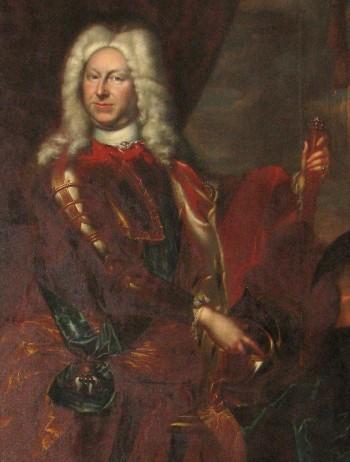
Frederick II, Duke Of Saxe-Gotha-Altenburg
| Name | Frederick II, Duke Of Saxe-Gotha-Altenburg |
| Title | duke of Saxe-Gotha-Altenburg (1676-1732) |
| Gender | Male |
| Birthday | 1676-07-28 |
| nationality | Germany |
| Source | https://www.wikidata.org/wiki/Q61447 |
| pptrace | View Family Tree |
| LastUpdate | 2025-11-12T01:17:02.504Z |
Family Tree
Tap  to expand more relatives
Introduction
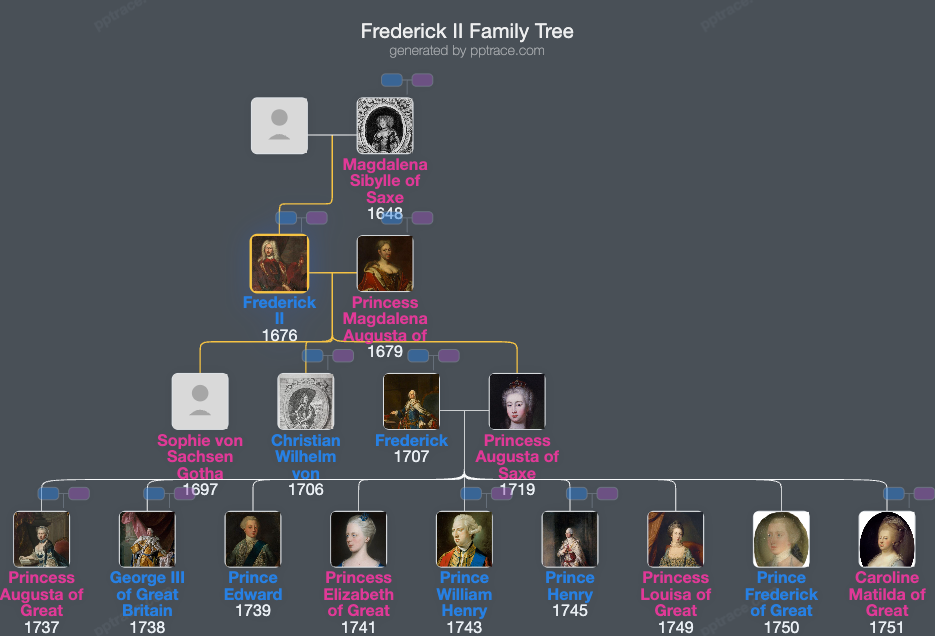
Frederick II, Duke of Saxe-Gotha-Altenburg, was born on 28 July 1676 in Gotha and died on 23 March 1732 in Altenburg. He was the fifth child and the first son of Frederick I, Duke of Saxe-Gotha-Altenburg, and Magdalena Sibylle of Saxe-Weissenfels.
Following the death of his father in 1691, Frederick II assumed control of the duchy of Saxe-Gotha-Altenburg. Due to his minority status at that time, administrative authority was exercised by his uncles, Bernhard I of Saxe-Meiningen and Heinrich of Saxe-Römhild, serving as guardians and co-regents. In 1693, after returning from a journey to Holland and England, Frederick II petitioned the Holy Roman Emperor for the recognition of his adult status and commenced independent governance of his territories.
During his reign, he maintained a court and standing army, inherited from his father and subsequently expanded. To mitigate financial expenditures, he leased his troops to foreign rulers, which led to complications in 1702 when King Louis XIV of France hired his soldiers for service against the Holy Roman Empire.
In domestic affairs, he continued policies established by his father. He founded an orphanage in Altenburg in 1715, established a workhouse and a lunatic asylum in Kahla in 1726, and created the Magdalenenstift in 1705, an endowment for unmarried noblewomen, named in honor of his mother and wife, both of whom bore the name Magdalena Sibylle. Additionally, he purchased the numismatic collection of Prince Anton Günther of Schwarzburg Arnstadt for 100,000 thaler from his private funds; this collection became the foundation of the Münzkabinetts at Schloss Friedenstein.
Frederick II expanded his territory through the accumulation of parts of Saxe-Coburg, Saxe-Eisenberg, and Saxe-Römhild—territories dissolved in 1699, 1707, and 1710 respectively. His accession to these regions followed lengthy hereditary disputes with other Ernestine duchies, which concluded in 1735 with an arbitral award by the Emperor, delineating territorial boundaries and sovereignty.
He married Magdalena Augusta of Anhalt-Zerbst on 7 June 1696 at Friedenstein Castle in Gotha. They had nineteen children, with nine surviving to adulthood. His offspring included Frederick III, Duke of Saxe-Gotha-Altenburg, Johann August, Christian Wilhelm, Ludwig Ernst, Moritz, Augusta, and Johann Adolf, among others. Notable among his children was Augusta, who married Frederick, Prince of Wales, and was the mother of King George III of Great Britain.
References for his biography include works by August Beck and Christian Ferdinand Schulze, which provide further detail on his life and governance.
He was part of the ruling house of Saxe-Gotha-Altenburg and was connected to the broader lineage of the Ernestine duchies through his familial and territorial affiliations.