Sophia Of Hanover
| Name | Sophia Of Hanover |
| Title | Princess of the Palatinate, Electress of Hanover, heir presumptive and ancestor of British monarchs following the Act of Settlement 1701 |
| Gender | Female |
| Birthday | 1630-10-14 |
| nationality | Germany |
| Source | https://www.wikidata.org/wiki/Q57224 |
| pptrace | View Family Tree |
| LastUpdate | 2025-11-12T01:14:54.805Z |
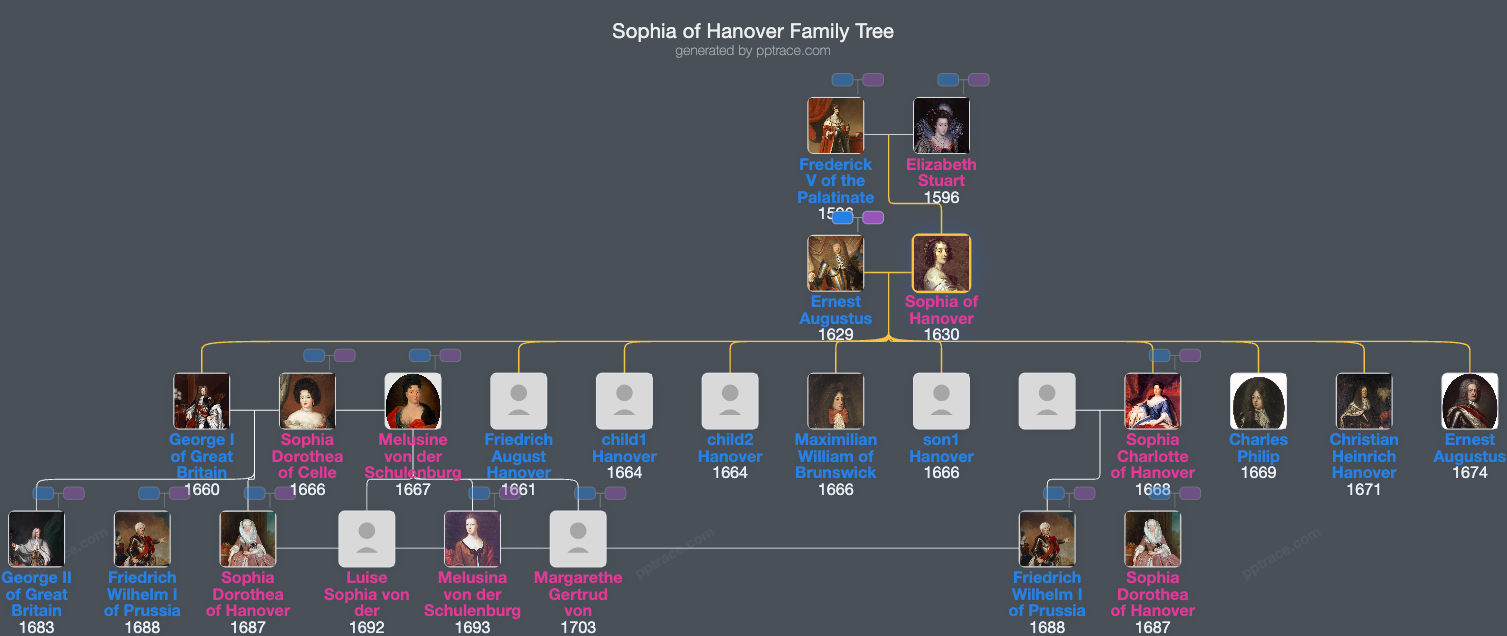
Family Tree
Tap  to expand more relatives
Introduction
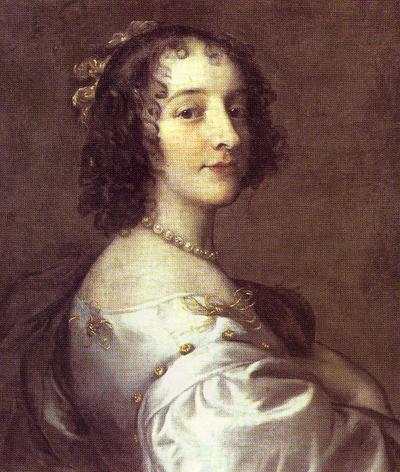
Sophia (German: Sophie; 14 October 1630 [O.S. 3 October 1630] – 8 June 1714 [O.S. 28 May 1714]) was a member of the House of Wittelsbach and held the title of Electress of Hanover from 1692 to 1698 as the consort of Prince-Elector Ernest Augustus. She was born in The Hague, in the Dutch Republic, as the twelfth child and fifth daughter of Frederick V of the Palatinate and Elizabeth Stuart, daughter of King James VI and I of Scotland and England. Her family had sought refuge in the Dutch Republic due to the aftermath of the Battle of White Mountain during the Thirty Years' War.
Sophia's early years included being granted an annuity of 40 thalers by the Estates of Friesland at birth. She was briefly courted by her first cousin, Charles II of England, but declined the proposal. Her elder brother, Frederick Henry, Hereditary Prince of the Palatinate, died by drowning during her infancy.
In 1658, she married Prince Ernest Augustus of Brunswick-Lüneburg, her third cousin, in Heidelberg. Ernest Augustus later became the first Elector of Hanover in 1692. The marriage produced seven children who survived to adulthood, including George I of Great Britain and Ireland, and Sophia Charlotte, Queen in Prussia. Sophia maintained a close relationship with philosopher Gottfried Leibniz and was known for her intellectual pursuits. She commissioned Herrenhausen Palace and its gardens, and she was actively involved in their development, including supporting various philosophers and artists.
Sophia's correspondence, beginning at age fifty, has been preserved and reveals her as a woman of significant intellectual ability and curiosity. She authored memoirs reflecting on her first fifty years of life, particularly in response to family losses.
She became the heir presumptive to the thrones of England, Scotland, and Ireland following the Act of Settlement in 1701, which designated the Protestant Sophia and her descendants as successors to Queen Anne. The act aimed to exclude, primarily, the Catholic claimant James Francis Edward Stuart and to establish a Protestant succession. Sophia's selection was influenced by her proximity and ability to communicate with King William III, as well as her Protestant faith and Dutch upbringing.
Sophia died in Hanover in 1714, shortly before she would have ascended to the British throne. Her death occurred after collapsing during a rainstorm in the gardens of Herrenhausen. Her oldest son, George Louis, succeeded Queen Anne as George I of Great Britain, becoming the first Hanoverian monarch of Great Britain. Sophia was buried initially in the chapel of Leine Palace in Hanover; her remains, after the palace's destruction during World War II, were transferred to the mausoleum of King Ernest Augustus I in Herrenhausen Gardens in 1957.
Her descendants, through her son George I, include the current royal families of several European nations. More than 5,000 of her legitimate descendants exist, with many in the line of succession to the British throne. Her writings, especially her memoirs and correspondence, have been published and remain significant for their historical and intellectual insights.
References to her work include "Memoirs of Sophia, Electress of Hanover 1630-1680," translated by H. Forester. Additional biographical materials include scholarly works by J. N. Duggan and Onno Klopp, and entries in encyclopedias such as Encyclopædia Britannica.