
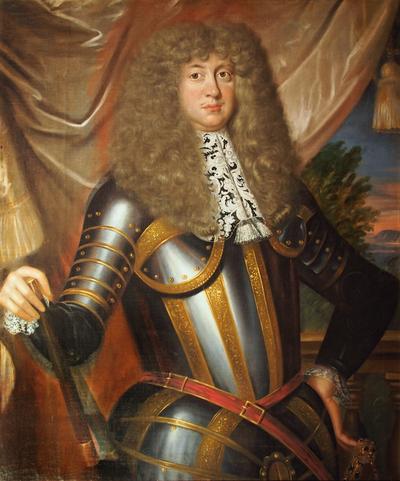
Ernest Augustus, Elector Of Brunswick-Lüneburg
| Name | Ernest Augustus, Elector Of Brunswick-Lüneburg |
| Title | German prince (1629-1698) |
| Gender | Male |
| Birthday | 1629-11-20 |
| nationality | United Kingdom |
| Source | https://www.wikidata.org/wiki/Q372190 |
| pptrace | View Family Tree |
| LastUpdate | 2025-11-12T01:14:53.848Z |
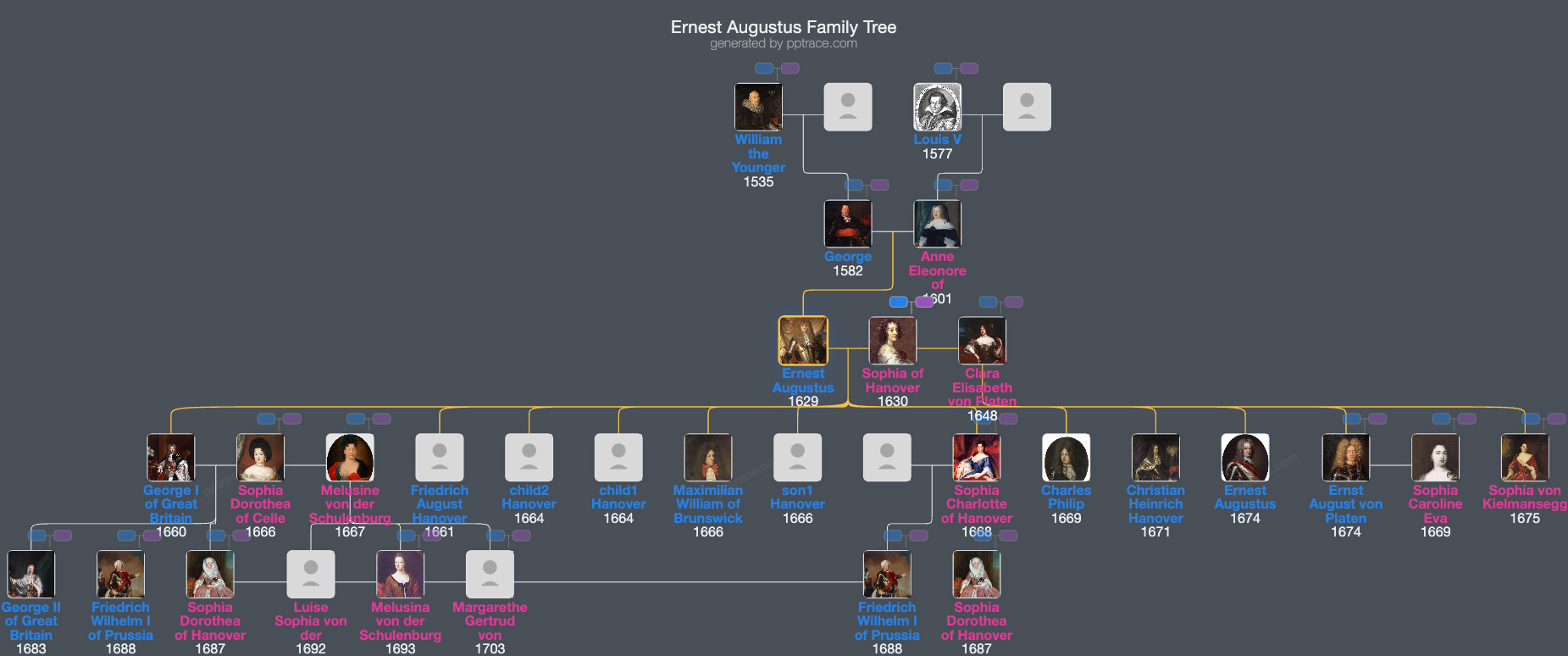
Family Tree
Tap  to expand more relatives
Introduction
Ernest Augustus (German: Ernst August) was born on 20 November 1629 at Herzberg Castle near Göttingen, in the Principality of Calenberg. He was the youngest son of George, Duke of Brunswick-Calenberg and Prince of Calenberg, and Anne Eleonore of Hesse-Darmstadt.
In his early life, Ernest Augustus was primarily based at the Hanover court, residing in the Leineschloss alongside his elder brother Christian Louis. On 30 September 1658, he married Sophia of the Palatinate in Heidelberg. Sophia was the daughter of Frederick V, Elector Palatine, and Elizabeth Stuart of England, who was a granddaughter of King James I of England. Sophia was initially betrothed to Ernest Augustus's older brother, George William; however, George William was unwilling to marry her. Consequently, Ernest Augustus married Sophia, and George William ceded his claim to Lüneburg.
As the fourth son in his family, Ernest Augustus had limited prospects of inheriting his father’s titles. Following the Peace of Westphalia in 1648, an agreement was established that the rulership of the Prince-Bishopric of Osnabrück would alternate between Catholic and Protestant bishops, with Protestant bishops being members of the House of Welf. When the throne of Osnabrück became vacant in 1662, Ernest Augustus was appointed Prince-Bishop. He and Sophia moved to Iburg Castle with their two surviving sons and Sophia’s niece, Princess Elizabeth Charlotte of the Palatinate.
In 1667, Ernest Augustus and Sophia commenced construction of Osnabrück Palace, and in 1673, they relocated there. Their youngest son was born at this residence in 1674. In 1665, Christian Louis died childless, leading to the transfer of the Lüneburg district to Ernest Augustus’s second brother, George William. However, George William retained the district of Celle.
In 1679, Ernest Augustus inherited the Principality of Calenberg from his third brother, John Frederick. In 1680, the family relocated to Hanover. That same year, his rule extended when he inherited the principality, consolidating his position among the Welf family territories.
In 1683, Ernest Augustus instituted primogeniture in his holdings, resisting the objections of his five younger sons. This administrative reform aimed to prevent the subdivision of his territory and was also a strategic move to attain the status of Prince-elector. He participated in the Great Turkish War on the side of Leopold I, Holy Roman Emperor.
In 1692, Ernest Augustus was appointed Prince-elector by the Emperor, raising the House of Hanover to electoral dignity. This elevation became effective in 1708 when it was confirmed by the Imperial Diet. Ernest Augustus was recognized as the first Elector of Hanover.
He died on 23 January 1698 at Herrenhausen Palace, Hanover. His succession was taken over by his eldest son, George Louis, who later became King George I of Great Britain. His primary residences included the Leineschloss in Hanover and Herrenhausen Palace, the latter of which he enlarged along with his wife Sophia to create a notable baroque garden.
Ernest Augustus was also the father of George I of Great Britain.
Children
- Charles Philip, Prince Of Hanover
- Child1 Hanover
- Maximilian William Of Brunswick-Lüneburg
- George I Of Great Britain
- Child2 Hanover
- Son1 Hanover
- Sophia Charlotte Of Hanover
- Sophia Von Kielmansegg, Countess Of Darlington
- Ernst August Von Platen-Hallermund
- Friedrich August Hanover, Prince Of Hanover
- Christian Heinrich Hanover
- Ernest Augustus, Duke Of York And Albany