Sophia Charlotte Of Hanover
| Name | Sophia Charlotte Of Hanover |
| Title | Prussian royal consort |
| Gender | Female |
| Birthday | 1668-10-30 |
| nationality | Q706018 |
| Source | https://www.wikidata.org/wiki/Q57674 |
| pptrace | View Family Tree |
| LastUpdate | 2025-11-12T01:15:04.784Z |
Family Tree
Tap  to expand more relatives
Introduction
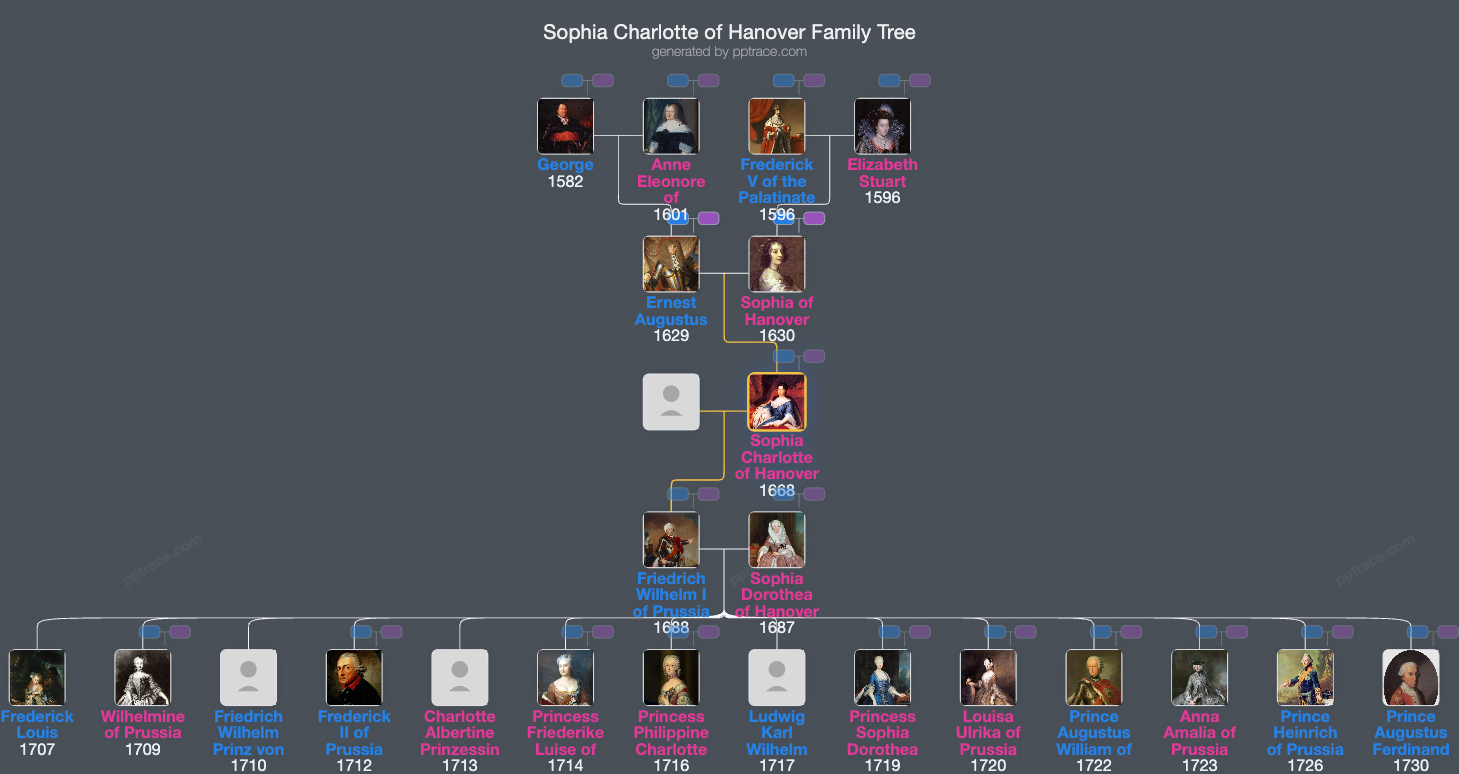
Sophia Charlotte of Hanover was born on 30 October 1668 at Iburg Castle in the Prince-Bishopric of Osnabrück. Her father was Elector Ernest Augustus of Hanover, and her mother was Sophia of the Palatinate. Her family moved in 1672 to the episcopal residence in Osnabrück and subsequently to Hanover in 1679, when Ernest Augustus succeeded his brother, Duke John Frederick of Brunswick-Lüneburg, as ruler of the Principality of Calenberg.
During her childhood, Sophia Charlotte traveled to France with her mother with the expectation of marriage prospects involving French royalty. She was considered as a potential bride for Louis, Grand Dauphin, heir to the French throne, but he married Duchess Maria Anna Victoria of Bavaria instead. She was also proposed as a candidate for marriage to King Louis XIV of France following his wife’s death in 1683; however, no marriage materialized from these plans.
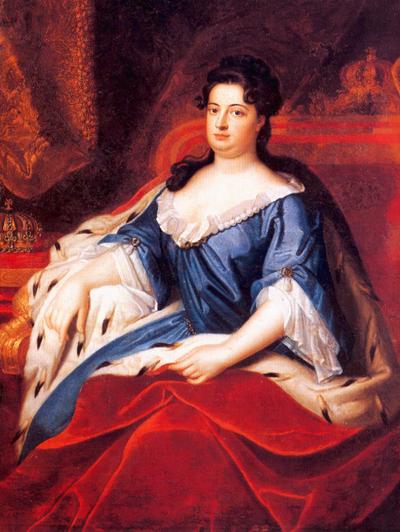
Instead, a marriage was arranged with Frederick of Hohenzollern, son of Frederick William, Elector of Brandenburg. The marriage took place on 8 October 1684. She became Electress of Brandenburg in 1688 and, after Brandenburg-Prussia was elevated to a kingdom in 1701, she became the first Queen in Prussia. Their only child to survive into adulthood was Frederick William I of Prussia, born on 14 August 1688, who later married Sophia Dorothea of Hanover and fathered future monarchs.
Frederick and Sophia Charlotte's marital relationship was marked by personal affection; Frederick was devoted to her despite maintaining an official mistress, Catharina Rickert. However, Sophia Charlotte's own interest in political affairs was limited, and she withdrew from active politics shortly after interfering to influence the fall of Prime Minister Eberhard von Danckelman in 1697.
In 1695, Sophia Charlotte acquired the Lietzow manor estate west of Berlin, exchanging it for Caputh, and constructed a Baroque summer residence there, designed by architects Johann Arnold Nering and Martin Grünberg. This residence, initially called Lietzenburg and later renamed Charlottenburg Palace after her death, served as her retreat and was used regularly from 1700.
As Queen, Sophia Charlotte was known for her intellectual pursuits and her court fostered a liberal environment that attracted scholars such as Gottfried Leibniz. She maintained a notable correspondence with Leibniz, and her influence extended into philosophy and science. She spoke multiple languages fluently, including German, French, Italian, and English. Her patronage supported the arts, music, and sciences; she employed musicians such as Attilio Ariosti and Giovanni Bononcini, and the composer Arcangelo Corelli dedicated works to her.
Sophia Charlotte notably hosted Tsar Peter the Great during his Grand Embassy visit in 1697, where his initial impression of her and her mother was one of intimidation, which was eased through her diplomatic demeanor.
She was also a significant cultural figure, surrounding herself with philosophers and theologians such as Isaac de Beausobre, Daniel Ernst Jablonski, and John Toland, and was involved in the early development of the Prussian Academy of Sciences.
Sophia Charlotte died of pneumonia on 1 February 1705 in Hanover at the age of 36, during a visit to her family. She was buried in the family crypt.
Her legacy includes several geographical locations and institutions named after her, such as the Charlottenburg district in Berlin, the Charlottensee lake in Bad Iburg, and the Sophie-Charlotte-Gymnasium in Berlin.