
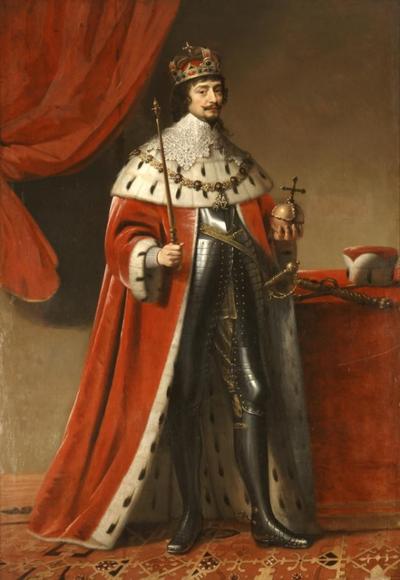
Frederick V Of The Palatinate
| Name | Frederick V Of The Palatinate |
| Title | Elector Palatine (1610–23), and King of Bohemia (1619–20), the Winter King |
| Gender | Male |
| Birthday | 1596-08-26 |
| nationality | Q22880 |
| Source | https://www.wikidata.org/wiki/Q57195 |
| pptrace | View Family Tree |
| LastUpdate | 2025-11-12T01:15:10.105Z |
Family Tree
Tap  to expand more relatives
Introduction
Frederick V (German: Friedrich V.; 26 August 1596 – 29 November 1632) was a notable noble figure within the Holy Roman Empire, serving as Elector Palatine of the Rhine from 1610 to 1623 and holding the title of King of Bohemia from 1619 to 1620. His brief reign as King of Bohemia led to the moniker "the Winter King" (Czech: Zimní král; German: Winterkönig), due to its short duration.
Born in Deinschwang, Palatinate, in present-day Germany, Frederick was the son of Frederick IV and Louise Juliana of Orange-Nassau. His maternal lineage linked him to William the Silent and Charlotte de Bourbon-Montpensier. He belonged to the House of Wittelsbach, specifically the Palatine branch, which was known for its Calvinist faith and political influence. His early education included time at Sedan, where he resided in the court of his uncle Henri de La Tour d'Auvergne, Duke of Bouillon, and was tutored by Calvinist theologian Daniel Tilenus. Frederick's intellectual and religious background marked his affiliation with Protestantism and mysticism.
He married Elizabeth Stuart, daughter of James VI of Scotland and I of England, on 14 February 1613 in Whitehall, London. Their marriage linked the Palatinate with the royal Stuarts of Britain and produced several children, including Charles Louis, who later became Elector Palatine, and Sophia, who was designated heir to the British throne by the Act of Settlement in 1701.
Frederick’s political career as Prince-Elector commenced in 1610 after the death of his father. His early reign involved efforts to bolster Protestant alliances, including substantial building projects such as the renovation of Heidelberg Castle and the commissioning of the Hortus Palatinus garden. His position was characterized by a stance as a leader of Protestant princes and an advocate for religious and political liberties within the Holy Roman Empire.
In 1618, following the Bohemian Revolt and subsequent defenestration of imperial officials, the Bohemian Estates elected him as King of Bohemia, recognizing his Protestant faith and leadership among the nobles. He was crowned in Prague on 4 November 1619. His accession was viewed as a challenge to the Habsburg Habsburg Habsburg dynasty and the Catholic Habsburg Holy Roman Emperor Ferdinand II, sparking the outbreak of the Thirty Years' War.
Frederick’s reign was marked by internal political instability, financial difficulties, and military conflicts. His decision to accept the Bohemian crown, while motivated by religious and political considerations, led to confrontations with imperial forces. His forces suffered a decisive defeat at the Battle of White Mountain on 8 November 1620, resulting in his rapid flight from Prague and the loss of his territories.
Following his defeat, Frederick lived in exile, primarily at The Hague. His lands in the Palatinate were confiscated and redistributed, with the electoral dignity awarded to Maximilian of Bavaria in 1623. Frederick endeavored to regain his sovereignty through diplomatic efforts and military alliances, notably with the Dutch and Swedish, but was unable to restore his position before his death.
He died in Mainz on 29 November 1632 from a pestilential fever. His remains were transported to Frankenthal, though his final resting place remains uncertain. His son and heir, Charles Louis, was restored to the Electoral Palatinate in 1648 under the Peace of Westphalia. Frederick’s descendants include notable figures such as his daughter Sophia, who was the heiress presumptive to the British throne, and through her, the Hanoverian royal line that began with King George I of Great Britain.
Frederick V’s life was deeply intertwined with the religious conflicts of early 17th-century Europe, and his brief reign as Bohemian king was a pivotal event in the broader context of the Thirty Years’ War.
