
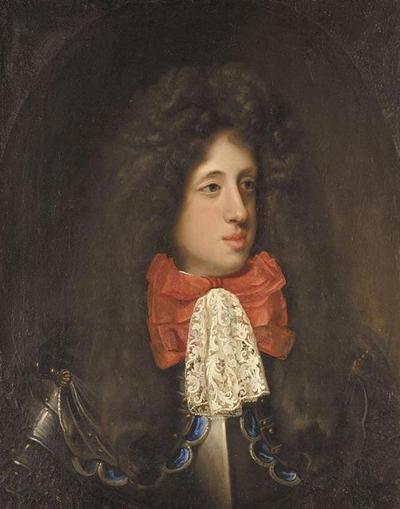
Maximilian William Of Brunswick-Lüneburg
| Name | Maximilian William Of Brunswick-Lüneburg |
| Title | German Field Marshal |
| Gender | Male |
| Birthday | 1666-12-13 |
| nationality | Germany |
| Source | https://www.wikidata.org/wiki/Q68229 |
| pptrace | View Family Tree |
| LastUpdate | 2025-11-12T01:15:05.809Z |
Family Tree
Tap  to expand more relatives
Introduction
Duke Maximilian William of Brunswick-Lüneburg, also known as Max, was born on December 13, 1666, at Schloss Iburg near Osnabrück. His parents were Ernest Augustus, Duke of Brunswick-Lüneburg, and Sophia of the Palatinate. He was the third of six sons to survive into adulthood. His birth was described by Duchess Sophia in her memoirs as a difficult delivery; during the birth, Maximilian William’s younger twin brother was stillborn, and there were concerns for Duchess Sophia’s survival. He was named after the Archbishop-Elector of Cologne Maximilian Henry of Bavaria and the Elector of Brandenburg Frederick William.
Maximilian William’s early childhood included the loss of his younger twin brother and observations of his mother’s concern about his development. His older brother, George Louis, was suspected of receiving his mother’s favoritism, especially after Maximilian William lost two fingers in a hunting accident.
The traditional inheritance practice within the Welf family was to divide lands equally among sons. However, in 1684, the family agreed to adopt primogeniture, transferring the entire inheritance to the eldest son. At seventeen, Maximilian William did not oppose this change. On his eighteenth birthday, his father entered into a contract with the Republic of Venice, appointing him as a general in the Morean War and nominal commander of 2,400 Brunswick-Lüneburg troops. Actual command was delegated to an experienced officer, under the supervision of Francesco Morosini, the future Doge of Venice. This war continued until 1688.
Following the death of his elder brother, Frederick Augustus, in battle in 1691, Maximilian William became second in line in the family. This circumstance motivated him to contest the primogeniture arrangement, which he and his brother Christian Henry openly rejected. To challenge the new inheritance laws, Maximilian William coordinated a conspiracy involving Joachim von Moltke, Anthony Ulrich of Brunswick-Wolfenbüttel, and Eberhard von Danckelmann. Duchess Sophia was reportedly aware but chose not to intervene. The conspiracy was uncovered in 1691, leading to Maximilian William’s arrest and charges of high treason. Moltke was executed, and Maximilian William was exiled in 1692. He initially sought protection from his uncle, George William, and later moved to Vienna to serve Emperor Leopold I.
While in imperial service, Maximilian William converted to Roman Catholicism in 1692 and attained the rank of Field Marshal. He commanded Hanoverian troops during the War of the Spanish Succession and participated in the Battle of Blenheim, where he led cavalry under Eugene of Savoy.
The Act of Settlement of 1701 designated Maximilian William’s mother, Sophia, as the Protestant relative who would succeed Queen Anne of Great Britain. However, because Maximilian William had converted to Catholicism, he was excluded from the succession line. Queen Anne died in 1714, and her successor was George Louis, Maximilian William’s brother, who inherited Brunswick-Lüneburg in 1698. Maximilian William and his brother Ernest Augustus were the only surviving brothers at that time. Unlike Ernest Augustus, Maximilian William did not receive peerage titles from the British crown.
In 1715, Maximilian William was elected Prince-Bishop of Osnabrück; however, the election was declared void due to its Lutheran basis and was awarded to Ernest Augustus instead.
Maximilian William died in Vienna on July 16, 1726. He had an illegitimate daughter, Maria Guelf (1695–1740), by an unknown woman. Maria married Jean Meinet and had issue.
**Ancestors and References** are listed but not elaborated upon in this summary.
